




Your smile is the first thing people notice, and it is often the last thing they forget. Yet for many patients who walk through our doors in Mission Viejo, the decision to explore cosmetic dental treatments has less to do with vanity and far more to do with confidence, comfort, and long-term oral health.
Here is something that surprises a lot of people: the line between “cosmetic” and “functional” dentistry is much blurrier than the industry sometimes admits. A chipped tooth is an aesthetic concern, but it is also a structural weakness. Crowded teeth look uneven, and they also trap plaque in places a toothbrush cannot reach. Worn-down enamel from grinding changes how your smile photographs, and it changes how your jaw joint functions.
That is why, at Aria Dental Care, we approach cosmetic dental treatments through a biological and holistic lens. We are not simply making teeth whiter or straighter. We are asking what caused the problem, which materials belong in your body, and how each change will affect your bite, your airway, and your overall wellness for decades to come.
This guide walks you through the full spectrum of cosmetic dental treatments available today, from the simplest whitening session to full porcelain veneer smile design. By the end, you will understand what each option does, who it suits, what it costs in time and tooth structure, and how to choose wisely.
What Are Cosmetic Dental Treatments?
Cosmetic dental treatments are procedures designed primarily to improve the appearance of your teeth, gums, and overall smile. They address color, shape, size, alignment, spacing, and the proportion of teeth to gums and lips.
But the best cosmetic dentistry is never purely superficial. The American Dental Association notes that many procedures marketed as cosmetic also restore function and protect tooth structure. You can read more about their perspective on aesthetic procedures at the American Dental Association’s MouthHealthy resource.
Patients typically seek out cosmetic dental treatments for one or more of these goals:
- Removing years of coffee, tea, wine, or tobacco staining
- Repairing chips, cracks, or worn edges
- Closing gaps between teeth
- Correcting teeth that appear too short, too small, or uneven
- Replacing dark, aging, or metal-containing restorations
- Straightening crowded or rotated teeth without traditional metal braces
- Reshaping a gum line that looks uneven or reveals too much tissue when smiling
- Replacing missing teeth with natural-looking, metal-free alternatives
Cosmetic Dentistry Versus Restorative Dentistry
Restorative dentistry repairs damage and disease. Cosmetic dental treatments enhance appearance. In practice, the two overlap constantly.
A porcelain crown placed on a cracked molar is restorative. The same crown placed on a discolored front tooth is cosmetic. The material, the technique, and the skill required are identical. What changes is the primary motivation.
We mention this because insurance often draws a hard line here, and patients are sometimes told a needed procedure is “just cosmetic.” When you understand that aesthetic dental procedures frequently deliver genuine functional benefit, you can advocate for yourself more effectively.
Why a Biological Approach to Cosmetic Dental Treatments Matters
Every material placed in your mouth stays there, releasing trace elements into saliva and tissue, twenty-four hours a day for years. That is a meaningful exposure, and it deserves careful thought.
Our practice philosophy is that smile enhancement procedures should never require introducing materials your body may react poorly to. That means:
- No dental amalgam, which contains roughly fifty percent mercury by weight
- No metal substructures under crowns or bridges when ceramic alternatives perform equally well
- Attention to BPA and resin monomer content in composite materials
- Consideration of individual sensitivity when selecting cements, bonding agents, and ceramics
The U.S. Food and Drug Administration has published safety communications regarding dental amalgam and certain higher-risk patient groups. Their guidance is available at the FDA’s dental amalgam information page. Our practice has been one hundred percent mercury-free since inception, and we follow SMART protocol whenever removing existing amalgam so that the removal process itself is done with appropriate protective measures.
Teeth Whitening: Where Most Smile Journeys Begin
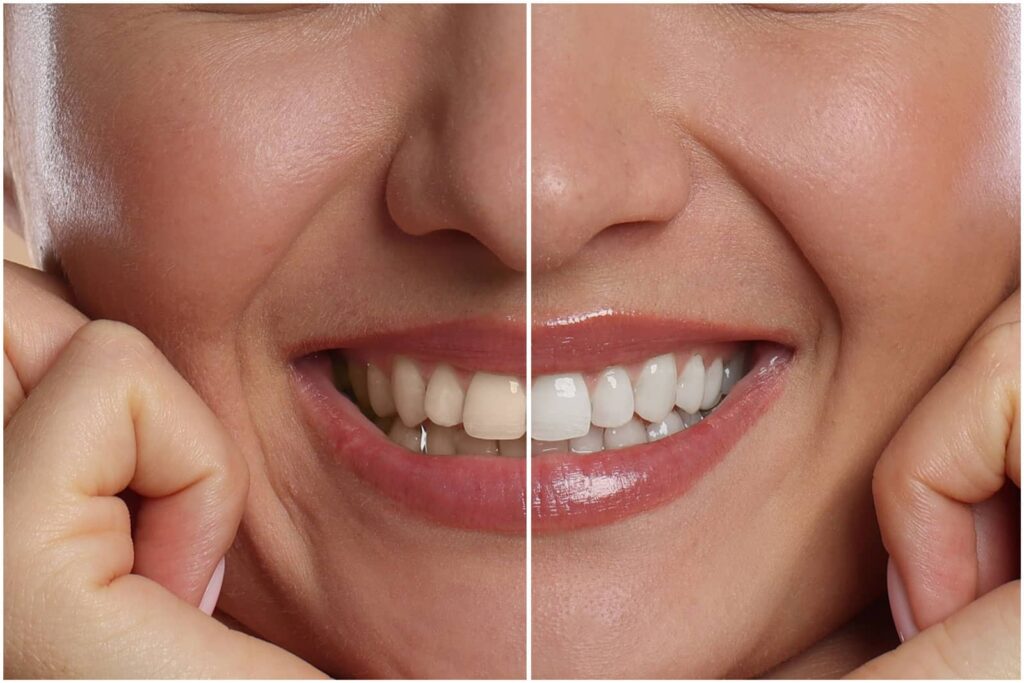
Professional teeth whitening is the most requested of all cosmetic dental treatments, and for good reason among patients exploring smile enhancement for the first time. It is non-invasive, it removes no tooth structure, it is relatively affordable, and the results are immediate and dramatic.
How Professional Whitening Actually Works
Whitening gels use peroxide compounds that break down into oxygen molecules. These molecules penetrate enamel and dentin, breaking apart the larger pigmented molecules that cause discoloration into smaller, less visible fragments.
Professional-strength gels are significantly more concentrated than over-the-counter strips, which is why a single in-office session can achieve results that would take weeks of drugstore products.
In-Office Whitening
A supervised in-office session typically takes sixty to ninety minutes. Your gums and soft tissue are isolated and protected, concentrated gel is applied in cycles, and many patients see several shades of improvement in one visit.
Advantages include:
- Fastest possible results, often before a wedding, reunion, or presentation
- Professional protection of gums and exposed root surfaces
- Immediate management of sensitivity if it develops
- Even, controlled application across all visible teeth
Take-Home Whitening Trays
Custom-fitted trays made from impressions of your teeth allow you to whiten at home over one to two weeks. Because the trays are made specifically for your arch, gel stays where it belongs instead of leaking onto gum tissue.
Advantages include:
- Gentler on sensitive teeth due to lower concentration over longer wear
- Reusable trays for future touch-up whitening
- Lower initial cost than in-office sessions
- You control the pace
Many patients combine both, starting with an in-office session and maintaining results with occasional tray use.
What Whitening Cannot Fix
This is where honest guidance matters. Whitening lightens natural tooth structure. It does not change:
- Existing crowns, veneers, bonding, or fillings, which retain their original shade
- Intrinsic gray discoloration from tetracycline exposure during tooth development
- Dark staining from internal bleeding after trauma, which requires internal bleaching
- Enamel thinning that reveals yellow dentin underneath
- Surface texture, shape, or alignment concerns
If your goal is a uniform, bright smile and you have visible old restorations on your front teeth, whitening alone will make those restorations stand out more, not less. In those cases, we plan whitening first, allow the shade to stabilize for about two weeks, then replace restorations to match.
Dental Bonding: The Conservative Option
Composite bonding is among the most conservative cosmetic dental treatments available today. A tooth-colored resin is sculpted directly onto the tooth, shaped by hand, and hardened with a curing light.
Bonding excels at:
- Repairing small chips on incisal edges
- Closing minor gaps between front teeth
- Masking small areas of discoloration
- Reshaping slightly irregular teeth
- Covering exposed root surfaces from gum recession
The appeal is significant. Most bonding requires little to no removal of healthy enamel, it can often be completed in a single visit, and it is reversible in the sense that little irreplaceable tooth structure is sacrificed.
The tradeoff is longevity. Composite resin is softer than porcelain, more prone to staining over time, and typically lasts five to eight years before needing refreshment or replacement. For younger patients, for temporary solutions, or for small corrections, that tradeoff is often exactly right.
We select composite materials with attention to their monomer composition, since resin-based materials vary considerably in their filler content and chemical formulation.
Porcelain Veneers: The Cornerstone of Smile Design
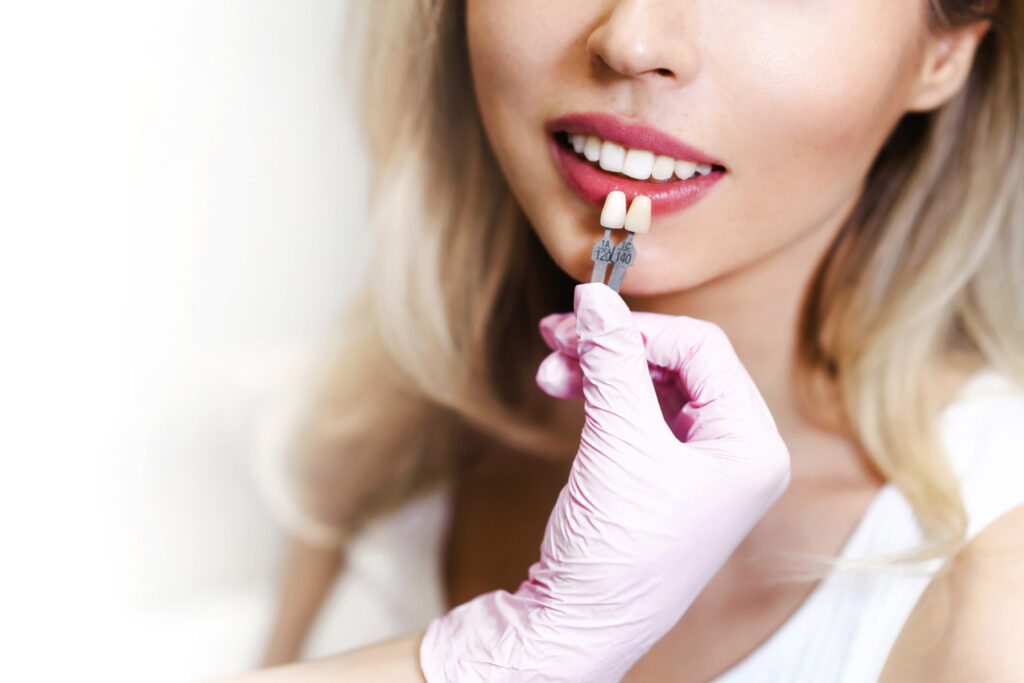
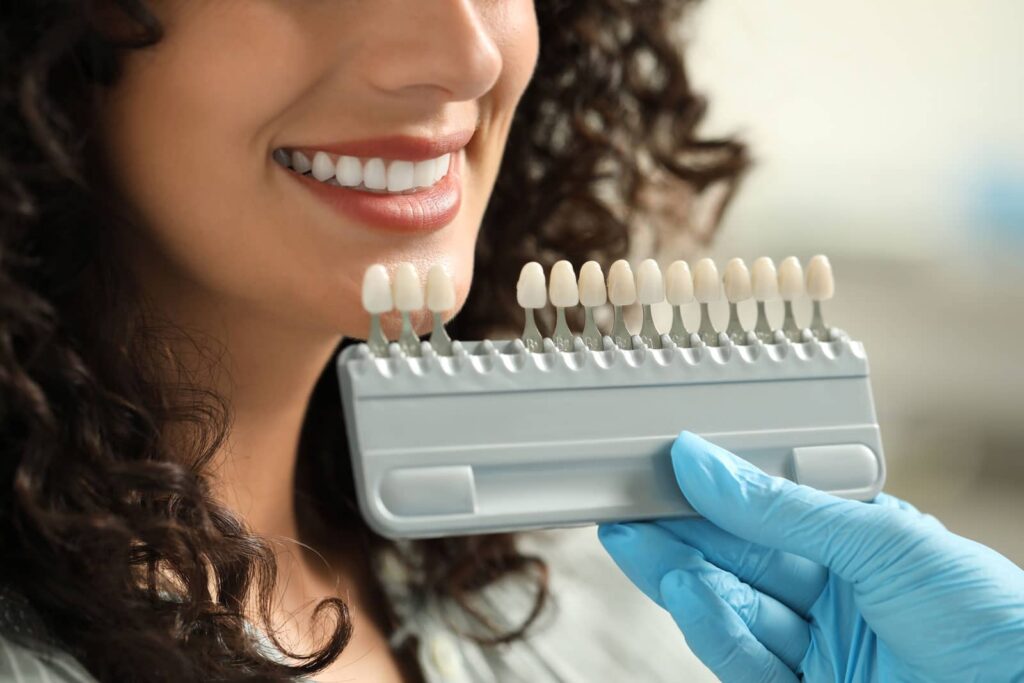
When patients picture a dramatic smile transformation, they are usually picturing veneers. These are thin shells of dental porcelain bonded to the front surfaces of teeth, and they represent one of the most powerful and versatile of all cosmetic dental treatments.
A single veneer can change color, shape, length, width, surface texture, and apparent alignment simultaneously. A set of six to ten can redesign an entire smile.
What Veneers Correct
- Deep intrinsic staining unresponsive to whitening
- Chips, cracks, and worn edges
- Gaps and spacing irregularities
- Teeth that are too small or disproportionate
- Mildly rotated or overlapping teeth in select cases
- Uneven tooth lengths and asymmetric smile lines
Traditional Versus Minimal-Prep Veneers
Traditional porcelain veneers require removing roughly half a millimeter of enamel from the front surface so that the veneer sits flush and does not look bulky. This is a permanent change. Once enamel is removed, the tooth will always require a covering.
Minimal-prep and no-prep veneers use ultra-thin ceramics that require little or no enamel reduction. They are not appropriate for every case, particularly when teeth are already large, protrusive, or dark enough to show through thin porcelain. But when a patient is a candidate, the conservation of natural tooth structure is meaningful.
Our philosophy leans strongly toward preserving natural tooth structure whenever the clinical result allows it. We discuss the enamel cost of every plan openly, because that conversation is one patients deserve to have before treatment begins, not after.
The Veneer Process Step by Step
- Consultation and smile analysis. We photograph, measure, and discuss goals in detail, evaluating facial proportion, lip dynamics, and bite relationship.
- Digital or wax mock-up. You preview the proposed result before any tooth is touched.
- Preparation appointment. Minimal enamel reduction where indicated, followed by precise digital scanning.
- Temporary veneers. You wear provisional restorations that let you test drive the shape and length.
- Laboratory fabrication. A skilled ceramist layers and characterizes each veneer.
- Bonding appointment. Veneers are tried in, adjusted, and permanently bonded.
- Bite refinement and follow-up. We verify that the new surfaces work harmoniously with your jaw movements.
How Long Do Veneers Last?
Well-made porcelain veneers, properly bonded and properly cared for, commonly last ten to fifteen years, and many last considerably longer. Longevity depends on:
- Bonding technique and material quality
- Whether you grind or clench, and whether a protective night guard is worn
- Gum health and stability of the tissue margin
- Home care and professional maintenance
- Diet and habits such as chewing ice or opening packaging with teeth
Veneers do not decay, but the natural tooth underneath still can. Excellent hygiene remains essential.
Ceramic Crowns and Metal-Free Restorations
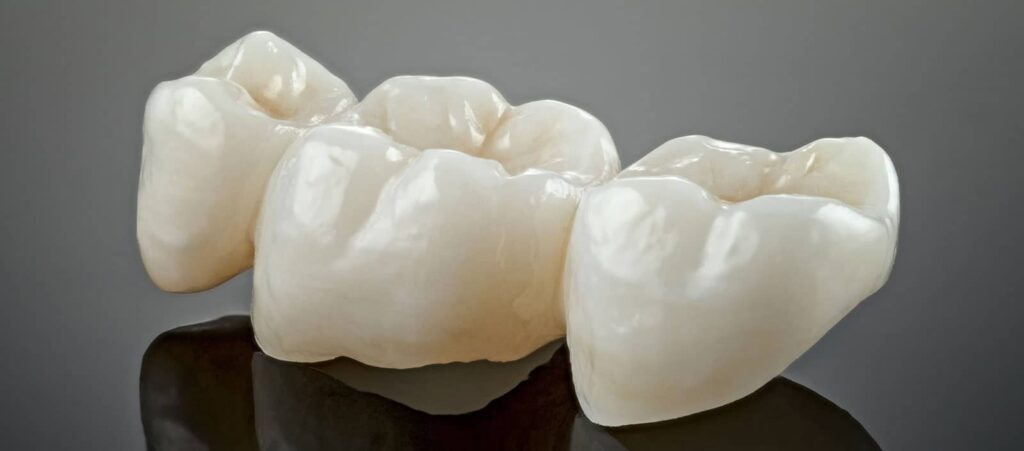
Among restorative cosmetic dental treatments, the full-coverage crown is the workhorse. When a tooth is too damaged for a veneer, a crown restores both strength and appearance. Modern all-ceramic crowns, particularly those made from zirconia and lithium disilicate, have transformed this category of aesthetic dental work.
Older crowns used a metal substructure with porcelain layered on top. Over time, gum recession often exposed a dark gray line at the margin, which is the visual signature of an aging metal-based crown. Metal-free ceramic crowns eliminate that problem entirely while offering light transmission properties much closer to natural enamel.
Benefits of metal-free crowns include:
- No dark margin lines as gums naturally recede
- Superior translucency and lifelike optical depth
- Excellent biocompatibility for patients with metal sensitivities
- No galvanic reaction with other metals in the mouth
- Strength sufficient for both anterior and posterior teeth
Inlays and Onlays: The Middle Ground
Sometimes a tooth needs more than a filling but less than a crown. Inlays and onlays, sometimes called partial crowns, are custom-fabricated ceramic restorations bonded into or over the prepared area.
Compared with large direct fillings, they offer better contours, better contact with neighboring teeth, and greater resistance to fracture. Compared with full crowns, they preserve substantially more healthy tooth structure, which aligns with our conservative treatment philosophy.
Cosmetic Orthodontics: Straightening Without Metal
Alignment is often the foundation that every other category of cosmetic dental treatments depends on. Straightening teeth first frequently reduces how much veneering or reshaping is needed afterward, which means less enamel removed overall.
Clear Aligner Therapy
Removable clear aligners have made adult orthodontics genuinely discreet. A series of custom trays gradually shifts teeth into planned positions.
Advantages include:
- Virtually invisible during wear
- Removable for eating, brushing, and flossing
- No metal brackets or wires
- Predictable digital treatment planning with previewable outcomes
- Typically fewer emergency visits than fixed appliances
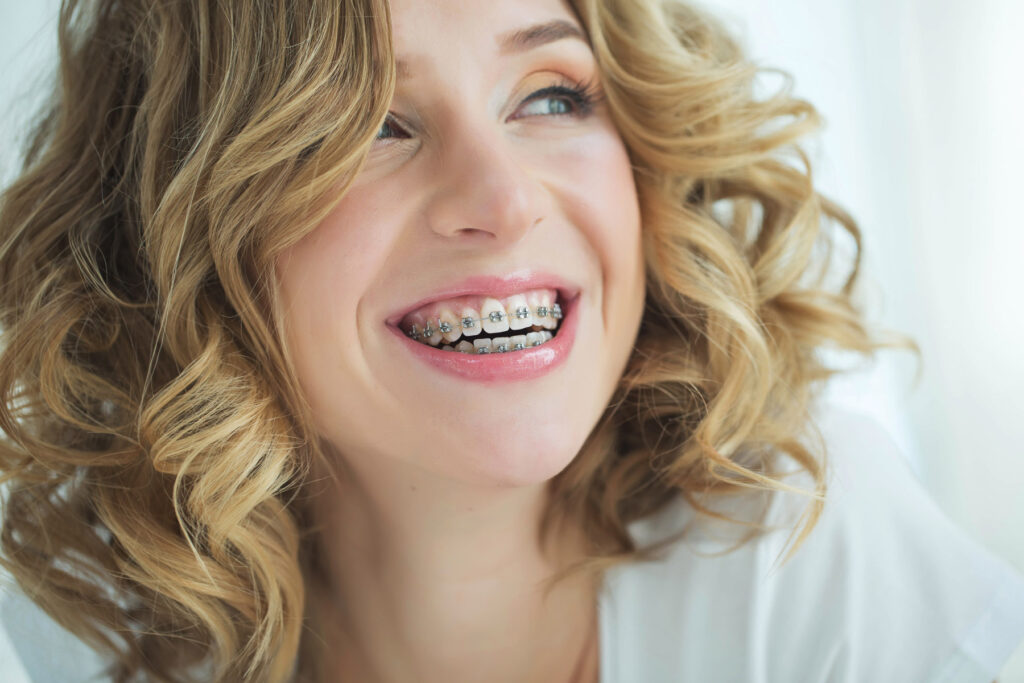
Clear Ceramic Braces
For cases requiring more control than aligners provide, tooth-colored ceramic brackets deliver full fixed-appliance mechanics with far less visual impact than stainless steel. They are an excellent option for complex rotations, significant crowding, or bite corrections.
Why Straightening Serves Health, Not Just Appearance
The National Institute of Dental and Craniofacial Research provides research-based information on oral health conditions, including how tooth position influences hygiene access and periodontal outcomes. Their resources are available at NIDCR. Crowded and overlapping teeth create plaque traps, complicate flossing, and can accelerate gum inflammation. Straightening addresses aesthetics and disease risk at the same time.
Gum Contouring and Laser Aesthetics
Your smile is a frame as much as a picture. Even beautifully shaped teeth can look wrong if the gum line is uneven or if excessive tissue shortens the visible tooth.
Among soft tissue cosmetic dental treatments, laser gum recontouring reshapes the tissue margin with remarkable precision. Because dental lasers seal tissue as they work, treatment is typically more comfortable than traditional scalpel surgery, with less bleeding and faster healing.
Laser aesthetic applications include:
- Correcting a gummy smile by exposing more natural crown
- Evening out an asymmetric gum line
- Refining tissue contours before veneer placement
- Treating dark pigmentation in gum tissue for patients who request it
Laser dentistry also plays an important role in periodontal therapy, and we frequently integrate it into comprehensive treatment plans where gum health must be stabilized before aesthetic work begins.
Replacing Missing Teeth: Ceramic Implants
No plan built around cosmetic dental treatments is complete if teeth are still missing. Gaps shift neighboring teeth, alter bite forces, and accelerate bone loss in the jaw.
Zirconia ceramic implants offer a metal-free alternative to conventional titanium. For patients who prioritize eliminating metals from the body, or who have documented sensitivities, ceramic implants provide a biocompatible option with a white color that avoids any grayness showing through thin gum tissue.
Implant-supported crowns, bridges, and dentures restore chewing function and facial support in ways removable appliances alone cannot match.
Choosing the Right Cosmetic Dental Treatments for You
With so many cosmetic dental treatments available, the real question is not “what can be done” but “what should be done, in what order, for this specific person.”
The Comprehensive Consultation
A meaningful consultation about cosmetic dental treatments should include:
- Full photographic series and digital records
- Evaluation of bite, jaw joint function, and muscle comfort
- Assessment of gum health and bone levels
- Discussion of grinding, clenching, and airway concerns
- Review of existing restorations and their materials
- Honest conversation about what each option costs in tooth structure, time, and money
We consider airway and bite function early in every plan. Rebuilding a smile without understanding why teeth wore down in the first place tends to produce beautiful work that does not last.
Questions Worth Asking Any Cosmetic Dentist
- How much natural tooth structure will this remove, and is it reversible?
- What specific materials will you use, and why those?
- Can I preview the result before committing?
- What is the realistic lifespan, and what happens when it needs replacement?
- How will this affect my bite and jaw joint?
- Can I see cases you have personally completed with similar starting conditions?
A Sensible Sequence
For most comprehensive cases, we work in this general order:
- Stabilize health first, treating decay, gum disease, and infection
- Address bite and airway function where indicated
- Align teeth orthodontically when it reduces the need for aggressive reshaping
- Whiten natural tooth structure and allow the shade to stabilize
- Refine gum contours if needed
- Place final restorations such as bonding, veneers, or ceramic crowns
- Protect the investment with a properly fitted night guard
Caring for Your Results
Cosmetic dental work is an investment, and it rewards maintenance.
Protecting the results of your cosmetic dental treatments comes down to a few consistent habits:
- Brush twice daily with a soft brush and non-abrasive toothpaste, since whitening pastes with harsh abrasives can dull porcelain over time
- Floss daily, paying close attention to veneer and crown margins
- Wear a night guard if you clench or grind, which is the single most protective habit for restorations
- Limit staining agents, and rinse with water after coffee, tea, or red wine
- Do not use teeth as tools
- Keep regular professional cleaning and examination appointments
- Schedule periodic whitening touch-ups to keep natural teeth matched to restorations
Why Patients Choose Aria Dental Care
The best cosmetic dental treatments sit at the intersection of art, engineering, and biology. Getting it right requires all three.
At Aria Dental Care in Mission Viejo, patients across Orange County choose us because of a combination that is genuinely difficult to find in one place:
- Accredited biological training. Dr. Maryam Horiyat holds accreditation with the International Academy of Oral Medicine and Toxicology and certification with the International Academy of Biological Dentistry and Medicine.
- One hundred percent mercury-free. We have never placed amalgam, and we follow SMART protocol for safe removal of existing amalgam restorations.
- Metal-free by default. Ceramic crowns, ceramic implants, and biocompatible composites are our standard, not an upcharge specialty.
- Advanced technology. Digital scanning, laser dentistry, ozone therapy, and modern imaging support both precision and comfort.
- Whole-person perspective. We evaluate airway, bite, and jaw function as part of aesthetic planning, not as an afterthought.
- Artistry in the details. Shade matching, surface texture, and proportion are where beautiful dentistry separates itself from adequate dentistry.
Ready to Explore Your Options?
Choosing among cosmetic dental treatments is easier when someone takes the time to understand your goals, examine your mouth thoroughly, and explain the real tradeoffs of each path. That is what a comprehensive consultation is for.
Whether you are considering the simplest of cosmetic dental treatments such as a whitening session, exploring porcelain veneers, or thinking about a complete smile transformation, we would be glad to walk through the possibilities with you.
Schedule your cosmetic consultation at Aria Dental Care and experience holistic, biological, and cosmetic dentistry in Mission Viejo, serving patients throughout Orange County.