





Every week, patients walk into Aria Dental Care holding a familiar box with a bright, smiling face on it and ask the same question: “Do teeth whitening strips work?” It’s a fair question, after all, these products are prominently displayed in every pharmacy, heavily marketed across social media, and promise a brighter smile in just days.
My honest answer? It depends, and as a biological dentist, I have significant concerns that go well beyond whether strips make your teeth look whiter. In this comprehensive guide, I’ll walk you through the science of how whitening strips work, what the research actually says about their effectiveness and safety, the hidden risks most manufacturers don’t mention, and what I recommend to my own patients instead.
Key Takeaway: Teeth whitening strips can lighten tooth shade by 2–5 levels for some users, but they come with real risks to enamel, gum health, and overall oral biology, especially when used repeatedly. At Aria Dental Care, we prioritize approaches that whiten teeth without compromising the body’s long-term health.
What Are Teeth Whitening Strips and How Do They Work?
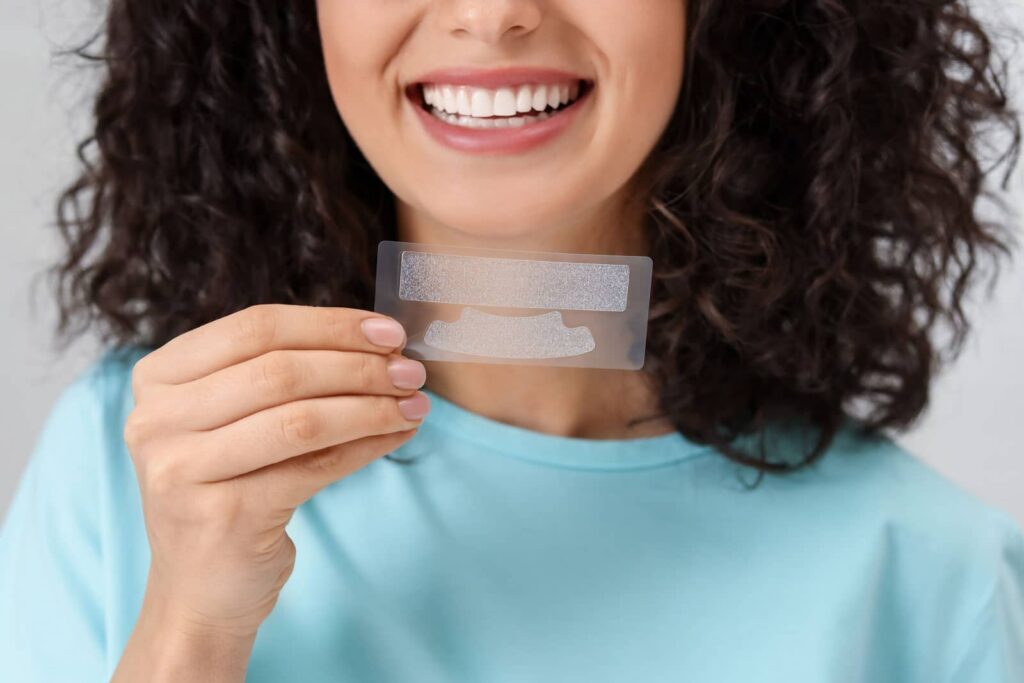
Teeth whitening strips are thin, flexible polyethylene plastic films coated with a whitening gel, most commonly hydrogen peroxide (H₂O₂) or its precursor, carbamide peroxide. When you press the strip against your teeth, the peroxide penetrates the outer enamel layer and breaks apart the molecular chains of chromogens, the colored compounds responsible for tooth staining.
The chemistry is straightforward: peroxide molecules diffuse through the semi-permeable enamel matrix, react with organic stain molecules embedded in the enamel and, to a lesser extent, in the dentin below, and oxidize them into lighter, less-visible compounds. This process is often described as “bleaching,” because it is chemically similar to how household bleach whitens fabrics, though at much lower concentrations.
What Concentration of Peroxide Do Over-the-Counter Whitening Strips Contain?
In the United States, over-the-counter (OTC) teeth whitening products are regulated by the U.S. Food and Drug Administration (FDA) and can legally contain up to 6% hydrogen peroxide or up to 15–22% carbamide peroxide. Professional in-office systems used by dentists can contain 25–40% hydrogen peroxide and are applied under controlled, protected conditions.
Concentration matters, both for how well the strips work and for how much tissue exposure risk they carry. The higher the peroxide concentration, the faster the whitening action, but also the greater the potential for sensitivity, enamel softening, and gum irritation.
Do Teeth Whitening Strips Actually Work? What the Research Says
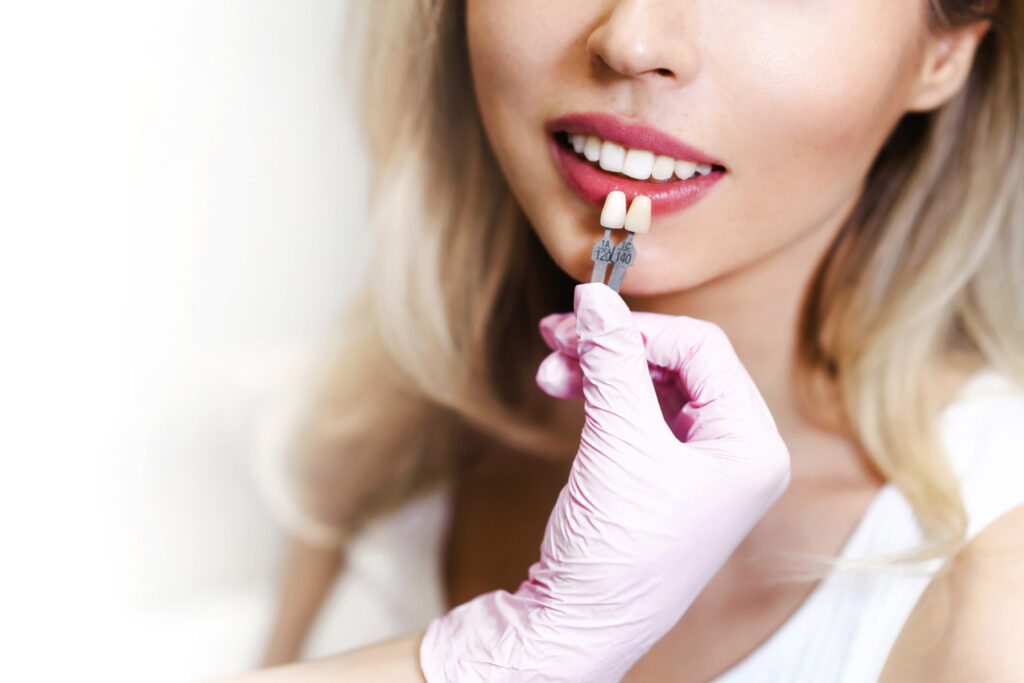
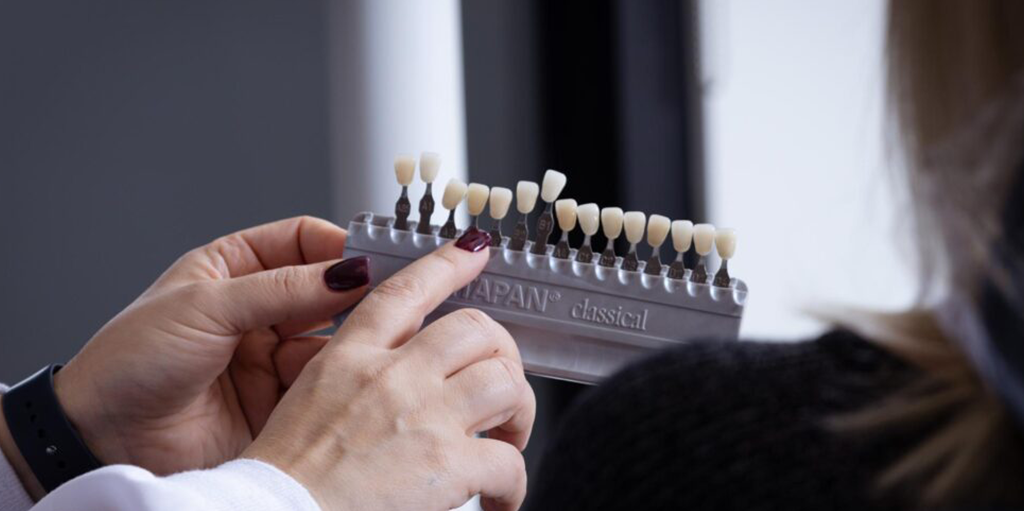
Scientifically speaking, yes, whitening strips do produce measurable whitening for many people. Multiple clinical studies published in peer-reviewed journals confirm that OTC strips containing hydrogen peroxide can brighten teeth by approximately 2 to 5 shades on the standard Vita shade guide when used consistently as directed.
A landmark study published in the Journal of the American Dental Association found that a 10% carbamide peroxide tray system, comparable to strip concentrations, produced significant lightening within two weeks of regular use. Similar findings have been replicated across multiple studies for strip-based delivery systems.
However, and this is critical, the research also reveals important limitations that product marketing conveniently omits.
Who Benefits Most from Teeth Whitening Strips?
Whitening strips work best on extrinsic stains, surface-level discoloration caused by food, beverages, and tobacco. They are most effective when teeth are naturally yellow or yellow-brown in tone, as opposed to gray, which is often caused by internal factors like tetracycline staining or dental trauma. The ideal candidate is someone with:
- Predominantly extrinsic, lifestyle-related staining (coffee, tea, wine, tobacco)
- Natural teeth with no significant restorations (crowns, veneers, bonding)
- Good baseline enamel health and thickness
- No existing significant tooth sensitivity
- Healthy gums with no recession
When Whitening Strips Do NOT Work Well
Here is the honest side of the story. Whitening strips consistently underperform or fail entirely in these situations:
- Dental restorations: Crowns, veneers, porcelain bridges, bonding, and fillings do not respond to peroxide. Strips will whiten surrounding natural teeth while restorations stay the same color, creating an uneven, mismatched appearance.
- Intrinsic staining: Discoloration originating inside the tooth, from tetracycline use in childhood, fluorosis, trauma, or nerve death, is largely unresponsive to OTC bleaching.
- Gray or brown undertones: These tooth shades respond poorly to peroxide-based whitening compared to yellow undertones.
- Severe enamel erosion or thinning: Thin enamel allows peroxide to reach the dentin more easily, increasing sensitivity without achieving better whitening.
- Gum recession exposing root surfaces: Exposed root cementum and dentin whiten differently from enamel, often leading to blotchy results and significant sensitivity.
Clinical Pearl from Dr. Horiyat: A significant number of patients I see have spent months using whitening strips on teeth that contain bonding or crowns, only to become frustrated that their smile looks uneven. A simple consultation before starting any whitening regimen could save you time, money, and unnecessary chemical exposure.
The Biological Dentist’s Concern: Hidden Risks of Whitening Strips You Should Know
This is where my perspective as a biological and holistic dentist diverges significantly from the mainstream narrative around whitening strips. The question isn’t just “do they work”, it’s “at what cost to your body?”
1. Enamel Demineralization and Softening
Multiple peer-reviewed studies have demonstrated that hydrogen peroxide at concentrations found in OTC strips can cause temporary demineralization of enamel. Research published in the Journal of Dentistry found that repeated exposure to hydrogen peroxide reduces the microhardness of enamel, making it temporarily more susceptible to acid erosion. While remineralization occurs over time when strips are discontinued, patients who use whitening strips continuously, or who consume acidic foods and beverages during whitening, may be doing lasting damage to one of the body’s most irreplaceable hard tissues.
Enamel does not regenerate. Once it is gone, it is gone. As a biological dentist, I consider enamel preservation one of the most important principles of long-term oral health.
2. Increased Tooth Sensitivity
Tooth sensitivity is the single most commonly reported side effect of whitening strips, and it’s not just uncomfortable. Sensitivity arises because peroxide penetrates enamel and enters the dentinal tubules, small channels that lead directly to the pulp (nerve) of the tooth. When peroxide irritates the pulp, you feel sharp, shooting, or lingering pain, especially to cold, heat, or sweets.
For most people, this sensitivity is temporary and resolves within 24–72 hours of stopping strip use. But in patients with existing thin enamel, worn teeth, cracked teeth, or active decay, sensitivity can be prolonged or severe. Research highlighted by the National Institute of Dental and Craniofacial Research (NIDCR) emphasizes that patients should be screened by a dental professional before undertaking any whitening regimen.
3. Gum Tissue Irritation and Chemical Burns
One-size-fits-all whitening strips are not designed to conform to the unique contours of your dental arch. This means the peroxide gel on the strip’s edges routinely contacts soft gum tissue. Hydrogen peroxide is a reactive oxidizing agent, when it touches the gingiva, it can cause:
- Chemical irritation presenting as white, blanched patches on gum tissue
- Temporary gum soreness and inflammation
- Gingival recession over time with repeated exposures
- Altered oral microbiome due to localized tissue destruction
While most gum irritation from OTC strips is mild and self-resolving, chronic exposure is a genuine concern, particularly from a biological dentistry standpoint, where we view gum health as deeply interconnected with systemic health.
4. Disruption of the Oral Microbiome
This is an area receiving growing attention in the scientific literature, and it is of particular concern from a holistic oral health perspective. The mouth is home to over 700 species of microorganisms, many of which are essential to healthy digestion, immune function, and even cardiovascular health. Peroxide-based whitening agents are broadly antimicrobial, meaning they do not selectively target harmful bacteria. They can disrupt the oral microbiome indiscriminately.
Research is still emerging on the long-term microbiome implications of repeated peroxide exposure, but from a biological dentistry standpoint, the precautionary principle applies: we should not introduce broad-spectrum oxidative agents into the complex ecosystem of the mouth without careful consideration.
5. Unregulated Chlorine Dioxide Products
In recent years, a number of whitening strips have appeared on the market using chlorine dioxide as the active agent instead of hydrogen peroxide, marketed as “peroxide-free” alternatives. However, chlorine dioxide is highly corrosive in concentrated forms, and there is limited peer-reviewed safety data on its use in dental whitening. Dr. Horiyat strongly advises patients to avoid chlorine dioxide-based whitening products entirely.
⚠️ Biological Dentistry Warning: Many whitening strips also contain inactive ingredients, including PVP (polyvinylpyrrolidone), various thickeners, and synthetic preservatives, that have not been studied for their long-term oral health effects. At Aria Dental Care, we believe that anything placed in your mouth for prolonged periods deserves rigorous safety evaluation, not just marketing claims.
Whitening Strips vs. Professional Teeth Whitening: An Honest Comparison
| Factor | OTC Whitening Strips | Professional Whitening (Aria Dental Care) |
| Whitening Effectiveness | 2–5 shades (variable) | 6–12+ shades (consistent, controlled) |
| Duration of Results | 3–6 months | 1–3 years with maintenance |
| Custom Fit | No, one-size-fits-all | Yes, custom-molded trays or in-office |
| Gum Protection | Minimal, gel frequently contacts gums | Professional protective barriers applied |
| Works on Restorations? | No | No (doctor coordinates shade matching) |
| Pre-Treatment Screening | None | Full dental exam, enamel & oral health review |
| Biocompatibility | Unknown additives and inactive ingredients | Biocompatible-vetted materials and formulations |
| Cost | $20–$60 per box | Varies; long-term cost often lower per result |
| Supervised Safety | No | Yes, dentist-monitored throughout |
Safer Biological and Holistic Alternatives to Whitening Strips
One of the most common follow-up questions patients ask after learning about these risks is: “So what do you actually recommend, Dr. Horiyat?” The answer is always grounded in the principle that a bright, beautiful smile should be achieved without compromising the body’s overall health.
1. Professional Custom-Tray Whitening Under Dental Supervision
This is the gold standard for safe, effective whitening at Aria Dental Care. We create custom-fitted whitening trays molded precisely to your unique dental arch. These trays ensure the whitening gel stays on your teeth, and off your gums. We prescribe biocompatible whitening gels at concentrations and treatment durations appropriate for your individual enamel health and shade goals. The process is fully monitored, and we provide remineralization support using fluoride-free hydroxyapatite protocols to protect enamel throughout treatment.
2. In-Office Professional Teeth Whitening
For patients who want faster, more dramatic results, professional in-office whitening delivers remarkable brightness in a single appointment, often in under two hours. We use protective gum barriers, carefully controlled peroxide concentrations, and post-whitening remineralization to minimize sensitivity and protect your enamel. Results are immediate, dramatic, and long-lasting.
3. Oil Pulling with Coconut Oil
This ancient Ayurvedic practice involves swishing a tablespoon of pure coconut oil in the mouth for 10–20 minutes. While its whitening effects are modest compared to peroxide-based treatments, coconut oil pulling has demonstrated antibacterial properties thanks to lauric acid, can reduce plaque, and may help remove some surface staining over time, without any chemical oxidation of enamel. It is an excellent complementary holistic oral health practice.
4. Activated Charcoal, With Caveats
Activated charcoal toothpastes and powders have become popular in the holistic dental space. While activated charcoal does bind to and help remove some surface stains, it is also highly abrasive. Used daily, it can accelerate enamel wear. Dr. Horiyat recommends using it sparingly, no more than once or twice a week, and only as a complement to a broader oral health routine.
5. Dietary Modifications and Oral Hygiene Optimization
Sometimes the most effective “whitening” strategy is simply removing what’s causing the staining. Reducing coffee, black tea, red wine, and dark berries, or rinsing with water immediately after consuming them, can meaningfully reduce re-staining between whitening treatments. Pairing this with a sonic or ultrasonic toothbrush for superior plaque and surface stain removal can make a significant cumulative difference over months.
6. Porcelain Veneers for Severe Discoloration
For patients with significant intrinsic staining, severely discolored teeth, or those seeking a comprehensive smile transformation, biocompatible porcelain veneers may be the most appropriate solution. At Aria Dental Care, we use only the highest-quality, biocompatible materials for all restorative and cosmetic work, including veneers free from metal and harmful heavy metals.
Aria Dental Care’s Holistic Approach: Before recommending any whitening approach, we conduct a comprehensive biological oral health assessment. This allows us to identify the true cause of discoloration, evaluate your enamel health, check for underlying issues that would be exacerbated by whitening, and design a personalized plan that achieves your aesthetic goals without compromising your systemic health.
If You Still Want to Use Whitening Strips: How to Reduce the Risks
If you choose to use OTC whitening strips, here are the precautions Dr. Horiyat advises from a biological dentistry perspective:
- Get a dental checkup first. Before applying any peroxide to your teeth, confirm you have no active decay, cracked teeth, deep gum recession, or failing restorations. Any of these can be made significantly worse by whitening treatments.
- Choose the lowest effective concentration. Look for strips containing no more than 6% hydrogen peroxide. Stronger is not always better, and lower concentrations reduce the risk to your enamel and gums.
- Do not exceed the recommended contact time. Leaving strips on longer than directed does not whiten faster, it simply increases chemical exposure time without meaningful benefit.
- Avoid whitening if you have existing sensitivity. If your teeth are already sensitive to cold or heat, whitening strips will likely intensify that sensitivity. Address the underlying cause of sensitivity first.
- Follow up with remineralization. After whitening with any peroxide product, use a hydroxyapatite toothpaste to help remineralize and strengthen enamel. Avoid acidic foods and beverages for at least one hour after strip use.
- Do not use whitening strips more than once every 3–6 months. Repeated peroxide exposure compounds risks to your enamel and oral microbiome. Treat OTC whitening as an occasional treatment, not a routine.
- Avoid strips if you are pregnant or nursing. The American Dental Association advises caution with elective whitening during pregnancy. At Aria Dental Care, we follow the most conservative biological guidelines for our pregnant patients.
The Biological Dentist’s Bottom Line: Do Whitening Strips Work?
Here is the unvarnished answer from a biological dentist who has treated thousands of patients in Orange County and beyond: Yes, whitening strips work, but not always, not for everyone, and not without risk.
They can be a convenient, moderately effective tool for certain people with certain types of staining who use them carefully and infrequently. But they are emphatically not the safest, most effective, or most body-conscious way to achieve a whiter smile. For many patients, particularly those with restorations, sensitivity, thin enamel, or complex staining, whitening strips are simply the wrong tool for the job.
At Aria Dental Care, our mission has always been to offer a truly biological, holistic, and functional dental experience. We believe that cosmetic dentistry and biological responsibility are not in conflict, in fact, the most beautiful smiles we create are also the healthiest ones. When it comes to teeth whitening, we invite you to experience the difference that professional, dentist-supervised, biocompatible whitening makes, for both the appearance and the long-term health of your smile.
Ready for a safer, brighter smile? Book your biological dental consultation at Aria Dental Care today.