






Having a tooth extracted is stressful enough on its own. The last thing you want in the days that follow is to wonder whether your healing is on track, or whether something has gone seriously wrong. If you are reading this article because you are concerned about what a dry socket looks like, or because you are experiencing pain several days after an extraction and want to know if that pain is normal, you are in exactly the right place.
Dry socket, clinically known as alveolar osteitis, is the most common complication following tooth extraction. It affects an estimated 2–5% of all extraction patients, and up to 30% of patients who have lower wisdom teeth removed. It is intensely painful, distinctive in appearance, and entirely recognizable once you know what to look for. It is also, in the vast majority of cases, both preventable and treatable.
This comprehensive guide covers everything you need to know: what a dry socket looks like, what the dry socket symptoms feel like, the dry socket vs normal healing comparison that helps you tell the difference, what causes it, how a holistic dental practice like Aria Dental Care approaches prevention and treatment, and what natural and conventional options exist for care. Whether you are pre-extraction and want to be prepared, or post-extraction and concerned, this article gives you the full picture.
The short answer: A dry socket looks like an empty, open tooth extraction site where the protective blood clot has been lost or dissolved. Instead of a dark red clot filling the socket, you will see exposed whitish-yellow bone at the base of the wound, often accompanied by severe, radiating pain that begins 2–4 days after extraction. At Aria Dental Care, dry socket prevention and holistic post-extraction healing are central to every extraction protocol Dr. Maryam Horiyat performs.
What Does a Dry Socket Look Like? A Visual and Clinical Description
The single most important thing to understand about what a dry socket looks like is this: the healthy healing socket and the dry socket are visually opposite to each other. Learning that difference is the key to recognizing a problem early.
What a Normal Healing Socket Looks Like
Immediately after a tooth extraction, the empty socket fills with blood. Within the first hour, that blood coagulates into a blood clot, a dark red, jelly-like mass that fills the hole left by the tooth root. This clot is not just an incidental byproduct of the wound; it is the biological foundation of your entire healing process. It protects the underlying bone and nerve endings from exposure, provides the cellular scaffold upon which new tissue grows, and signals the body to begin the repair process.
Over the first several days of normal healing, the clot gradually transitions. It becomes firmer, slightly darker, and begins to be replaced by granulation tissue, a soft, pinkish-red connective tissue that is the early stage of the new gum tissue growing to close the socket. By one week post-extraction, in a normally healing socket, you should see:
- A socket that is partially or fully filled with firm, dark red-to-pinkish tissue
- Gum tissue beginning to close over the edges of the socket
- Mild tenderness and swelling that are decreasing day by day
- No visible bone at the base of the socket
What a Dry Socket Looks Like
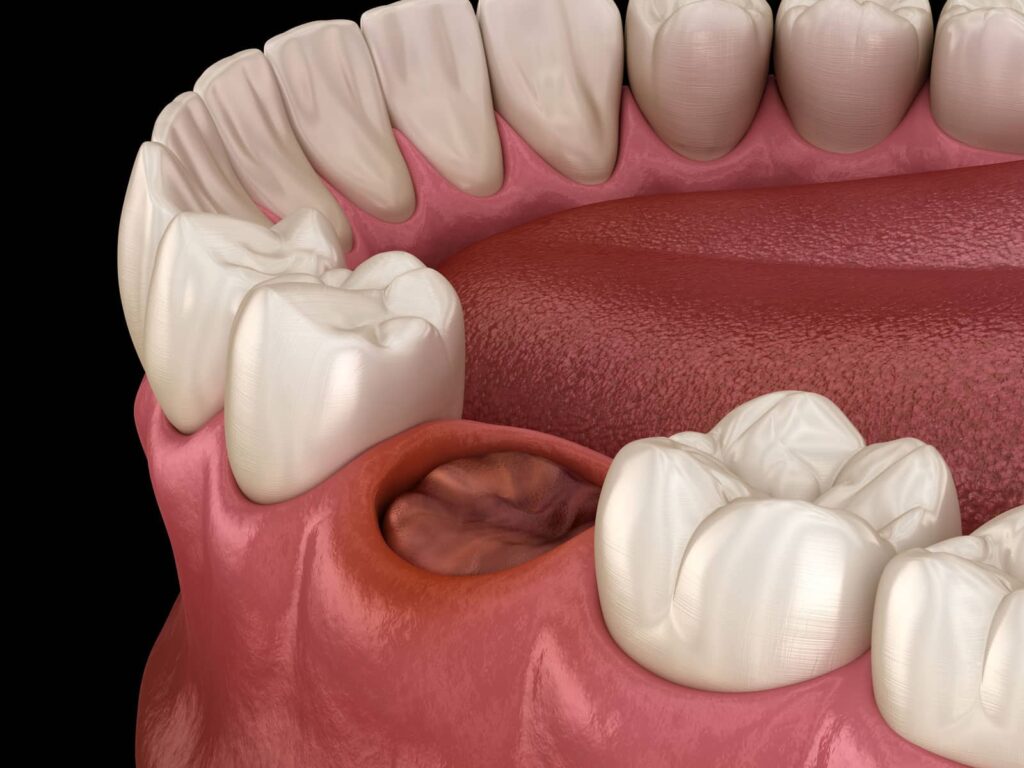
A dry socket presents in striking contrast. When the blood clot is lost, whether by being dislodged mechanically or dissolved prematurely, the socket is left open and unprotected. This is what a dry socket looks like upon visual inspection:
- An empty or partially empty socket, where a clot or granulation tissue should be, there is instead a hollow, open wound
- Exposed bone, whitish, grayish, or pale yellowish bone is visible at the base and walls of the socket. This is the most definitive visual sign of a dry socket
- No dark red clot, the protective clot is either entirely absent or exists only in fragments around the periphery of the socket
- Possible food debris, the open socket is prone to trapping food particles, which may be visible within the wound
- Inflamed, red gum margins, the gum tissue immediately surrounding the socket may appear irritated and swollen
- A grayish or off-white discoloration of the tissue within the socket in some cases, indicating early signs of local inflammation or infection
The visual appearance of a dry socket is often described by patients as looking like “an empty hole” or as if the wound “opened back up” after initially seeming to close. If you look at the extraction site in the mirror with good lighting and see exposed, pale bone rather than a filled, tissue-covered socket, that is a dry socket, and it warrants prompt attention.
Dry Socket Symptoms: What It Feels Like
While what a dry socket looks like is diagnostic in itself, most patients do not identify the condition visually, they identify it by pain. The dry socket pain is one of the most distinctive characteristics of this complication, and it is important to understand how it differs from normal post-extraction discomfort.
Normal Post-Extraction Discomfort
After any tooth extraction, some degree of pain, swelling, and tenderness is expected and normal. This discomfort typically:
- Peaks in the first 24–48 hours after extraction
- Is manageable with over-the-counter analgesics such as ibuprofen
- Gradually and consistently decreases each day from day 2 onward
- Is localized to the extraction site and surrounding area
- Does not prevent sleep or significantly impair daily function
Dry Socket Pain: Distinctly Different
Dry socket symptoms follow a completely different pattern:
- Delayed onset: The most characteristic feature of dry socket pain is that it appears after the initial post-extraction pain has begun to resolve. The patient feels relief on days 1–2, then experiences a sudden and significant worsening of pain on days 2–4. This delayed pain escalation, often described as “the pain was getting better, then suddenly became much worse”, is the hallmark symptom of dry socket
- Severity: Dry socket produces severe, throbbing pain that is substantially more intense than normal post-extraction discomfort. Patients frequently describe it as among the worst pain they have experienced
- Radiating pain: The pain typically radiates from the extraction site to the jaw, ear, temple, neck, or eye on the same side of the face, because the exposed bone and nerve are transmitting pain signals widely through the trigeminal nerve network
- Unresponsive to standard analgesics: Over-the-counter pain medications that adequately controlled the initial post-extraction discomfort are frequently ineffective against dry socket pain, or provide only partial, short-lived relief
- Bad taste or odor: Many patients with dry socket notice an unpleasant taste in their mouth or bad breath (halitosis) arising from the open socket, particularly if food debris has accumulated within it
- Pain with air exposure: Some patients notice a sharp intensification of pain when cool air contacts the extraction site, a direct result of nerve endings in the exposed bone reacting to temperature change
Dry Socket vs Normal Healing: How to Tell the Difference
The dry socket vs normal healing question is one of the most common concerns patients bring to Aria Dental Care in the days following an extraction. Here is a clear, side-by-side comparison to help you evaluate your own healing:
| Normal Healing | Dry Socket | |
| Appearance | Dark red clot or pinkish granulation tissue filling the socket | Empty socket with exposed pale or whitish bone |
| Pain pattern | Peaks at 24–48 hours, then steadily decreases | Initially decreases, then suddenly worsens at days 2–4 |
| Pain severity | Mild to moderate, managed by OTC analgesics | Severe, throbbing, often radiating; poorly controlled by OTC meds |
| Odor/taste | Minimal or none | Noticeable bad taste or breath from open socket |
| Swelling | Mild, peaking at 48–72 hours then resolving | May persist or worsen alongside pain escalation |
| Timeline | Improving daily from day 2–3 onward | Deteriorating or plateau after initial improvement |
| Action needed | Continue home care | Contact your dentist promptly |
If your experience matches the right column of this table, particularly the combination of exposed bone on visual inspection, delayed pain escalation, and radiating severity, contact Aria Dental Care or your treating dentist without delay. Dry socket does not resolve on its own without treatment.
What Causes Dry Socket After Tooth Extraction?
Understanding dry socket causes is essential, both for prevention and for making sense of why it happened. The blood clot in the extraction socket can be lost in two ways: it can be physically dislodged, or it can be chemically dissolved before it has had time to mature into stable granulation tissue.
Mechanical Dislodgment
- Sucking motions: The negative pressure created by using a straw, smoking, or any suction action can physically pull the clot from the socket. This is the most commonly cited mechanical cause of dry socket
- Vigorous rinsing or spitting: Forceful rinsing or spitting in the first 24–48 hours can dislodge a freshly formed, still-fragile clot
- Touching the site: Probing the socket with the tongue, a finger, or a toothpick out of curiosity or concern is a frequent cause of clot disruption
- Eating hard, crunchy, or sticky foods: Chewing near the extraction site in the early healing period can dislodge the clot through direct mechanical contact
Chemical and Biological Dissolution
- Smoking and tobacco use: Tobacco smoke contains hundreds of chemical compounds that impair blood flow, reduce oxygen delivery to healing tissue, and directly interfere with clot stability. Nicotine causes vasoconstriction that starves the healing socket of the blood supply it needs. Smoking is the single most significant modifiable risk factor for dry socket
- Oral contraceptives: Estrogen-containing oral contraceptives have been associated with elevated fibrinolytic activity, the breakdown of fibrin, which is the protein matrix that holds the blood clot together. Patients on oral contraceptives have a measurably higher risk of dry socket
- Certain medications: Blood thinners and anti-platelet medications can impair initial clot formation; corticosteroids can impair healing
- Bacterial contamination: Pre-existing periodontal disease or periapical infection at the extraction site can introduce bacteria that enzymatically dissolve the clot before it can mature
Risk Factors That Increase Dry Socket Likelihood
- Previous history of dry socket (the strongest predictor of recurrence)
- Lower wisdom tooth extractions (the deep socket anatomy and dense bone of the lower jaw make clot retention more difficult)
- Difficult or traumatic extractions requiring significant bone manipulation
- Female sex (particularly in the second half of the menstrual cycle or while on oral contraceptives)
- Age over 30
- Compromised immune function or systemic illness
- Poor oral hygiene at the time of extraction
- Dry mouth (xerostomia), which reduces the natural antibacterial and healing properties of saliva
A Holistic Approach to Dry Socket Prevention at Aria Dental Care
At Aria Dental Care, Dr. Maryam Horiyat’s approach to tooth extraction and post-extraction care is grounded in the same holistic, biocompatible philosophy that defines every treatment at Orange County’s #1 biological dental practice. Prevention is always preferable to treatment, and a holistic approach to extraction healing addresses not just the mechanical do’s and don’ts, but the whole-body conditions that support optimal tissue repair.
Pre-Extraction Optimization
Holistic dry socket prevention begins before the extraction itself. Dr. Horiyat evaluates each patient’s systemic health, nutritional status, and lifestyle factors that may influence healing:
- Vitamin C and D status: Both vitamins are critical to collagen synthesis and bone metabolism. Patients who are deficient may heal more slowly and be more vulnerable to post-extraction complications. Nutritional supplementation in the weeks before an elective extraction can meaningfully improve healing outcomes
- Zinc status: Zinc plays a key role in wound healing and immune function. Deficiency is associated with impaired tissue repair
- Blood sugar management: Uncontrolled blood glucose impairs every aspect of wound healing and increases infection risk. Patients with diabetes or pre-diabetes receive specific pre- and post-extraction guidance
- Smoking cessation counseling: Patients who smoke are strongly counseled to abstain for at least 72 hours pre-extraction and for the full healing period, ideally longer. The risk reduction from even short-term smoking cessation is significant
Minimally Traumatic Extraction Technique
The degree of trauma to the extraction socket during the procedure itself directly influences healing. Dr. Horiyat employs a minimally traumatic extraction philosophy, using precise, controlled force to remove the tooth with minimal disturbance to surrounding bone and soft tissue. Less surgical trauma means a healthier, more vascularized socket environment, which supports more stable clot formation and faster healing.
Where appropriate, platelet-rich fibrin (PRF), a concentration of the patient’s own growth factors derived from a small blood draw, may be placed into the socket at the time of extraction to accelerate tissue healing, support clot stability, and reduce the risk of dry socket. This advanced, completely biocompatible technique is a hallmark of biologically oriented oral surgery.
Post-Extraction Holistic Care Instructions
Every Aria Dental Care extraction patient receives comprehensive, individualized post-operative instructions that address both conventional wound care and holistic healing support:
The first 24–48 hours (critical clot protection period):
- Bite gently but firmly on gauze for 45–60 minutes immediately post-extraction to support initial clot formation
- Do not use straws under any circumstances for at least 72 hours
- Do not smoke or use any tobacco or nicotine product for a minimum of 72 hours, ideally the full healing period
- Do not rinse, spit forcefully, or touch the socket for the first 24 hours
- Eat only soft foods on the opposite side of the mouth; avoid hot liquids
- Keep your head elevated while sleeping to reduce blood pooling and swelling
Supporting systemic healing:
- Stay well hydrated, adequate hydration supports blood viscosity and tissue healing
- Continue or initiate vitamin C and D supplementation as recommended by Dr. Horiyat
- Avoid alcohol for at least 48–72 hours post-extraction, as it is vasodilatory and can impair clot stability
- Manage stress and rest adequately, immune function and healing are both impaired by sleep deprivation and cortisol elevation
- After 24 hours, gentle warm saltwater rinses (a quarter teaspoon of sea salt in 8 oz of warm water) support oral hygiene and reduce bacterial load without disturbing the healing clot
Natural and Holistic Remedies That Support Extraction Healing
At Aria Dental Care, we recognize that many patients are interested in natural and biocompatible approaches to supporting post-extraction healing. The following have evidence or established traditional use supporting their role in oral wound healing:
- Clove oil (eugenol): Clove oil has been used for centuries for dental pain relief and is, in fact, the active ingredient in most conventional dry socket dressings used by dentists. A small amount applied carefully to the socket lining, not the clot itself, can provide meaningful topical pain relief
- Warm saltwater rinses: After the first 24 hours, gentle saltwater rinses reduce bacterial load and support a clean healing environment
- Manuka honey: Applied topically in small amounts, medical-grade manuka honey has documented antibacterial and wound-healing properties and is used in some integrative dental practices as a socket dressing adjunct
- Arnica montana: Widely used in holistic medicine for bruising, swelling, and post-surgical recovery, arnica (taken orally as directed) may help manage post-extraction inflammation
- Staying hydrated and nourished: Adequate intake of protein, vitamins C and D, zinc, and omega-3 fatty acids provides the biological substrate for tissue repair
It is important to note that natural remedies are supportive, they are not a substitute for professional treatment if a dry socket develops. If you suspect dry socket, contact Aria Dental Care promptly.
How Is Dry Socket Treated? Conventional and Holistic Options
If dry socket does occur despite preventive measures, prompt treatment significantly reduces the duration and severity of symptoms. The National Institute of Dental and Craniofacial Research (NIDCR) recognizes dry socket as a well-documented post-extraction complication that responds well to professional intervention.
Conventional Dry Socket Treatment
The standard dental treatment for dry socket involves:
- Gentle irrigation: The open socket is gently rinsed with saline or a dilute antiseptic solution to remove food debris and bacteria without further disrupting the wound
- Medicated socket dressing: A medicated dressing, most commonly containing eugenol (the active component of clove oil), often combined with zinc oxide and other analgesic agents, is carefully packed into the socket. This dressing soothes exposed nerve endings, provides direct antimicrobial action, and supports the beginning of granulation tissue formation
- Dressing changes: The medicated dressing is typically replaced every 24–48 hours until granulation tissue has formed and pain has significantly resolved. Most patients require 2–5 dressing changes over the course of 7–14 days
- Pain management: Systemic anti-inflammatory medication (most commonly ibuprofen or naproxen) is recommended to manage the radiating jaw and ear pain while the socket heals
- Antibiotics: Antibiotics are not routinely required for uncomplicated dry socket, as it is an inflammatory, not primarily infectious, condition. However, if there are signs of secondary infection, Dr. Horiyat may prescribe a targeted antibiotic course
The Holistic Advantage in Dry Socket Treatment
At Aria Dental Care, the treatment of dry socket goes beyond simply packing the socket and sending the patient home. Dr. Horiyat’s holistic approach additionally addresses:
- Root cause evaluation: Why did the clot fail? Were there nutritional deficiencies, medication interactions, or lifestyle factors that contributed? Addressing these reduces the risk of prolonged healing or recurrence
- Biocompatible dressing materials: Where possible, the most biocompatible and minimally chemical dressing options are used, prioritizing natural eugenol-based formulations consistent with Aria Dental Care’s biological dental philosophy
- PRF application: In some dry socket cases, platelet-rich fibrin derived from the patient’s own blood can be applied to the socket to dramatically accelerate healing by delivering a concentrated burst of growth factors directly to the wound
- Nutritional support: Targeted post-treatment nutritional guidance supports the systemic healing response
Dry Socket After Wisdom Tooth Extraction: Special Considerations
Dry socket after wisdom tooth extraction deserves specific attention because wisdom tooth extractions, particularly lower (mandibular) third molars, carry the highest risk of this complication. The anatomy of the lower jaw creates deep, narrow sockets that are inherently more difficult for the body to fill and protect with a stable clot. Post-extraction swelling in this area can be more pronounced, making socket visualization more difficult.
The dry socket symptoms in wisdom tooth cases can be particularly severe due to the proximity of the inferior alveolar nerve, which runs through the lower jawbone immediately beneath the third molar sockets. Radiation of pain to the ear, temple, and neck is especially common and pronounced in lower wisdom tooth dry socket cases.
Patients who have had wisdom teeth removed at Aria Dental Care are given specific, detailed post-operative instructions, a scheduled follow-up appointment, and direct contact access to the practice so that any early signs of dry socket can be identified and treated promptly.
The American Dental Association (ADA) highlights that post-extraction follow-up and clear patient education about warning signs are key factors in early dry socket identification and successful management.
When to Call Your Dentist: Warning Signs That Demand Prompt Attention
Knowing what a dry socket looks like and recognizing its symptoms is essential, but equally important is knowing when to act. Contact Aria Dental Care immediately if you experience any of the following after a tooth extraction:
- Pain that was initially improving but has returned or significantly worsened after day 2
- Visible exposed bone or an obviously empty socket on self-examination
- Severe, throbbing pain that radiates to the ear, jaw, temple, or neck
- Pain that is not controlled by over-the-counter medications
- A persistent bad taste or offensive odor from the extraction site
- Fever, swelling that is worsening after day 3, or red streaking around the socket
Do not wait to see if the pain resolves on its own. Dry socket does not heal without treatment. Early intervention dramatically reduces the duration and severity of symptoms and prevents the complication from progressing.
The Role of Systemic Health in Extraction Healing: The Biological Dentistry Perspective
One of the most distinctive aspects of receiving tooth extraction care at a holistic biological dental practice like Aria Dental Care is the recognition that your mouth does not exist in isolation from the rest of your body. The health of your immune system, your nutritional status, your hormonal balance, and your stress levels all directly influence how quickly and completely your extraction socket heals.
The Centers for Disease Control and Prevention (CDC) has long emphasized the interconnection between oral health and systemic health, a relationship that is particularly pronounced in the context of oral wound healing. At Aria Dental Care, this interconnection is not just acknowledged, it is actively managed as part of every patient’s care plan.
Patients who come to Aria Dental Care for extractions benefit from a level of pre- and post-extraction support that extends well beyond what is typically offered at a conventional dental practice. This includes nutritional assessment and guidance, integrative healing support, minimally traumatic surgical technique, and the option of advanced biological tools like PRF, all in service of the fastest, most complete, most complication-free healing possible.
Conclusion: Recognizing Dry Socket Early and Healing Holistically
Knowing what a dry socket looks like, an empty, open wound with visible pale bone, accompanied by severe, radiating pain that emerges days after an initially improving extraction, is knowledge that could save you days of unnecessary suffering. The visual and symptomatic contrast between dry socket vs normal healing is clear once you know what to look for, and the window between symptom onset and prompt treatment is the difference between a manageable complication and days of intense pain.
At Aria Dental Care, dry socket prevention is not an afterthought, it is an integral part of every extraction protocol. Dr. Maryam Horiyat’s holistic, biologically oriented approach to post-extraction care addresses the whole patient: optimizing nutritional status before procedures, employing minimally traumatic surgical technique, offering advanced healing tools like platelet-rich fibrin, and providing genuinely comprehensive post-operative guidance that supports the fastest, most complete healing possible.
Whether you are preparing for an upcoming extraction and want to do everything right, or you are currently experiencing post-extraction pain and need answers quickly, Aria Dental Care is here to provide the expert, compassionate, whole-body care you deserve.
Do not wait through unnecessary pain. If something feels wrong after your extraction, contact us the same day.