



If you have ever Googled “what drug is used for IV sedation in dentistry” the night before a dental appointment, you are in excellent company. Dental anxiety affects roughly one in three adults, and for a large portion of that group, those who dread the sounds, sensations, or perceived loss of control that come with dental treatment, IV sedation in dentistry has become nothing short of life-changing. It is the difference between avoiding necessary care for years and walking out of a single comfortable appointment with your smile fully restored.
But here is the thing: most patients know that sedation exists, and most have heard it described as being “put to sleep.” What very few patients understand is which drugs are actually used, how those drugs work, what a deep sedation dental procedure actually involves, and how intravenous sedation dentistry compares to the oral sedation pill a general dentist might prescribe.
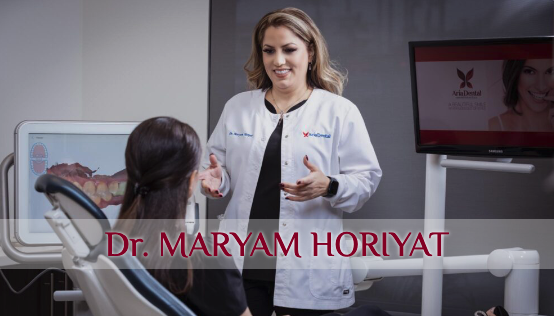
This guide, written by Dr. Maryam Horiyat of Aria Dental, answers every one of those questions in plain language, so that when you sit down for your consultation, you are informed, empowered, and ready.
The short answer: The most widely used drug for IV sedation in dentistry is midazolam (Versed), a short-acting benzodiazepine that produces deep relaxation, anxiety relief, and powerful amnesia. It is frequently combined with a short-acting opioid analgesic such as fentanyl for pain control, or with propofol when a deeper sedation dental procedure is required. At Aria Dental, all sedation protocols are personalized, holistically considered, and performed with the highest standards of patient safety in Orange County.
What Is IV Sedation in Dentistry? Understanding the Basics
Before diving into specific medications, it is worth establishing exactly what is IV sedation in dentistry, because the term is used loosely and is often misunderstood.
Intravenous sedation dentistry is the practice of delivering sedative medications directly into a patient’s bloodstream through a small catheter, most commonly placed in a vein on the back of the hand or inner forearm, for the purpose of reducing anxiety, discomfort, and awareness during a dental procedure. The word “intravenous” simply means “into the vein.” The IV route is preferred over oral or nasal routes because it offers several significant clinical advantages explored throughout this article.
It is important to understand that sedation exists on a spectrum of depth, formally defined by the American Dental Association (ADA):
- Minimal sedation (anxiolysis): You are relaxed and fully awake. Typically achieved with nitrous oxide or a low-dose oral sedative.
- Moderate sedation (conscious sedation dentistry): You are drowsy and calm, may not remember much of the procedure, but you can respond to verbal commands and breathe independently. This is the most commonly targeted level in IV sedation in dentistry.
- Deep sedation: You are on the edge of unconsciousness, and can only be aroused by repeated or painful stimulation. Airway support may be required. This is reserved for more complex or lengthy procedures.
- General anesthesia: You are completely unconscious and require full airway management. Rarely performed in a standard dental office setting.
When most dentists, patients, and articles refer to “IV sedation in dentistry,” they are referring to moderate sedation, or conscious sedation dentistry. The patient is profoundly calm and typically has no memory of the procedure, yet retains the ability to breathe independently and respond to simple instructions. It is not sleep. It is not general anesthesia. It is something patients often describe as the most peaceful experience they have ever had in a dental chair.
Why the Intravenous Route Makes All the Difference
The reason intravenous sedation dentistry is so effective is precisely how the drugs are delivered. Compared to swallowing a pill, the IV route offers:
- Near-immediate onset: Most IV sedation drugs take effect within 60–180 seconds of administration, compared to 30–60 minutes for oral medications.
- Real-time titration: The provider can increase or decrease the dose incrementally during the procedure based on how the patient is responding in that moment.
- Predictable, consistent effect: Oral absorption is affected by individual metabolism, food in the stomach, and other variables. IV delivery bypasses all of that entirely.
- Reversibility: Several of the drugs used for IV sedation have specific pharmacological reversal agents that can rapidly counteract their effects if needed, a crucial safety advantage.
What Drug Is Used for IV Sedation in Dentistry? A Complete Drug-by-Drug Guide
There is no single universal drug for IV sedation in dentistry. Instead, providers draw from a carefully selected pharmacological toolkit, choosing and combining agents based on the procedure, the patient’s health profile, and the depth of sedation required. Here is a thorough breakdown of every major drug used in intravenous sedation dentistry today.
1. Midazolam (Versed), The Gold Standard for Conscious Sedation Dentistry
If there is one answer to the question “what drug is used for IV sedation in dentistry,” it is midazolam. Sold under the brand name Versed, midazolam is a short-acting benzodiazepine and the single most widely administered agent in outpatient dental IV sedation worldwide.Midazolam works by potentiating the effects of GABA, the brain’s primary inhibitory neurotransmitter, at GABA-A receptors throughout the central nervous system. The clinical result is a rapid, dose-dependent cascade of effects almost uniquely suited to conscious sedation dentistry:
- Anxiolysis: Even a small initial dose produces immediate, profound relief from dental anxiety.
- Sedation: The patient becomes deeply drowsy and indifferent to their surroundings within minutes.
- Anterograde amnesia: Midazolam selectively blocks the formation of new memories from the time of injection forward. Most patients recall nothing of the procedure, which they overwhelmingly report as a feature, not a side effect.
- Muscle relaxation: Physical tension in the jaw and neck, a major source of discomfort for anxious dental patients, is markedly reduced.
- Anticonvulsant effect: A beneficial secondary property in patients with seizure disorders.
Midazolam’s onset after IV administration is approximately 2–3 minutes, its peak effect occurs around 5 minutes, and its primary sedative effect lasts 45–60 minutes, though the amnesic effect can persist for 1–2 hours. Crucially, it has a specific reversal agent: flumazenil (Romazicon), which can rapidly reverse all benzodiazepine effects within 1–2 minutes of administration. This makes midazolam uniquely safe among sedation agents.
2. Fentanyl, Precision Pain Control in Intravenous Sedation Dentistry
Benzodiazepines like midazolam are masterful at reducing anxiety and producing sedation, but they have limited intrinsic analgesic (pain-relieving) properties. For procedures involving significant tissue manipulation, implant placement, bone grafting, extractions, periodontal surgery, an opioid analgesic is added to the IV sedation protocol to provide targeted pain control.
Fentanyl is the opioid of choice in dental IV sedation. It is a synthetic opioid approximately 80–100 times more potent than morphine by weight, but the doses used in dentistry are tiny, measured in micrograms, and its short duration and rapid clearance make it well-suited to outpatient procedures.
Key clinical properties of fentanyl in intravenous sedation dentistry:
- Onset after IV administration: 1–2 minutes
- Peak effect: Approximately 3–5 minutes
- Duration of analgesic effect: 30–60 minutes
- Synergy with midazolam: The combination produces deeper sedation than either agent alone at equivalent doses
- Reversal agent: Naloxone (Narcan) can rapidly reverse opioid-induced respiratory depression and sedation
The midazolam-fentanyl combination is the most widely used IV sedation protocol in outpatient dentistry globally. Together, they address both the psychological dimension (anxiety, memory formation) and the physiological dimension (pain, tissue response) of the dental experience.
3. Propofol, The Deep Sedation Dental Procedure Agent
Propofol is a milky-white intravenous anesthetic that produces rapid, smoothly titratable sedation ranging from mild relaxation to complete unconsciousness depending on dose. Colloquially known as “the milk of amnesia,” propofol is best known for its use in hospital-based general anesthesia but has become increasingly relevant in dental settings where a deep sedation dental procedure is required.
In a dental context, propofol is typically reserved for:
- Patients who require deep sedation rather than conscious sedation (for example, those with severe dental phobia or significant special needs)
- Cases where the practitioner holds an advanced deep sedation or general anesthesia permit
- Full-mouth reconstruction and complex multi-hour surgical procedures
- Situations where extremely rapid and clear-headed recovery is desirable, propofol clears the body very quickly
The primary limitation of propofol is its narrow therapeutic window, the dose difference between comfortable sedation and full unconsciousness is small, meaning it requires a highly trained provider and robust airway management capabilities. Unlike midazolam and fentanyl, there is no pharmacological reversal agent for propofol; recovery depends entirely on the drug being metabolized and cleared.
4. Diazepam (Valium), A Reliable Benzodiazepine with a Long History
Diazepam (Valium) was the original benzodiazepine used in IV sedation in dentistry and continues to appear in some protocols today, particularly as an oral premedication the night before or morning of a procedure. Its mechanism is identical to midazolam, GABA-A receptor potentiation, but its much longer half-life (20–100 hours) means its sedative effects can linger for an entire day or more. For most modern IV sedation protocols, midazolam has largely replaced diazepam as the primary intravenous agent due to its superior control and faster offset.
5. Ketamine, A Versatile Adjunct for Complex Cases
Ketamine is a dissociative anesthetic that, at sub-anesthetic doses, produces analgesia, sedation, and amnesia while preserving spontaneous breathing, a combination that makes it a valuable adjunct in select IV sedation protocols, particularly for pediatric patients or medically complex adults. At low doses, ketamine provides additional pain relief and deepens the sedative effect without significantly increasing respiratory risk. It is not typically used as a primary agent for routine conscious sedation dentistry in adults, but it deserves mention as part of the broader intravenous sedation dentistry pharmacological toolkit.
6. Nitrous Oxide, A Complementary Tool in IV Sedation Protocols
While not itself an IV drug, nitrous oxide (laughing gas) frequently plays a supporting role in IV sedation protocols. It is commonly used during the pre-IV phase, administered via nasal mask to reduce anxiety during catheter placement, and can be continued alongside IV agents to reduce the total dose of intravenous medications required. Its extremely rapid onset and offset, excellent safety record, and minimal impact on respiratory function make it a welcome adjunct in holistic dental practices like Aria Dental, where minimizing total drug burden is a clinical priority.
Summary Table: IV Sedation Drugs in Dentistry at a Glance
| Drug | Class | Primary Role | IV Onset | Duration | Reversal Agent |
| Midazolam (Versed) | Benzodiazepine | Anxiolysis, sedation, amnesia | 2–3 min | 45–60 min | Flumazenil ✓ |
| Fentanyl | Synthetic opioid | Analgesia (pain control) | 1–2 min | 30–60 min | Naloxone ✓ |
| Propofol | Alkylphenol anesthetic | Deep sedation, rapid recovery | <1 min | 5–10 min* | None |
| Diazepam (Valium) | Benzodiazepine | Anxiolysis, premedication | 1–3 min | 2–6 hr+ | Flumazenil ✓ |
| Ketamine | Dissociative anesthetic | Analgesia, adjunct sedation | 1–2 min | 15–30 min | None |
The Difference Between IV Sedation and Oral Sedation in Dentistry
One of the most common questions patients ask before scheduling a sedation appointment is: what is the difference between IV sedation and oral sedation in dentistry? Both approaches achieve a calmer, more comfortable dental experience, but they differ significantly in how they work, how predictably they work, and what procedures they are best suited for.
Oral Sedation in Dentistry
- Medication taken by mouth (pill or liquid), typically 30–60 minutes before the appointment
- Onset is slow and highly variable: 30–60 minutes, depending on individual metabolism and stomach contents
- Achieves minimal to moderate sedation, cannot reliably reach deep sedation levels
- Once swallowed, the dose cannot be adjusted in real time
- Common agents include triazolam (Halcion), diazepam (Valium), and lorazepam (Ativan)
- Best suited for: mild-to-moderate dental anxiety and shorter, less complex procedures
IV Sedation in Dentistry
- Medication delivered directly into the bloodstream via a small IV catheter
- Onset is rapid and predictable: 60–180 seconds after administration
- Achieves moderate sedation (conscious sedation dentistry) up to a full deep sedation dental procedure
- The provider can adjust the dose continuously throughout the procedure in real time
- Common agents include midazolam, fentanyl, and propofol (detailed above)
- Best suited for: moderate-to-severe anxiety, lengthy or complex procedures, patients wanting reliable amnesia
The difference between IV sedation and oral sedation in dentistry ultimately comes down to control, predictability, and depth. Oral sedation operates on a “set it and forget it” basis, once the pill is taken, neither you nor your dentist has meaningful control over how strongly or how long the drug acts. Intravenous sedation dentistry, by contrast, is dynamic. Dr. Horiyat can observe your level of sedation in real time and fine-tune the dose second by second to keep you exactly where you need to be, calm, comfortable, and safe.
For patients with severe dental phobia, those undergoing procedures lasting longer than 60–90 minutes, or anyone who wants the reliable amnesia and deep relaxation that IV sedation uniquely provides, intravenous sedation dentistry is the clearly superior choice.
What Is a Deep Sedation Dental Procedure, And When Is It Needed?
While conscious sedation dentistry covers the needs of the vast majority of patients, a subset of procedures and patients requires what is formally classified as a deep sedation dental procedure. In this state, the patient is taken to the edge of unconsciousness. Protective reflexes such as swallowing are diminished, and the patient may require assistance maintaining a clear airway. They cannot be easily aroused by verbal commands, distinguishing this state clearly from conscious sedation dentistry, in which the patient remains responsive.
Situations That May Call for a Deep Sedation Dental Procedure
- Severe dental phobia, patients for whom even moderate sedation does not provide sufficient anxiety relief
- Full-mouth reconstruction, procedures spanning multiple hours requiring the patient to remain completely still
- Complex oral surgical procedures, multiple simultaneous implants, extensive bone grafting, or full-arch extractions
- Patients with special needs, individuals with cognitive, physical, or behavioral conditions that prevent cooperation under moderate sedation
- Select pediatric cases, children requiring extensive treatment who cannot cooperate even with nitrous oxide and oral sedation
Deep sedation in a dental office typically involves propofol, often combined with midazolam and/or an opioid, and requires the provider to hold a specific deep sedation permit issued by the state dental board. In California, the Dental Board of California regulates these permits stringently, ensuring that providers offering this level of care are fully trained and equipped.
The National Institute of Dental and Craniofacial Research (NIDCR) acknowledges deep sedation as a legitimate and valuable intervention for patients with significant dental anxiety or complex dental needs, and supports the ongoing training standards that ensure its safety in outpatient dental settings.
Aria Dental’s Holistic Approach to Intravenous Sedation Dentistry
At Aria Dental, IV sedation in dentistry is not simply a tool for patient management, it is a carefully considered clinical and holistic intervention, administered with the same biocompatible philosophy that defines every aspect of Dr. Horiyat’s practice. As Orange County’s #1-ranked holistic and biological dental office, Aria Dental approaches sedation with the understanding that what enters your body matters, not just during the procedure, but in the days and weeks of recovery that follow.
Comprehensive Pre-Sedation Health Evaluation
Before any intravenous sedation dentistry is administered, Dr. Horiyat conducts a thorough medical and lifestyle review that goes well beyond a standard anesthesia questionnaire. Her team evaluates:
- All current medications, including supplements, herbal remedies, and over-the-counter drugs, many of which have meaningful interactions with sedation agents
- Liver and kidney function indicators, which directly affect how quickly sedation drugs are metabolized and cleared
- Nutritional status and any deficiencies that may affect recovery
- Sleep quality and adrenal health, which can influence sensitivity to benzodiazepines
- History of previous reactions to anesthesia or sedation of any kind
- Cardiovascular health, respiratory function, and any conditions that affect airway management
Minimizing Drug Burden: The Biological Philosophy in Practice
A core principle of biological dentistry is minimizing unnecessary chemical and toxic load on the body. Applied to IV sedation in dentistry, this means:
- Using the lowest effective dose to achieve the desired level of conscious sedation dentistry, never more sedation than the procedure and patient actually require
- Choosing agents with the shortest half-life and fastest clearance to reduce the duration of drug exposure and minimize liver detoxification burden
- Avoiding unnecessary polypharmacy, combining only those agents whose combination is clinically justified, not by default
- Supporting recovery holistically with post-procedure guidance on hydration, nutrition, and activity that support the body’s natural detoxification processes
IV Sedation and Safe Mercury Amalgam Removal
One of the most clinically important applications of IV sedation in dentistry at Aria Dental Care is in combination with Safe Mercury Amalgam Removal Technique (SMART) procedures. IV sedation ensures patient comfort and complete stillness, allowing Dr. Horiyat to perform the meticulous SMART protocol, rubber dam isolation, sectioning, high-volume evacuation, without any time pressure or patient movement. This combination represents holistic dental care in its fullest expression: the procedure and the patient’s comfort managed with equal diligence.
Is IV Sedation in Dentistry Safe? Monitoring, Risks, and Recovery
Patient safety is the non-negotiable foundation of every IV sedation appointment at Aria Dental Care. Comprehensive monitoring for intravenous sedation dentistry includes:
- Continuous pulse oximetry: Monitors blood oxygen saturation (SpO₂) and heart rate in real time throughout the procedure
- Capnography (EtCO₂): The most sensitive real-time monitor for breathing, detects subtle changes in ventilation before oxygen levels are affected
- Electrocardiography (ECG): Continuous heart rhythm monitoring throughout every deep sedation dental procedure or conscious sedation appointment
- Non-invasive blood pressure monitoring: Cuff-based readings taken at regular intervals
- Supplemental oxygen: All patients receiving IV sedation breathe supplemental oxygen via nasal cannula throughout treatment
- Reversal agents on hand: Flumazenil and naloxone are immediately accessible in the treatment room at all times
- ACLS-trained personnel: Providers and staff are trained in Advanced Cardiac Life Support and emergency airway management
The Centers for Disease Control and Prevention (CDC) recognizes dental anxiety as a significant barrier to oral health care access and supports evidence-based sedation practices that allow more patients to receive the care they need safely and comfortably.
Serious adverse events from IV sedation in a properly equipped dental setting are rare. The most common side effects are mild and transient: post-procedure drowsiness lasting a few hours, occasional mild nausea (most common when opioids are used), minor bruising at the IV site, and temporary memory gaps. The strong majority of patients who undergo IV sedation in dentistry describe their experience as the most comfortable dental appointment they have ever had.
What to Expect: Your IV Sedation Appointment from Start to Finish
Before Your Appointment
- Fasting: Do not eat or drink (except small sips of water with essential medications) for at least 6–8 hours before your IV sedation appointment. This is a critical safety requirement.
- Medications: You will receive personalized instructions on which medications to continue and which to pause. Follow these carefully.
- Transportation: You must have a responsible adult drive you home. You cannot drive or operate machinery for 24 hours after IV sedation in dentistry.
- Clothing: Wear loose, comfortable clothing with short sleeves or easily rolled-up sleeves for IV catheter access.
During Your Appointment
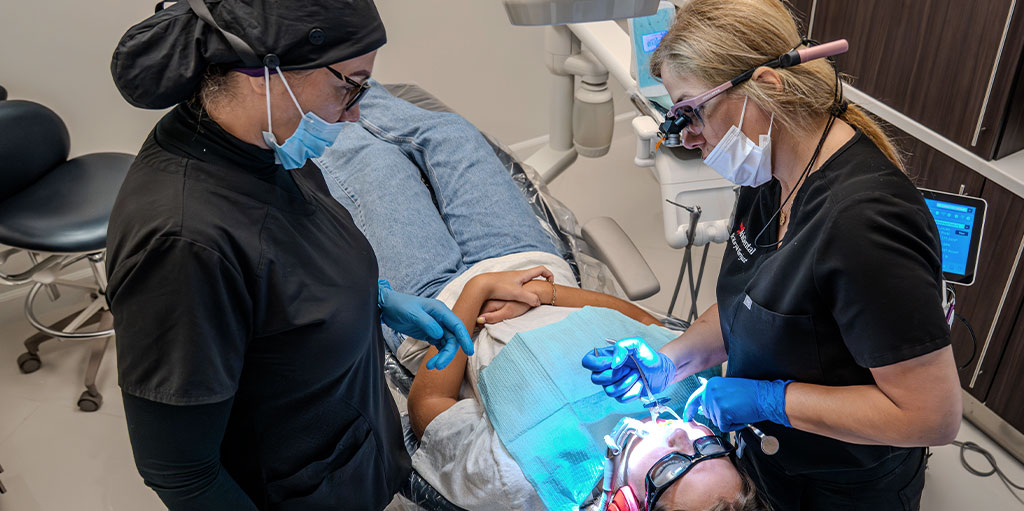
On arrival, vital signs are taken and your pre-sedation checklist is confirmed. A small IV catheter is placed, most patients describe this as a brief pinch, no more uncomfortable than a routine blood draw. Once monitoring equipment is in place, Dr. Horiyat carefully and slowly introduces the sedation medications. Within two to three minutes, the majority of patients feel a wave of profound calm wash over them. Anxiety dissolves. Physical tension releases. Awareness narrows to a pleasant, dreamlike quality.
Throughout the procedure, continuous monitoring keeps the Aria Dental Care team fully aware of your physiological status at every moment. At the conclusion of treatment, sedation is discontinued and you are moved to a recovery area where you are monitored until alert and stable enough to be safely discharged.
After Your Appointment
- Rest at home for the remainder of the day
- Begin with clear liquids and advance to soft foods as tolerated
- Avoid alcohol for at least 24 hours post-sedation
- Avoid making important decisions or signing legal documents for 24 hours
- Follow all post-operative care instructions specific to your dental procedure
- Contact Aria Dental Care promptly if you experience any unusual symptoms during recovery
IV Sedation vs. General Anesthesia: Understanding the Key Distinction
Patients often confuse IV sedation with general anesthesia. While the two share pharmacological overlap, they are meaningfully different in clinical terms.
Under IV sedation at the conscious-to-moderate-sedation level, you retain protective airway reflexes, breathe independently, and can respond to verbal commands. Under general anesthesia, you are completely unconscious, airway reflexes are abolished, and you require intubation or a laryngeal mask airway to maintain breathing. General anesthesia in a dental office requires significantly more equipment, a higher level of provider training and licensing, and a more intensive recovery protocol.
For the vast majority of dental procedures, including complex implant surgeries, multiple extractions, and lengthy cosmetic restorations, IV sedation to the moderate or deep sedation dental procedure level provides all the comfort and cooperation benefits of general anesthesia, with a safer profile, faster recovery, and lower overall risk in an outpatient setting.
Conclusion: IV Sedation in Dentistry Is the Gateway to the Dental Care You Deserve
Understanding what drug is used for IV sedation in dentistry is more than satisfying intellectual curiosity, it is the foundation of informed, confident consent. When you know that midazolam is well-studied, reversible, and used in carefully controlled doses; that fentanyl is present in microgram quantities for targeted pain relief; that the difference between IV sedation and oral sedation in dentistry is fundamentally one of control and predictability; and that a deep sedation dental procedure is a carefully regulated, clinically legitimate intervention, dental anxiety begins to lose its grip.
At Aria Dental Care, Dr. Maryam Horiyat brings not only advanced training in intravenous sedation dentistry but also a deeply holistic perspective that ensures every sedation protocol is designed with your whole-body health in mind. From the pre-sedation evaluation to the post-procedure recovery guidance, every detail is handled with precision, compassion, and an unwavering commitment to biocompatible care.You deserve comfortable, healthy, high-quality dental care. And with IV sedation, that care does not have to come at the cost of anxiety, pain, or dread. Contact Aria Dental Care today and take the first step toward a dental experience that genuinely surprises you, in the very best way.