







Clinically reviewed by Dr. Maryam Horiyat, DDS, AIAOMT, CIABDM | Last reviewed October 21, 2026
A chipped front tooth raises a surprisingly tricky question: is fixing it a health issue or a cosmetic one? The honest answer is that it can be both, and that overlap is exactly why so many patients feel unsure about the difference between cosmetic dentistry procedures and general dentistry.
In simple terms, general dentistry keeps your teeth, gums, and bite healthy and working. Cosmetic dentistry focuses on how your smile looks. The two share tools, materials, and very often the same dentist, but they differ in purpose, timing, cost, insurance treatment, and how much they change your natural teeth.
The short answer: General dentistry prevents, diagnoses, and treats problems that affect oral health and function, such as cavities, gum disease, and infection. Cosmetic dentistry procedures are usually elective treatments, such as teeth whitening, dental bonding, and porcelain veneers, that improve the color, shape, alignment, or overall appearance of a smile. In most cases, a healthy general dentistry foundation should come before any cosmetic work begins.

What Is General Dentistry?
General dentistry is the primary care of oral health. A general dentist is usually the first professional you see for checkups, the one most likely to notice early warning signs, and the one who coordinates referrals when you need a specialist. If a family physician manages your overall health, a general dentist plays the same role for your teeth, gums, and jaw.
Every general dentist in the United States holds either a Doctor of Dental Surgery (DDS) or a Doctor of Dental Medicine (DMD) degree. The two degrees reflect the same core education; the title simply depends on the dental school that awarded it. Dentists must also pass national and state licensing requirements before they can treat patients.
The guiding priorities of general dentistry are prevention, early detection, and restoring function. In everyday terms, that means catching small problems before they turn into painful, complicated, and expensive ones.
Common General Dentistry Services
Most general dental practices provide a broad menu of preventive and restorative care, including:
- Routine exams and professional cleanings at an interval your dentist sets based on your risk level (twice a year is common)
- Digital X-rays and oral cancer screenings to find problems that are not visible yet
- Tooth-colored fillings to repair cavities
- Gum disease treatment, from gingivitis care to scaling and root planing for periodontitis
- Root canal therapy and tooth extractions for infected or badly damaged teeth
- Crowns, bridges, and dentures to restore broken or missing teeth
- Sealants and remineralizing treatments to protect vulnerable enamel
- Night guards and sports mouthguards to prevent grinding and injury damage
- Emergency dental care for toothaches, abscesses, and fractured teeth
Why Preventive Dental Care Matters
Preventive care is less glamorous than a smile makeover, but it does the heavy lifting. According to the National Institute of Dental and Craniofacial Research’s Oral Health in America report, tooth decay affects about 90% of adults ages 20 to 64, and gum disease affects almost half of adults ages 45 to 64. Both conditions are largely preventable, and general dentistry is where that prevention happens.

What Are Cosmetic Dentistry Procedures?
Cosmetic dentistry procedures are treatments designed primarily to improve the appearance of your teeth, gums, or smile. They address concerns such as discoloration, chips, gaps, uneven edges, worn-down teeth, and mild crowding. Some of them also improve function, but appearance is the main reason patients choose them.
Most aesthetic dental treatments are elective, which means they are not required to treat disease. Elective does not mean unimportant, though. A smile you feel comfortable showing affects how you speak, how you photograph, and how confident you feel in a job interview or a first meeting. Many patients describe cosmetic care as the step that finally ended years of smiling with their lips closed.
Is Cosmetic Dentistry a Recognized Dental Specialty?
No, and this surprises many people. The American Dental Association’s National Commission on Recognition of Dental Specialties and Certifying Boards currently recognizes 12 dental specialties, including orthodontics, periodontics, endodontics, and prosthodontics. Cosmetic dentistry is not on that list.
In practical terms, a “cosmetic dentist” is usually a general dentist who has chosen to focus on aesthetic work and pursued additional training beyond dental school. Prosthodontists, who specialize in restoring and replacing teeth, also perform a great deal of esthetic dentistry. Additional training might include continuing education in smile design, dental materials, and adhesive techniques, or involvement with professional groups such as the American Academy of Cosmetic Dentistry (AACD).
When you evaluate a provider, the credential that matters is not a specialty title. It is documented training, years of experience with the specific procedure, and a portfolio of that dentist’s own patient results.
The Most Common Cosmetic Dentistry Procedures Explained
The following cosmetic dentistry procedures account for most of the questions patients bring to a consultation. Each one solves a different problem, and each comes with its own tradeoffs.
Professional Teeth Whitening
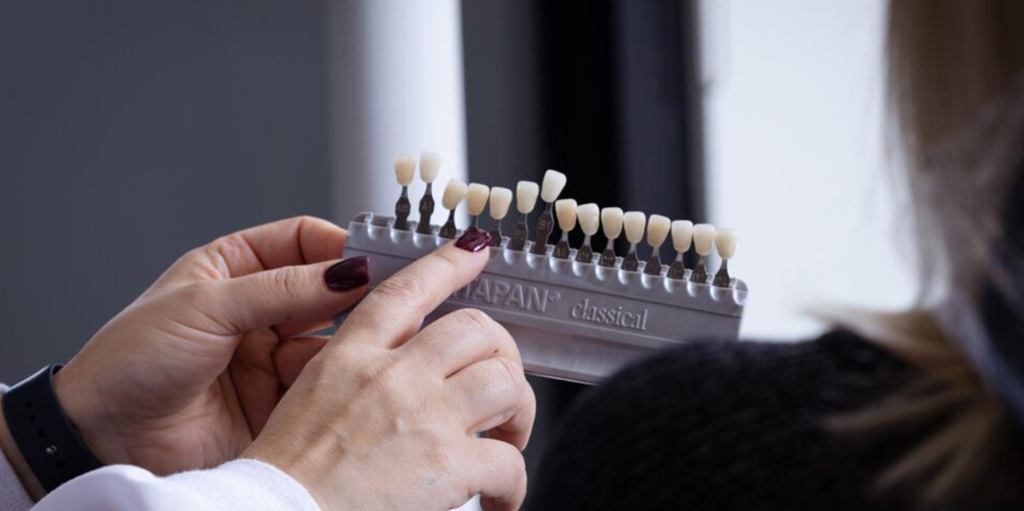
Whitening lightens natural enamel with peroxide-based gels. In-office whitening uses a stronger gel applied under professional supervision, while take-home systems use custom trays and a milder gel over several days or weeks. Practices such as Aria Dental Care offer professional teeth whitening in both formats.
- Best for: yellowing and surface stains from coffee, tea, red wine, tobacco, or age
- Limitations: does not change the color of crowns, veneers, or fillings, and is less predictable on gray or internal staining
- Tooth structure: nothing is removed; results fade gradually and can be refreshed
- Common side effect: temporary tooth sensitivity
Dental Bonding
Composite bonding applies tooth-colored resin directly to the tooth, then sculpts and polishes it to blend in. It is often completed in a single visit without anesthesia.
- Best for: small chips, minor gaps, slightly short or uneven teeth
- Limitations: composite can stain and chip over time and usually needs repair sooner than porcelain
- Tooth structure: little or no enamel removal in many cases
Porcelain Veneers
Porcelain veneers are thin, custom-made ceramic shells bonded to the front surfaces of teeth. They can change color, shape, length, and the apparent alignment of the smile at the same time.
- Best for: permanent discoloration, worn or chipped front teeth, and patients who want a comprehensive change
- Limitations: most veneers require removing a thin layer of enamel, so the decision is generally permanent
- Longevity: well-maintained veneers commonly last a decade or longer
Enamel Contouring and Gum Contouring
Enamel contouring (also called tooth reshaping) removes a very small amount of enamel to smooth rough edges or even out tooth length. Gum contouring reshapes the gumline, often with a soft-tissue laser, to correct a “gummy” smile or uneven gum heights.
- Both are quick, conservative refinements that are frequently combined with other treatments
- Enamel does not grow back, so a careful dentist uses contouring sparingly
Clear Aligners and Cosmetic Orthodontics
Clear aligners and tooth-colored braces move teeth gradually into better positions. They sit right on the border between cosmetic and general care: straighter teeth look better, and they are also easier to brush and floss, which can lower the risk of decay and gum problems. More complex bite issues may call for an orthodontist, one of the 12 recognized specialists.
Tooth-Colored Crowns, Dental Implants, and Smile Makeovers
Some cosmetic dentistry procedures are really restorative treatments delivered with appearance in mind. A porcelain or zirconia crown protects a cracked tooth while matching its neighbors. A dental implant replaces a missing tooth root and supports a natural-looking crown. A smile makeover combines several of these treatments into one coordinated plan, and a well-designed plan almost always begins with general dental care.

Cosmetic vs General Dentistry: A Side-by-Side Comparison
| Factor | General Dentistry | Cosmetic Dentistry Procedures |
| Primary goal | Prevent and treat disease; restore function | Improve color, shape, alignment, or overall appearance |
| Medical necessity | Usually necessary | Usually elective |
| Typical treatments | Exams, cleanings, fillings, gum therapy, extractions, root canal therapy | Whitening, bonding, veneers, contouring, aligners, smile makeovers |
| When it happens | First, and ongoing for life | After the mouth is healthy and stable |
| Impact on tooth structure | Varies; prevention is non-invasive | Ranges from none (whitening) to permanent (veneers) |
| Insurance | Preventive care is commonly covered | Purely cosmetic work is usually excluded |
| Who provides it | General dentist (DDS or DMD) | General dentist with added aesthetic training, or a prosthodontist |
| Visit pattern | Regular recall visits | Planned treatment, then maintenance visits |
6 Key Differences Between Cosmetic and General Dental Care
The comparison table gives the big picture. Here is what those differences mean when you are actually sitting in the dental chair.
1. Purpose: Health First vs Appearance First
General dentistry asks, “Is this mouth healthy, and will it stay that way?” Cosmetic dentistry asks, “Does this smile look the way the patient wants it to?” Both questions are legitimate. The difference is which one drives the treatment decision. A filling exists because decay must be stopped. Whitening exists because the patient wants brighter teeth.
2. Medical Necessity and Treatment Timing
General dental treatment is often time-sensitive. A small cavity left alone can grow into an infection, and early gum disease can progress to bone loss. Cosmetic treatment, by contrast, can usually be scheduled whenever it suits your budget and calendar. That flexibility comes with one firm rule: cosmetic dentistry procedures should follow, not replace, the treatment of active disease.
3. Reversibility and Tooth Structure
This is one of the most important differences and one of the least discussed. Most general dentistry aims to preserve as much natural tooth as possible. Cosmetic options range widely. Whitening and many bonding cases leave enamel intact, while traditional veneers and enamel contouring remove tooth structure permanently. Before agreeing to any treatment, ask exactly how much tooth will be altered and whether a more conservative option could achieve a similar result.
4. Dental Insurance Coverage and Cost
Many dental plans group services into preventive, basic, and major categories, with preventive visits covered at the highest percentage. Purely cosmetic treatments such as whitening and veneers placed for appearance are typically excluded. The gray area is treatment with a functional purpose: a crown that restores a broken tooth or an implant that replaces a missing one may receive partial coverage even though the result also looks good. A pre-treatment estimate from your insurer is the only reliable way to know. Some practices also offer insurance verification or phased treatment plans to spread out costs.
5. Training, Credentials, and Who Performs the Work
Any licensed dentist can legally perform many cosmetic treatments, but skill levels vary widely. Because cosmetic dentistry is not a recognized specialty, the best signals of expertise are continuing education in aesthetic techniques, memberships in organizations such as the AACD, and a body of documented cases. For general dentistry, look for a dentist who explains findings clearly, uses current diagnostic tools, and refers to specialists when a problem falls outside their scope.
6. Long-Term Maintenance
General dental care is a lifelong habit, not a one-time project. Cosmetic results need upkeep too. Whitening fades and needs periodic touch-ups. Bonding may need polishing or repair after a few years. Veneers and crowns require the same brushing, flossing, and checkups as natural teeth, and patients who grind may need a night guard to protect their investment. Put simply, cosmetic work increases the value of good general care rather than replacing it.
Where Restorative Dentistry Fits Between the Two
Restorative dentistry sits in the middle of this conversation. Crowns, bridges, inlays, onlays, and implants restore function, yet modern tooth-colored materials also make them look natural. That is why the same procedure can be classified as general or cosmetic depending on the reason behind it.
Consider two crowns. The first covers a fractured molar to prevent the tooth from splitting; that is restorative care with a clear health purpose. The second reshapes a healthy but slightly small front tooth to balance a smile; that is a cosmetic decision. The material and technique may be identical. The clinical reason, the documentation, and often the insurance outcome are different. Comprehensive cases such as a full-mouth reconstruction often blend restorative and cosmetic goals in a single plan.
Why Oral Health Comes Before Cosmetic Treatment
The Centers for Disease Control and Prevention identifies cavities, severe gum disease, and severe tooth loss as the three oral conditions that most affect overall health and quality of life. Those are general dentistry problems, and they can quietly undermine cosmetic results.
A few examples show why sequence matters:
- Whitening over decay or cracked enamel can cause significant sensitivity and leave the underlying problem untreated.
- Veneers or crowns placed on inflamed gums may look fine at first, but gums can shift as inflammation resolves, exposing the edges of the restorations.
- Bonding over an undiagnosed cavity hides the decay rather than treating it.
- Aligners on teeth with active gum disease can place added stress on already weakened support.
This is why a responsible cosmetic consultation usually starts with a full exam, X-rays, a gum evaluation, and a professional dental cleaning if one is due. It can feel like a detour when you are eager for results, but it protects both your health and your investment.
How to Choose Between a Cosmetic Dentist and a General Dentist
Start with the reason you are booking the appointment:
- Pain, bleeding gums, sensitivity, a broken tooth, or an overdue checkup: see a general dentist first.
- Healthy teeth, but unhappy with color, shape, or spacing: schedule a cosmetic consultation.
- A mix of both: look for a practice that offers general, restorative, and aesthetic care under one roof, so one team can plan the right order of treatment.
Questions to Ask Before Cosmetic Dentistry Procedures
- What specific training and experience do you have with this procedure?
- Can you show before-and-after photos of your own patients rather than stock images?
- How much natural tooth structure will this treatment remove, if any?
- What more conservative alternatives could achieve a similar result?
- How long should the results last, and what will maintenance involve?
- Which parts of this plan might insurance cover?
Red Flags to Watch For
- Recommending veneers on many teeth without first discussing whitening, bonding, or orthodontics
- Skipping a full exam, X-rays, or a gum evaluation before cosmetic work
- Pressure to commit on the same day, or pricing that is unclear in writing
- Promises of “perfect” or guaranteed results
An Integrated Approach: Perspective from Aria Dental Care
This article was clinically reviewed by Dr. Maryam Horiyat, DDS, who leads Aria Dental Care in Mission Viejo, California. Dr. Horiyat earned her undergraduate degree at UCLA and her DDS from the University of California, San Francisco. She is accredited by the International Academy of Oral Medicine and Toxicology (IAOMT), certified by the International Academy of Biological Dentistry and Medicine (IABDM), and a member of the American Academy of Cosmetic Dentistry.
Her practice combines general, cosmetic, and biological dentistry in one setting. As part of its practice philosophy, Aria Dental Care emphasizes metal-free, biocompatible materials and plans cosmetic treatment around each patient’s overall oral health. That integrated model reflects the central point of this guide: cosmetic dentistry procedures tend to deliver the most durable results when they are planned by a team that also manages the patient’s general dental care.
Patients who want to explore options can review Aria Dental Care’s cosmetic dentistry services or read the practice’s companion guide, Cosmetic Dentistry vs General Dentistry.
Final Thoughts: Choosing the Right Care for Your Smile
General dentistry and cosmetic dentistry are not competing choices. They are two stages of the same goal: a mouth that is healthy, comfortable, and something you are happy to show. General care protects the foundation. Cosmetic dentistry procedures refine what sits on top of it. When the two are planned together, in the right order and by a dentist who explains the tradeoffs honestly, patients get results that look good on day one and still hold up years later.
If you are weighing cosmetic treatment, start with a comprehensive exam, ask the questions in this guide, and choose a provider whose training and track record match the procedure you want.