




If you are missing most or all of your teeth, you are standing at a fork in the road. One path leads to a removable plate that sits on your gums, comes out at night, and needs adhesive to stay put. The other leads to a fixed, full-arch set of teeth anchored by all on 6 dental implants that you brush, bite with, and forget about.
At Aria Dental Care in Mission Viejo, patients from across Orange County come to us after years of loose dentures, sore spots, and a diet built around soft food. They are not just asking which option looks better. They are asking which option protects their jawbone, their nutrition, and their long-term health.
That is exactly the right question, and it is why this comparison exists.
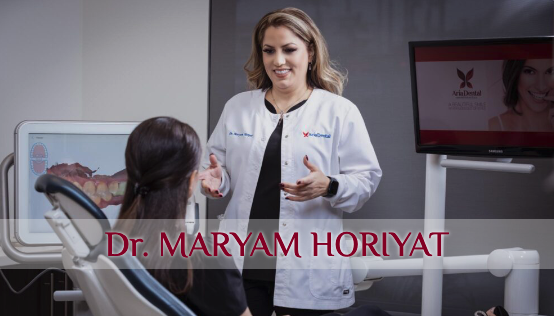
Ready to see which option fits your mouth, your health goals, and your budget? Schedule your consultation with Dr. Maryam Horiyat
Your Top Questions About All-on-6 Dental Implants, Answered
Before the full comparison, here are the four questions Orange County patients ask us most often. Each one gets a complete answer below.
What Is All-on-6 Dental Implants?
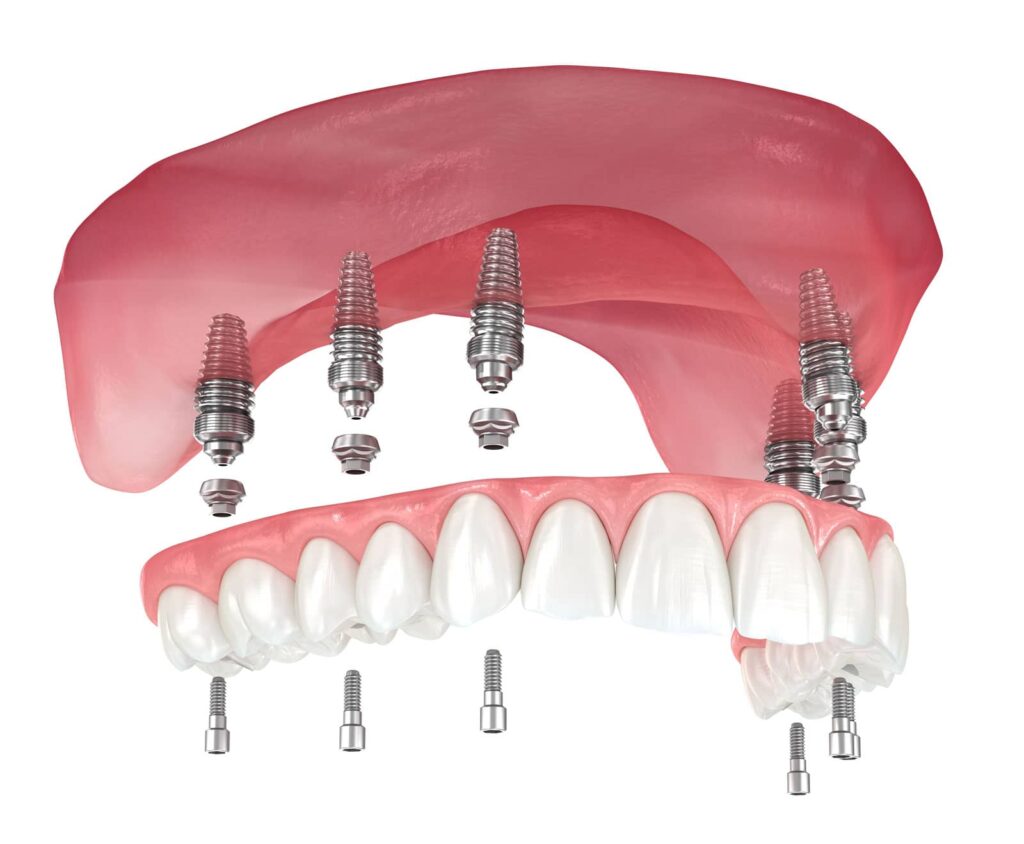
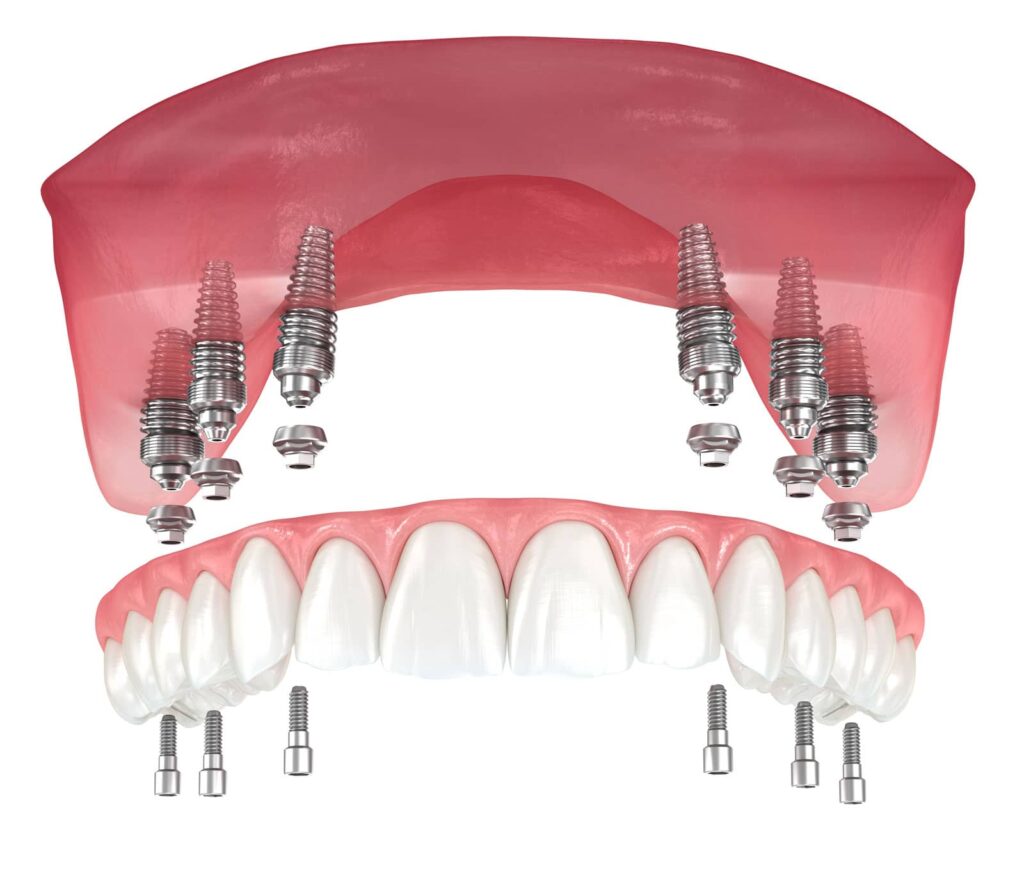
All-on-6 is a full-arch tooth replacement technique in which six dental implant posts support one complete fixed bridge of teeth, on the upper jaw, the lower jaw, or both. Instead of replacing missing teeth one at a time, the entire arch is rebuilt on six strategically placed anchors.
Here is what defines the treatment:
- Six titanium or ceramic posts are placed into the jawbone, where they fuse to the bone through a biological process called osseointegration.
- Posterior implants are often angled to engage the densest available bone, which frequently reduces or eliminates the need for extensive bone grafting or sinus lifts.
- A single fixed prosthesis is secured onto those six anchors. It does not come out. Only your dental team removes it, and only for maintenance.
- Immediate loading is often possible, meaning many patients leave surgery the same day with a fixed provisional bridge rather than an empty mouth.
Think of it as the difference between a boat tied to a dock and a boat floating free. Both are on the water. Only one stays where you put it.
Unlike snap-in overdentures, which still detach and still rest partly on your gum tissue, an All-on-6 restoration transfers your bite force through the implants and into the bone, the way natural tooth roots do.
Which Is Better, All-on-4 or All-on-6 Dental Implants?
Neither one is universally better. The honest answer is that the right number of implants is determined by your bone, not by a brand name.
Here is the practical difference:
| Consideration | All-on-4 | All-on-6 |
| Implants per arch | 4 | 6 |
| Force distribution | Concentrated across fewer anchors | Spread across a wider span |
| Cantilever length | Longer rear extension | Shorter rear extension |
| Bone requirement | Designed for limited bone volume | Generally needs more available bone |
| Redundancy | Loss of one implant is more consequential | Additional anchors provide more margin |
| Cost | Lower | Higher |
| Best suited for | Patients with significant bone loss who want to avoid grafting | Patients with adequate bone, heavier bite forces, larger arches, or bruxism |
All-on-4 tends to make sense when bone volume is limited, cost is a deciding factor, or grafting is medically undesirable. It is a well-documented protocol with a long clinical track record.
All-on-6 tends to make sense when you have adequate bone, you clench or grind, you have a broader arch, you are restoring the upper jaw where bone is naturally softer, or you simply want more anchor points supporting the restoration.
Dr. Horiyat evaluates each arch individually using 3D CBCT imaging and a full bite analysis. Some patients receive All-on-4 on the lower and All-on-6 on the upper, because the two jaws have very different bone characteristics. Any office that quotes you an implant count before scanning your jaw is selling a package, not planning treatment.
How Long Do All on 6 Dental Implants Last?
There are two separate answers, because there are two separate components.
The implants themselves are designed as a long-term foundation. With healthy bone, controlled systemic health, and consistent maintenance, many patients keep their implant posts for decades. Osseointegrated implants do not decay the way natural teeth do.
The bridge on top is a prosthetic component. It experiences daily wear, and it may eventually be refreshed, repaired, or replaced. Material matters here. Acrylic-based prostheses wear faster than monolithic zirconia bridges, which are considerably more wear-resistant.
What actually drives longevity:
- Oral hygiene. Peri-implantitis, an inflammatory condition affecting the tissue and bone around implants, is the leading cause of late implant loss. It is largely preventable.
- Professional maintenance visits. Your prosthesis should be professionally cleaned on the schedule Dr. Horiyat sets for your case.
- Smoking. Tobacco use is one of the strongest documented risk factors for implant failure.
- Systemic health. Uncontrolled diabetes, certain medications, and immune conditions influence healing and long-term bone stability.
- Bite forces and bruxism. Untreated grinding stresses both the implants and the bridge. A night guard is often part of the plan.
A note on honesty: no dentist can guarantee a specific lifespan for any implant, and any practice that promises “lifetime teeth” is making a claim it cannot substantiate. What we can do is plan carefully, use quality components, and give you a maintenance protocol that protects your investment. Individual results vary.
How to Clean All-on-6 Dental Implants
This is the question that determines whether your restoration lasts five years or twenty-five. Your fixed bridge cannot get cavities, but the tissue and bone underneath it absolutely can become inflamed and recede.
The critical detail most patients miss: there is a small space between the underside of your bridge and your gum tissue. That space is where debris and bacteria collect, and it is not reachable with a toothbrush alone.
Your daily routine:
- Brush twice daily with a soft-bristled or electric brush, angling toward the gumline on the outer and inner surfaces.
- Use a water flosser every single day. For All-on-6 patients this is not optional. Direct the tip along the tissue side of the bridge at a low-to-medium setting to flush the space underneath.
- Thread superfloss or implant-specific floss beneath the bridge and shoeshine it along the tissue, working section by section between the implant posts.
- Use interdental brushes sized to reach around each abutment where access allows.
- Choose a non-abrasive toothpaste. Avoid gritty whitening pastes and abrasive charcoal products, which can scratch the prosthetic surface and create texture that holds plaque. Acidulated phosphate fluoride products are generally avoided around titanium surfaces. We will recommend a biocompatible product suited to your restoration material.
- Rinse as directed. Alcohol-heavy and chlorhexidine rinses are used only when prescribed and only for defined periods, since long-term use has drawbacks.
Your professional routine:
- Hygiene visits every three to six months, depending on your risk profile.
- Periodic prosthesis removal. Your bridge can be unscrewed by your dental team so the implant abutments and tissue underneath can be cleaned and inspected thoroughly. This is one of the most important and most skipped appointments in full-arch care.
- Radiographic monitoring of bone levels around each implant.
- Ozone therapy, used at Aria Dental Care to support tissue health around implants during maintenance.
- Implant-safe instrumentation. Titanium and zirconia surfaces should be cleaned with instruments that will not scratch them. Not every hygiene department is equipped for this. Ours is.
What to avoid: hard bristles, abrasive pastes, metal picks, opening packages with your teeth, chewing ice or hard candy, and smoking.
What Are Traditional Dentures?
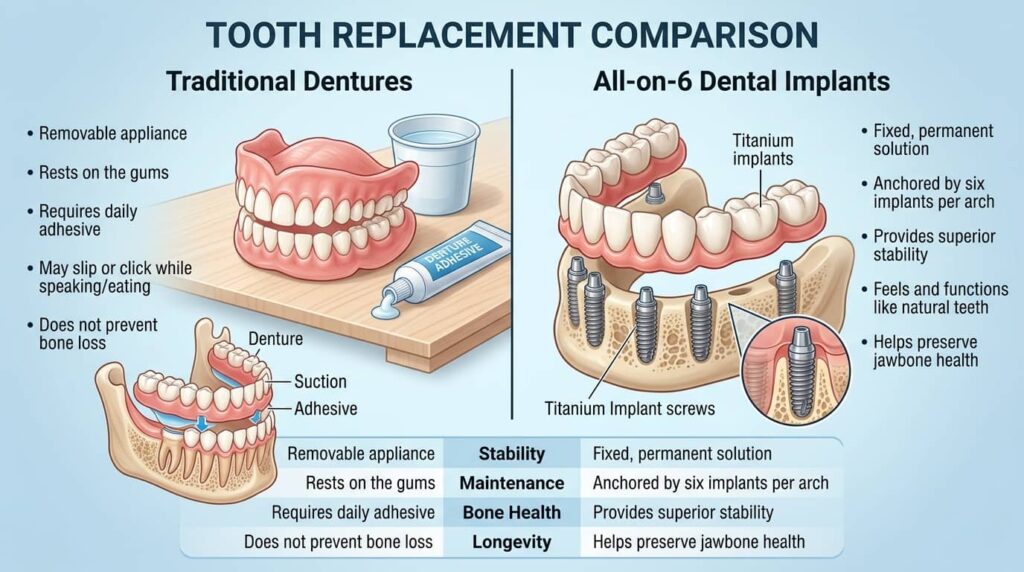
Conventional full dentures are removable acrylic appliances that rest on the gum tissue. According to the American Dental Association, they replace missing teeth and help restore chewing, speaking, and facial support after tooth loss.
They serve a real purpose. They are accessible, non-surgical, and lower in upfront cost. For some patients, they are the appropriate starting point.
But they come with well-documented trade-offs:
- They rest on the bone rather than in it, so they do not stimulate the jaw.
- They rely on suction, adhesive, or clasps for retention.
- They shift during eating and speaking, particularly on the lower arch.
- They require relines and replacements as the underlying ridge changes shape.
- They cover the palate on the upper arch, which affects taste and temperature perception.
All-on-6 Dental Implants vs. Traditional Dentures: The Side-by-Side Comparison
| Factor | All-on-6 Dental Implants | Traditional Dentures |
| Retention | Anchored to six implants fused to bone | Rests on gums, held by suction or adhesive |
| Removable? | No, fixed in place | Yes, removed daily |
| Jawbone stimulation | Transmits force into the bone | No direct bone stimulation |
| Chewing capacity | Approaches natural function for most patients | Noticeably reduced, diet often restricted |
| Palate coverage (upper) | Open palate design possible | Full palate typically covered |
| Speech comfort | Stable, no slipping during speech | Slipping and clicking are common complaints |
| Adhesive required | Never | Frequently |
| Daily maintenance | Brush, water floss, superfloss | Nightly soaking, cleansers, adhesive removal |
| Fit over time | Stable as long as implants remain healthy | Loosens as the ridge resorbs |
| Upfront cost | Higher | Lower |
| Long-term value | Fewer remakes, high patient satisfaction | Repeat relines and replacements add up |
| Surgery required | Yes | No |
Why Jawbone Preservation Changes the Entire Conversation
This is the single point most patients are never told before they choose.
When a tooth is lost, the bone that once held it begins to change. The U.S. Food and Drug Administration notes that tooth loss can lead to complications including rapid bone loss, speech changes, and altered chewing patterns, and that replacing a lost tooth with a dental implant can meaningfully improve quality of life and health.
Traditional dentures sit on top of that changing ridge. They do not send force into the bone. Over the years, many long-term denture wearers notice their appliance loosening, their lower face shortening, and their profile changing.
Full-arch dental implants engage the bone directly. That functional loading is why implant-supported restorations are so often recommended when preserving facial structure matters to a patient.
Curious how much bone you still have to work with? A 3D CBCT scan answers that question in minutes. Book your implant evaluation in Mission Viejo
The Holistic and Biological Difference at Aria Dental Care
Plenty of offices place full-arch implants. Very few approach them the way a biological dental practice does.
Dr. Maryam Horiyat holds accreditation with the IAOMT (AIAOMT) and certification with the IABDM (CIABDM), and she brings a whole-body lens to every implant case.
Material Selection and Biocompatibility
- Biocompatible material focus. We prioritize materials chosen with your individual sensitivities and health history in mind.
- Metal-free options where clinically appropriate. For patients who prefer to avoid metal, we discuss ceramic and zirconia implant systems and explain honestly where the current evidence supports them and where full-arch metal-free protocols have documented limitations. You get the real picture, not a sales pitch.
- Biocompatibility testing available. For patients with autoimmune conditions, chemical sensitivities, or a history of reactions, we can discuss individualized material screening.
Surgical Protocol
- Ozone therapy used to support a clean surgical field.
- Laser dentistry for precise, tissue-conserving soft tissue work.
- Mercury-safe SMART protocol if existing amalgam fillings must be removed before your full-arch treatment.
- 3D CBCT imaging and guided planning so implant position is decided digitally before anything is placed.
- Sedation options for patients who need surgery to be a non-event.
Whole-Body Integration
We look at your airway, your bite, your nutrition, and your medical history. A full-arch restoration is not just cosmetic dentistry. It is a rebuild of how you eat, breathe, and sleep for the next few decades.
Who Is a Good Candidate for All-on-6 Implants?
You may be an excellent candidate if you:
- Are missing all or most teeth in one or both arches
- Have failing teeth due to advanced periodontal disease or extensive decay
- Are tired of denture adhesive, slipping, and sore spots
- Want a permanent teeth replacement solution that does not come out at night
- Have adequate bone volume, or are open to grafting where indicated
- Are in reasonably good general health and do not smoke heavily
- Care about long-term jawbone and facial structure preservation
Traditional dentures may be more appropriate if you:
- Are not a surgical candidate due to medical conditions
- Need an immediate, lower-cost interim solution
- Prefer a non-surgical path
There is no wrong answer here. There is only the answer that is right for your body, your goals, and your circumstances. Dr. Horiyat will tell you which one that is, even when it is not the more expensive option.
What the All-on-6 Process Looks Like at Aria Dental Care
- Comprehensive consultation and 3D imaging. CBCT scan, digital records, medical history review, and airway assessment.
- Personalized treatment plan. Implant count, material selection, sedation preference, and a clear written fee breakdown before anything begins.
- Surgical placement. Extractions if needed, six implants placed in planned positions, often with a fixed provisional bridge the same day.
- Healing and osseointegration. Typically several months while the implants integrate with the bone. You are never without teeth during this period.
- Final prosthesis delivery. Your definitive bridge is designed for your bite, your facial proportions, and your smile.
- Ongoing maintenance. Regular hygiene visits protect your investment for the long haul.
Cost: Being Honest About the Numbers
All on 6 dental implants cost more upfront than traditional dentures. That is simply true, and any office that dances around it is not being straight with you.
What is also true:
- Conventional dentures require relines, adjustments, remakes, and adhesive purchases over the years.
- Denture-related bone loss can eventually make future implant treatment more complex and more expensive.
- A well-maintained full-arch implant restoration is designed to serve for many years, with the prosthetic component being the primary item eventually refreshed.
We provide transparent written estimates, discuss insurance coordination, and offer financing options so you can evaluate the decision with real numbers rather than guesswork.
Request your personalized All-on-6 cost estimate
Serving Patients Across Orange County
Aria Dental Care welcomes full-arch implant patients from Mission Viejo, Laguna Niguel, Lake Forest, Rancho Santa Margarita, Aliso Viejo, Ladera Ranch, San Juan Capistrano, San Clemente, Irvine, Coto de Caza, Dana Point, and communities throughout Orange County.
For patients specifically seeking a holistic dentist in Orange County who performs full-arch implant work with biocompatible material protocols, we are one of the few practices combining both disciplines under one roof.
Stop Working Around Your Teeth. Start Living With Them.
Every year you wait with a loose denture, your jawbone continues to change and your options continue to narrow. The best time to have this conversation was five years ago. The second-best time is right now.
Dr. Maryam Horiyat and the team at Aria Dental Care have built Orange County’s leading holistic, biological, and cosmetic dental practice around one promise: your health comes before everything else, including the sale.
Book your All-on-6 consultation today. Bring your questions. Bring your skepticism. Leave with a plan.
👉 Schedule Your Consultation at Aria Dental Care
📍 Mission Viejo, Orange County, California 🔗 ariadentalcare.com
For additional independent information on implant dentistry, the American Academy of Implant Dentistry maintains a patient information resource.