




Losing teeth is one of the most quietly life-altering experiences a person can face. It changes how you eat, how you speak, how you feel in social situations, and over time, it literally reshapes your face as the underlying jawbone gradually shrinks without roots to stimulate it. For decades, the standard answers were traditional dentures and fixed dental bridges. Both have helped millions of people. But neither truly replaces the experience of having a full, stable, naturally functioning set of teeth.
The All-on-4 dental implants concept has changed that conversation entirely. It is one of the most significant advances in modern implant dentistry, a treatment that allows patients with severe tooth loss or complete edentulism to receive a full arch dental bridge, permanently fixed to just four strategically placed dental implants. In many cases, this transformation can be accomplished in a single surgical day, with teeth placed the same day as surgery.
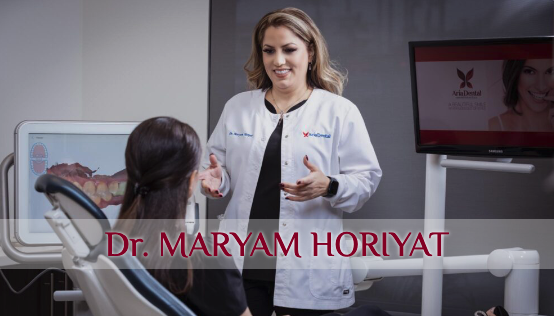
At Aria Dental Care, Orange County’s #1 Holistic, Biologic & Cosmetic Dental Office, the All-on-4 implant bridge is offered within our comprehensive, whole-body philosophy, using only the most biocompatible implant materials, guided by advanced three-dimensional imaging, and designed to produce results that are as healthy as they are beautiful. Dr. Maryam Horiyat, DDS, AIAOMT, CIABDM, brings advanced training in implant dentistry, oral surgery, and full-mouth reconstruction to every All-on-4 case, making Aria Dental Care the most trusted All-on-4 dentist in Orange County for patients who want excellence, safety, and lasting results.
This guide answers every question you need to ask: what an All-on-4 bridge is, who is a candidate for All-on-4 implants, how it compares to traditional dentures and bridges, how long it lasts, whether it prevents bone loss, and what makes Aria Dental Care’s approach uniquely comprehensive. By the end, you will have everything you need to decide whether this treatment is the right next step for you.
What Is an All-on-4 Dental Implant Bridge? A Comprehensive Definition
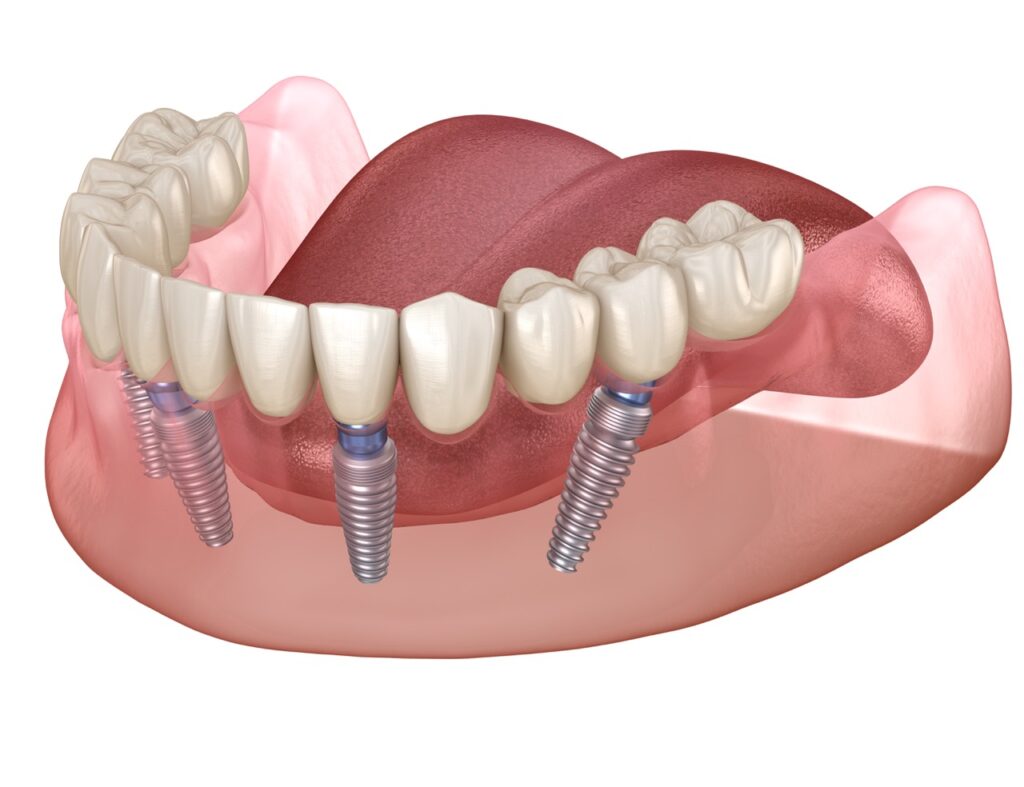
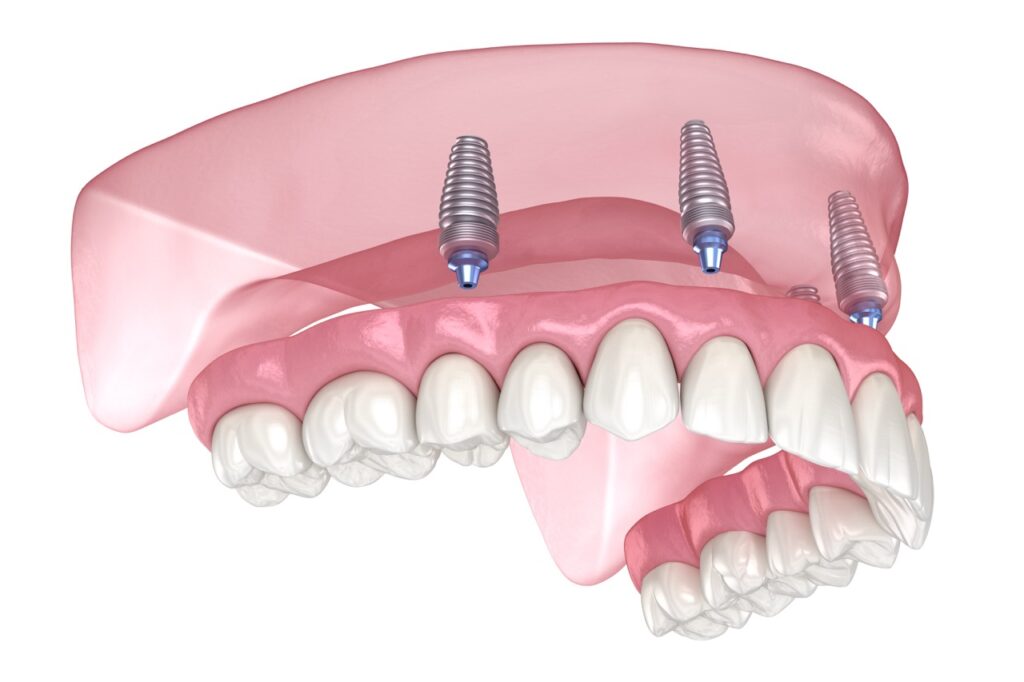
The All-on-4 dental implants concept, also referred to as an All-on-4 implant bridge, full arch dental bridge on implants, or “teeth in a day”, is a surgical and prosthetic protocol in which a complete arch prosthesis (a full set of upper or lower teeth) is permanently anchored to exactly four titanium or zirconia implants placed in the jawbone. The name reflects the foundational engineering principle: all of the teeth in a full arch, supported on four implants.
The four implants are placed with deliberate precision. Two are positioned vertically in the anterior (front) region of the jaw, where bone density is naturally greatest. The remaining two are placed toward the posterior (back) of the jaw at a controlled angle of up to 45 degrees. This angled placement is the engineering breakthrough at the heart of the All-on-4 concept, it allows the implants to engage a longer, stronger path through available bone and to avoid anatomical obstacles like the maxillary sinuses in the upper jaw and the inferior alveolar nerve canal in the lower jaw. As a result, most patients can receive All-on-4 dental implants without bone grafting, even when bone loss has already occurred.
The prosthesis itself, the All-on-4 implant bridge that attaches to these four implants, is a fixed, non-removable full arch dental bridge typically containing 10 to 14 prosthetic teeth. Unlike removable dentures, it does not come out. It is cared for like natural teeth: brushed, water-flossed, and professionally maintained at regular intervals. It functions with a level of stability, comfort, and chewing efficiency that no removable prosthesis can match.
The Prosthesis: Material Options for Your All-on-4 Bridge
The visible portion of your All-on-4 implant bridge, the prosthesis itself, can be fabricated from several materials, each with distinct clinical properties:
- Acrylic with titanium framework (temporary bridge): The immediate prosthesis placed on the day of surgery. Lightweight, comfortable, and functional while osseointegration proceeds, but intended as a temporary restoration rather than a final one.
- Full-archzirconia bridge(final restoration): The gold standard for the permanent All-on-4 implant bridge. High-strength zirconia ceramic is extraordinarily durable, biocompatible, metal-free, and lifelike in appearance. At Aria Dental Care, our commitment to metal-free, biocompatible dentistry makes monolithic zirconia our preferred final restoration material for every All-on-4 case.
- Porcelain-fused-to-metal (PFM): Less commonly used today, as zirconia offers superior strength, aesthetics, and biocompatibility without the metallic substructure that can cause gum discoloration over time.
Who Is a Candidate for All-on-4 Implants? The Full Candidacy Assessment
Understanding who is a candidate for All-on-4 implants is the most important question any patient considering this treatment can ask, and it deserves a thorough, honest answer. Not every patient qualifies immediately, but the range of eligible candidates is broader than many people realize, particularly because the angled implant design often eliminates the need for bone grafting.
At Aria Dental Care, candidacy is never determined from a brochure, it is determined through a comprehensive clinical evaluation that includes cone beam CT (CBCT) imaging, a full medical and dental history review, assessment of bone volume and density, and a detailed discussion of your health, lifestyle, and goals.
Strong Indicators That You May Be a Good Candidate
- You are missing most or all teeth in one or both arches, or have multiple teeth that are failing and not restorable
- Tou have been struggling with uncomfortable, loose, or unstable traditional dentures and want a permanently fixed solution
- You have adequate bone volume in the anterior jaw to support implant placement, confirmed through CBCT imaging
- You are in good general health, with no medical conditions that significantly impair healing or osseointegration
- You are a non-smoker, or you are genuinely motivated and committed to quitting before and throughout the healing period
- You want a solution that functions, feels, and looks like natural teeth, is permanently fixed, and prevents further bone loss
- You are committed to the professional maintenance care that keeps All-on-4 dental implants healthy long-term
Factors That May Require Additional Evaluation or Preparation
- Active, untreated gum disease (periodontitis): must be fully resolved before implant placement, as active bacterial infection dramatically increases failure risk
- Uncontrolled diabetes: well-managed diabetes is generally compatible with implant treatment, but uncontrolled blood glucose impairs healing and osseointegration and must be optimized before surgery
- Heavy smoking: one of the strongest risk factors for implant failure, constricts blood flow to healing tissue, impairs immune response, and reduces osseointegration rates significantly. We work with patients to support cessation as part of the pre-surgical care plan
- Severe posterior bone loss: while All-on-4 dental implants are specifically designed to minimize grafting needs, some patients with extreme bone loss may require preparatory bone grafting or sinus augmentation
- Bisphosphonate or anti-resorptive medications: prescribed for osteoporosis, these medications can impair bone healing around implants and require thorough review and physician consultation
- Unmanaged severe bruxism: excessive grinding and clenching places dangerous stress on implants during healing; a management protocol including night guard therapy and, where indicated, Botox, is integrated into the pre-surgical plan
The following quick-reference table summarizes candidacy indicators:
| Strong Candidate Indicators | May Need Additional Evaluation |
| Missing most or all teeth in an arch | Active, uncontrolled gum disease |
| Failing or non-restorable teeth | Uncontrolled diabetes |
| Sufficient anterior bone volume | Heavy smoker (elevated failure risk) |
| Good general health | Severe posterior bone loss needing grafting |
| Non-smoker or willing to quit | Bisphosphonate / anti-resorptive medications |
| Committed to professional maintenance | Unmanaged severe bruxism |
All-on-4 vs Dentures vs Traditional Bridge: Which Is Right for You?
Patients facing full-arch tooth loss encounter three primary replacement options: the All-on-4 implant bridge, traditional removable dentures, and a conventional fixed dental bridge. Each has a distinct profile of advantages, limitations, costs, and long-term consequences. Understanding the differences honestly is essential to making the right choice.
All-on-4 vs Dentures: Why the Gap Is Wider Than Most People Expect
The comparison between All-on-4 vs dentures is perhaps the most important one for patients who have already been living with removable prostheses. On the surface, dentures and an All-on-4 implant bridge both replace missing teeth, but the similarity largely ends there.
Traditional dentures rest on the gum tissue and rely on suction, adhesives, or clasps for retention. They move. They rock. They slip during eating and speaking. They reduce chewing efficiency to just 20 to 25 percent of natural teeth. And critically, they do not stimulate the underlying jawbone, which means that bone resorption continues unabated beneath every denture, progressively changing the shape of the jaw, altering the fit of the appliance, and producing the characteristic ‘sunken’ facial appearance of long-term denture wearers.
An All-on-4 dental implant bridge is fixed, non-removable, and rooted in the bone. It restores chewing efficiency to up to 80 percent of natural teeth. It requires no adhesives, no nightly removal, and no soaking. And because the implants transmit chewing forces directly into the jawbone, they stimulate it to maintain its density and volume, preventing the bone loss that dentures accelerate. The comparison between All-on-4 vs dentures is not simply about convenience; it is about long-term jaw health, facial structure, quality of life, and nutrition.
| Feature | All-on-4 Implant Bridge | Traditional Dentures |
| Implants Required | 4 per arch | 0 |
| Fixed or Removable | Fixed , non-removable | Removable |
| Bone Grafting Needed? | Rarely required | Not applicable |
| Prevents Bone Loss? | Yes , stimulates bone | No , bone continues to resorb |
| Chewing Efficiency | Up to 80% of natural teeth | 20–25% of natural teeth |
| Natural Appearance | Highly lifelike | Can look artificial |
| Maintenance | Brush & water-floss daily | Remove, soak & clean daily |
| How Long It Lasts | Implants: lifetime; Bridge: 15–20+ yrs | 5–8 yrs before refitting |
| Approx. Cost | $20,000–$30,000 per arch | $1,000–$3,500 |
All-on-4 vs Traditional Bridge: Understanding the Structural Difference
A traditional fixed dental bridge replaces missing teeth by anchoring a prosthetic tooth (or teeth) between two crowns placed on neighboring natural teeth or implants. For patients missing one to three consecutive teeth in an intact arch, a traditional bridge is often an excellent solution. But for patients missing an entire arch, or most of one, a conventional bridge is not a viable option. The number of anchor points required, the span involved, and the forces generated make a conventional fixed bridge impractical and biomechanically unsound for full-arch replacement.
The All-on-4 implant bridge solves this problem elegantly: by distributing the load across four strategically placed implants, two vertical anteriors and two angled posteriors, it creates a structurally sound, full-arch fixed dental bridge that does not require grinding down healthy neighboring teeth and does not place undue stress on any single anchor point. For full-arch cases, the All-on-4 vs traditional bridge comparison consistently favors the implant-supported option in terms of function, longevity, bone preservation, and patient satisfaction.
All-on-4 vs All-on-6: Which Full Arch Solution Is Better for You?
Patients who have researched full arch dental bridge options frequently encounter both All-on-4 and All-on-6 treatment concepts and want to understand the meaningful differences. Both use the same fundamental principle, a full arch prosthesis supported by a fixed number of implants, but the clinical indications, bone requirements, cost, and load distribution differ in ways that are genuinely important.
| Feature | All-on-4 | All-on-6 |
| Number of Implants | 4 per arch | 6 per arch |
| Bone Requirement | Lower , angled implants maximize available bone | Higher , requires greater bone volume |
| Bone Grafting | Rarely needed | More commonly required |
| Load Distribution | 4-point , excellent for most patients | 6-point , ideal for heavy bite force |
| Cost | Lower | Higher |
| Best For | Most full-arch candidates, bone-deficient jaws | Bruxers, patients with strong bite, ample bone |
The single most important factor in choosing between All-on-4 vs All-on-6 is your individual bone anatomy, determined definitively by CBCT imaging. For the majority of patients, All-on-4 dental implants provide outstanding outcomes without the additional cost and surgical complexity of two more implants. For patients with high bite forces, confirmed bruxism, or bone volume that can comfortably support six implants, All-on-6 may offer additional long-term stability.
At Aria Dental Care, Dr. Horiyat evaluates every patient’s bone anatomy, bite force, and clinical profile individually before recommending four, six, or any other implant configuration. The goal is always the most conservative approach that delivers the most predictable, durable outcome, never more treatment than is genuinely indicated.
Does All-on-4 Prevent Bone Loss? The Critical Long-Term Health Benefit
This is one of the most medically significant questions a patient considering All-on-4 dental implants can ask, and the answer is one of the most compelling reasons to choose an implant-supported solution over a removable one.When natural teeth are lost, the alveolar bone that surrounded their roots no longer receives mechanical stimulation. Without this stimulation, the body resorbs the bone, a progressive, irreversible shrinkage that changes the shape of the jaw, distorts facial appearance, reduces the volume of bone available for future implants, and makes traditional dentures increasingly difficult to fit comfortably over time. This is why long-term denture wearers develop the characteristic ‘collapsed’ facial profile that adds years to their apparent age.Does All-on-4 prevent bone loss? Yes, and this is one of its most important clinical advantages. Dental implants function as artificial tooth roots: they transmit the mechanical forces of chewing directly into the surrounding bone, stimulating it to maintain its density and volume through a biological process called mechanotransduction. The National Institute of Dental and Craniofacial Research (NIDCR) confirms that osseointegrated implants are the most effective prosthetic tool currently available for preserving alveolar bone following tooth loss.In practical terms, All-on-4 dental implants do not merely restore your smile, they preserve the skeletal structure of your face. Patients who choose an All-on-4 implant bridge instead of dentures are investing not just in aesthetics and function, but in the long-term structural integrity of their jaw and the youthful contours of their face. This is a health benefit that extends decades beyond the initial treatment.
How Long Does All-on-4 Last? Setting Realistic Long-Term Expectations
How long does All-on-4 last is one of the first questions every patient asks, and it deserves a detailed, honest answer rather than a simple marketing claim.
The All-on-4 implant bridge consists of two separate components with different lifespans: the implants themselves, and the prosthetic bridge attached to them.
Implant Longevity: Built to Last a Lifetime
The titanium or zirconia implant posts that integrate with your jawbone are designed to last a lifetime. Long-term clinical studies consistently report implant survival rates above 94 to 97 percent over 10 years for All-on-4 dental implants placed in appropriate candidates by experienced clinicians. The primary threats to implant longevity are biological, peri-implantitis (infection around the implant), which is preventable with proper home care and professional maintenance; and mechanical, unmanaged bruxism or trauma that places excessive force on the implant-bone interface.
At Aria Dental Care, our pre-surgical health optimization protocol, our use of premium biocompatible titanium and zirconia implants, and our rigorous ongoing maintenance program are all specifically designed to maximize the long-term success of your implants.
Bridge Longevity: The Prosthesis Over Time
The prosthetic All-on-4 implant bridge, the visible teeth attached to the implants, has a different clinical lifespan from the implants themselves. A high-quality monolithic zirconia full arch dental bridge typically lasts 15 to 20 years or more with proper care. Acrylic hybrid bridges, which are sometimes used as definitive restorations in lower-cost treatment plans, typically last 5 to 10 years before requiring replacement or significant repair.
At Aria Dental Care, we use only premium-grade zirconia for our final All-on-4 restorations, because we believe that the highest-quality materials produce the most durable, most biocompatible, and most aesthetically enduring outcomes. A bridge that lasts 20 years represents a fundamentally different value proposition from one that needs replacement in five.
What Determines How Long Your All-on-4 Bridge Lasts
- Consistent daily oral hygiene: brushing twice daily, water-flossing beneath the bridge, and using interdental brushes around abutments
- Professional maintenance every three to six months at Aria Dental Care, using instruments safe for implant and zirconia surfaces
- Wearing a night guard if bruxism is present, to protect the bridge and implant connections from excessive force during sleep
- Avoiding very hard foods (ice, hard candy, whole nuts) that can fracture any ceramic prosthesis
- Attending annual implant health and bridge integrity assessments with Dr. Horiyat
- Managing systemic health factors, particularly blood sugar control and tobacco avoidance, that affect peri-implant tissue health
The Aria Dental Care Holistic Approach to All-on-4 Implants in Orange County
Aria Dental Care is not simply another All-on-4 dentist in Orange County. We are Orange County’s only full-service implant practice that fully integrates biological and holistic dentistry principles into every aspect of All-on-4 care, from the materials we choose to the pre-surgical preparation we provide to the long-term maintenance program we offer every patient.
Biocompatible, Metal-Free Implant and Bridge Materials
Every All-on-4 implant bridge placed at Aria Dental Care uses the highest-quality biocompatible materials available. We offer both commercially pure titanium implants, with more than five decades of osseointegration research behind them, and ceramic zirconia implants for patients who prefer a completely metal-free solution or who have documented metal sensitivities. Our final bridge restorations are fabricated exclusively from monolithic zirconia: strong, stain-resistant, metal-free, and selected from dental laboratories that meet our rigorous biocompatibility standards.
This commitment to metal-free, biocompatible dentistry reflects our core belief that every material placed in the body should support health, not compromise it. It is a standard we hold ourselves to at every appointment, for every patient.
Advanced Technology for Precision and Safety
Our CBCT three-dimensional imaging, digital implant planning software, intraoral scanning, and computer-guided surgical stent technology allow Dr. Horiyat to plan and place every All-on-4 dental implant with millimeter precision, minimizing surgical time, reducing tissue trauma, and maximizing the predictability of osseointegration. Digital smile design technology allows patients to preview their anticipated prosthetic result before committing to treatment, so there are no surprises at the final delivery appointment.
Pre-Surgical Whole-Body Health Optimization
Before any All-on-4 surgery at Aria Dental Care, we conduct a comprehensive health optimization review as standard protocol. This includes assessment of key nutritional markers (vitamin D, zinc, calcium, and magnesium are particularly important for osseointegration), evaluation of inflammatory burden and systemic conditions affecting healing, a complete medication review, and a detailed discussion of sleep quality and stress management. This approach reflects our understanding that implant success is not determined only in the surgical suite, it is determined by the biological environment of the whole body in which those implants are asked to heal.
Sedation Dentistry for Complete Comfort
For patients with dental anxiety or simply those who prefer to be deeply relaxed during a surgical procedure, we offers multiple sedation options including oral conscious sedation and IV sedation. Our goal is that every All-on-4 patient, regardless of their anxiety level or medical history, can receive this life-changing treatment in complete comfort and safety.
Life with an All-on-4 Implant Bridge: What to Expect Day to Day
Immediately After Surgery: The First Two Weeks
The immediate post-surgical period requires rest, dietary restriction (liquids and soft foods only), and diligent care of the surgical site. Swelling, mild bruising, and manageable discomfort are normal and typically peak at 48 to 72 hours before gradually resolving. At Aria Dental Care, every patient receives a comprehensive post-operative care kit, detailed written instructions, and direct access to Dr. Horiyat for any concerns during the early healing period.
- Take prescribed medications exactly as directed and do not skip doses
- Apply ice packs to the cheeks in 20-minute cycles for the first 24 hours to reduce swelling
- Eat only liquids and very soft foods (smoothies, yogurt, soup, mashed vegetables) for the first two weeks
- Avoid tobacco, alcohol, and strenuous physical activity for at least the first week post-surgery
- Sleep with your head slightly elevated to minimize overnight swelling
- Rinse gently with prescribed antimicrobial mouthwash, do not spit forcefully
The Healing Phase: Months 1 Through 6
As osseointegration, the biological fusion of implant and bone, progresses over three to six months, dietary restrictions ease and oral function progressively improves. By weeks three to four, most patients are comfortable with a broader range of soft foods. By months two to three, the majority have largely returned to normal daily function. Follow-up appointments at Aria Dental Care at one week, one month, three months, and six months allow Dr. Horiyat to monitor healing, adjust the temporary bridge if needed, and confirm that osseointegration is proceeding as planned.
Long-Term Daily Maintenance
Once your final zirconia All-on-4 implant bridge is in place, daily maintenance is far simpler than caring for traditional dentures, and very similar to caring for natural teeth:
- Daily brushing: Soft-bristled or electric toothbrush, twice daily, cleaning all surfaces of the bridge and the gumline thoroughly.
- Water flossing: A water flosser is the most effective tool for cleaning beneath the bridge around the implant abutments, spaces conventional floss cannot reliably reach.
- Interdental brushes: Used to clean the spaces between the bridge and gum tissue where debris can accumulate.
- Professional cleaning every 3 to 6 months: At Aria Dental Care, All-on-4 patients receive professional peri-implant cleaning using specialized instruments that protect implant and zirconia surfaces.
- Annual implant and bridge assessment: Dr. Horiyat evaluates the structural integrity of the bridge, the stability of each implant, and the health of surrounding peri-implant tissues at every annual examination.
Take the First Step: Schedule Your All-on-4 Consultation at Aria Dental Care
If you are living with missing teeth, struggling with uncomfortable dentures, or facing the loss of multiple failing teeth, the All-on-4 implant bridge may be the most transformative dental investment of your life, one that restores not just your smile, but your confidence, your nutrition, your social ease, and the long-term structural health of your jaw and face.
As the most trusted All-on-4 dentist in Orange County with a genuine commitment to holistic, whole-body implant care, Aria Dental Care offers every patient the expertise, the technology, the biocompatible materials, and the personal attention their case deserves. We do not rush consultations, we do not recommend treatment that is not genuinely indicated, and we do not settle for outcomes that are anything less than exceptional.
The first step is a comprehensive consultation in which Dr. Horiyat evaluates your candidacy with CBCT imaging, discusses your goals with complete transparency, and presents a fully individualized treatment plan. No pressure. No guesswork. Just honest, expert guidance from one of Orange County’s most trusted implant specialists.
Visit us at ariadentalcare.com to request your All-on-4 consultation in Orange County today. Your new smile, and a new chapter of your life, is waiting.