






Almost everyone snores now and then. A stuffy nose, a glass of wine before bed, or simply sleeping on your back can turn a quiet night into a symphony of rattles and rumbles. So the question sits in the back of many minds, usually planted there by a frustrated partner: is snoring sleep apnea, or is it just an annoying habit that means nothing at all?
The honest answer is that snoring can be either. For a great many people, it is a harmless nuisance. For a significant number of others, it is the loudest and most obvious warning sign of a serious, often undiagnosed sleep disorder. Learning how to tell the difference is not about winning an argument over who kept whom awake. It is about protecting your heart, your brain, your energy, and your long-term health.
At Aria Dental Care, Orange County’s holistic, biological, and cosmetic dental practice, airway and sleep health sit at the center of how whole-body wellness is understood. This guide walks through what snoring actually is, what sleep apnea actually is, the specific clues that separate the two, and the steps to take if the noise coming from your bedroom might be more than background static.
Is Snoring Sleep Apnea? The Short Answer
Here is the concise version for anyone who wants clarity before the deeper explanation. Snoring is a symptom, not a diagnosis. Sleep apnea is a medical condition. Loud, chronic snoring is one of the most common symptoms of obstructive sleep apnea, but snoring on its own does not confirm that you have the disorder.
Think of it this way. All apples are fruit, but not all fruit are apples. In the same spirit, most people with obstructive sleep apnea snore, yet plenty of people who snore do not have sleep apnea at all. The noise is the same. What separates ordinary snoring from a sleep breathing disorder is what happens to your airflow and your oxygen levels while you sleep.
So when someone asks is snoring sleep apnea, the most useful response is another question: does the snoring come with pauses in breathing, gasping, choking, or crushing daytime exhaustion? Those companions are what move the conversation from harmless habit toward a condition that deserves professional attention. The rest of this article explains exactly how to read those signals.
What Is Snoring, Really? Understanding the Basics
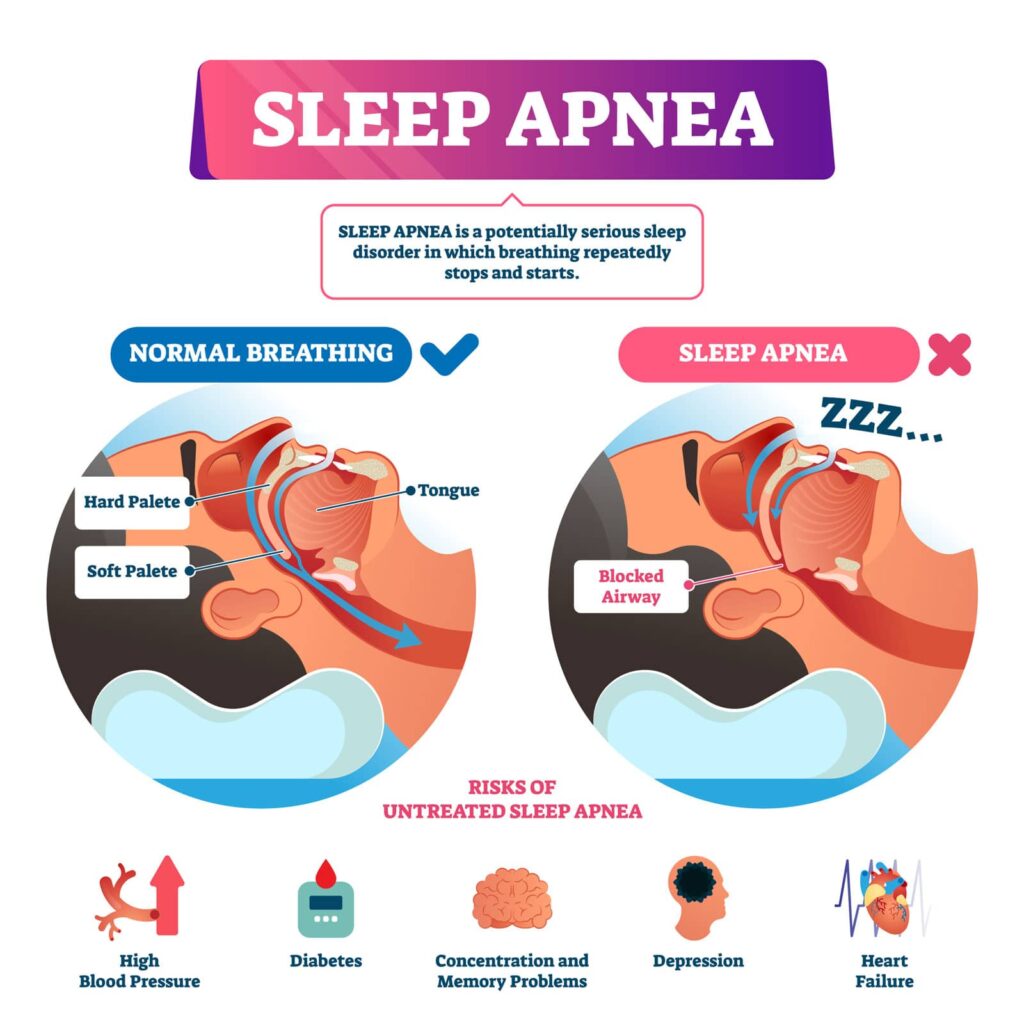
Snoring is the sound of turbulent airflow. When you are awake, the muscles that keep your throat open hold everything in place, and air moves smoothly. During sleep, those same muscles relax. In many people they relax enough that the airway narrows, and the soft tissues at the back of the throat, including the soft palate, uvula, tongue base, and tonsils, begin to vibrate as air pushes past them. That vibration is the rattle, buzz, or roar you hear.
The volume and the pitch depend on how narrow the passage becomes and how forcefully the air is traveling. A slight narrowing produces a soft flutter. A significant narrowing produces the kind of window-shaking noise that sends partners to the guest room.
Common Causes of Snoring
Snoring has many triggers, and understanding yours is the first step toward relief. Frequent contributors include:
- Nasal congestion or blockage from allergies, a cold, a deviated septum, or chronic sinus issues, which forces mouth breathing and turbulent airflow.
- Sleep position, especially sleeping flat on the back, which allows the tongue and soft palate to fall backward and crowd the airway.
- Alcohol and sedatives, which over-relax the throat muscles beyond their normal nighttime slackness.
- Excess weight, particularly extra tissue around the neck that presses on the airway.
- Nasal and oral anatomy, including a long soft palate, enlarged tonsils or adenoids, a large tongue, or a narrow dental arch.
- Aging, which naturally reduces muscle tone in the throat over time.
- Chronic mouth breathing, which dries tissues and encourages vibration.
Many of these factors overlap. Someone might snore only after a late dinner and a drink, while another person snores every single night because of their jaw and airway structure. That structural piece is where a holistic, airway-focused dental perspective becomes especially valuable.
When Snoring Is Harmless (Primary Snoring)
The medical term for snoring without any breathing interruptions is primary snoring, sometimes called simple snoring or benign snoring. In primary snoring, the airway narrows enough to create noise, but not enough to block airflow or lower blood oxygen. Breathing stays steady and sleep stays largely intact.
Primary snoring is common, it tends to be socially disruptive rather than medically dangerous, and it usually responds well to lifestyle adjustments, positional changes, and simple interventions. The catch is that no one can look at a sleeping person and know for certain whether the snoring is primary or a sign of something more. The sound alone does not reveal what is happening to oxygen levels. That uncertainty is precisely why the difference between snoring and sleep apnea deserves a careful look.
What Is Sleep Apnea? A Closer Look
Sleep apnea is a disorder in which breathing repeatedly stops and starts during sleep. According to the National Heart, Lung, and Blood Institute, these interruptions can happen dozens or even hundreds of times a night, and each pause deprives the body and brain of oxygen. You can learn more directly from the National Heart, Lung, and Blood Institute’s overview of sleep apnea.
An apnea is a complete or near-complete stop in airflow that lasts at least ten seconds. A hypopnea is a partial reduction in airflow that also lowers oxygen. Sleep specialists count these events across a night and calculate the apnea-hypopnea index, or AHI, which measures how many happen per hour. That number guides whether the condition is mild, moderate, or severe. This is one reason the question is snoring sleep apnea cannot be answered by ear alone. The defining feature of the disorder is measured, not merely heard.
There are three main types of sleep apnea, and they differ by cause.
Obstructive Sleep Apnea (OSA)
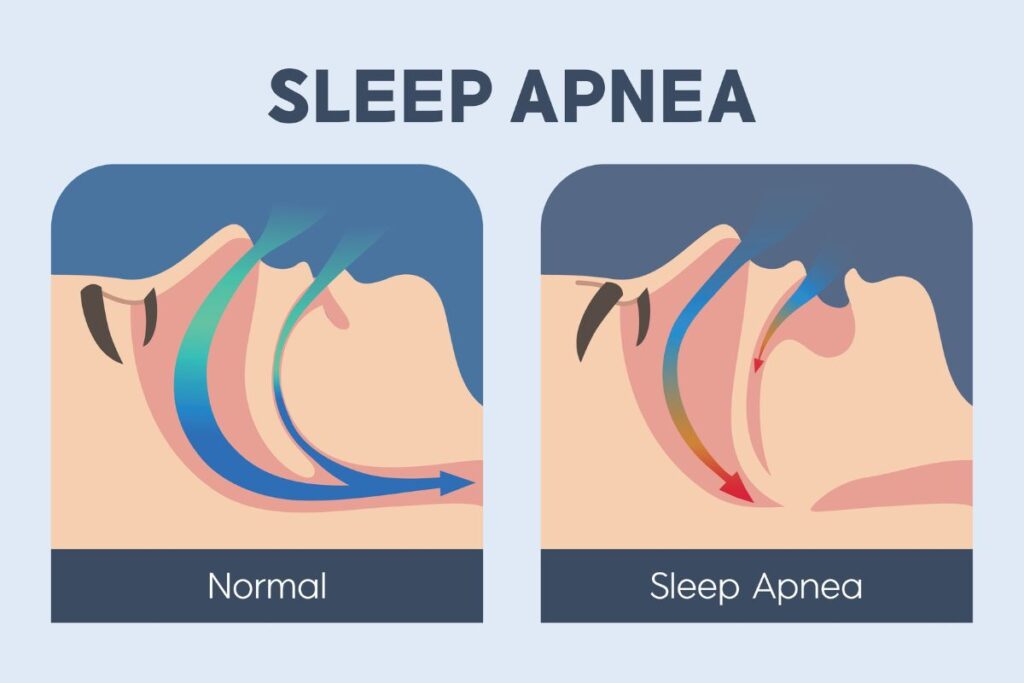
Obstructive sleep apnea is by far the most common form, and it is the type most closely linked with snoring. In OSA, the throat muscles relax and the airway physically collapses or becomes blocked during sleep. The person keeps trying to breathe, the chest and diaphragm keep working, but air cannot get through. Pressure builds until the brain briefly rouses the body just enough to reopen the airway, often with a loud gasp, snort, or choking sound. Then sleep resumes and the cycle repeats.
Because OSA is a mechanical airway problem, it connects directly to anatomy that dentists are trained to observe: the tongue, the jaw, the palate, the dental arches, and the overall shape of the oral cavity. When people ask whether their snoring could be sleep apnea, obstructive sleep apnea is almost always the version they are worried about.
Central Sleep Apnea
Central sleep apnea is less common and works differently. Instead of a blocked airway, the problem lies in signaling. The brain temporarily fails to send the proper messages to the muscles that control breathing, so the body simply does not attempt a breath. There is no obstruction and often no loud snoring. Central sleep apnea is frequently tied to other medical conditions affecting the heart or nervous system, and it requires medical management by a physician.
Complex Sleep Apnea Syndrome
Some people show a combination of both patterns, which specialists call complex or mixed sleep apnea. It begins as obstructive apnea, but central-type events persist even after the airway obstruction is treated. This category underscores why professional evaluation matters. Sleep breathing disorders are not one-size-fits-all, and self-diagnosis based on snoring alone can miss the full picture.
Snoring vs Sleep Apnea: How to Tell the Difference
This is the heart of the matter. If snoring is the sound and sleep apnea is the condition, what are the practical clues that tell them apart? While only a sleep study can deliver a definitive answer, several signs strongly suggest that snoring may be crossing into sleep apnea territory.
Warning Signs Your Snoring Could Be Sleep Apnea
Pay close attention if snoring is accompanied by any of the following. A bed partner often notices the nighttime signs long before the snorer does. A quick self-assessment like the Epworth Sleep Apnea Self Test can help gauge daytime sleepiness before a professional visit.
- Witnessed pauses in breathing, where the snoring stops, silence falls, and then breathing resumes with a gasp or snort.
- Gasping, choking, or snorting that jolts you or your partner awake.
- Loud, chronic snoring that happens nearly every night rather than occasionally.
- Excessive daytime sleepiness, including dozing off at work, while reading, or, most dangerously, while driving.
- Morning headaches caused by overnight oxygen dips and carbon dioxide buildup.
- Waking unrefreshed even after a full night in bed.
- Difficulty concentrating, memory lapses, or brain fog during the day.
- Mood changes, including irritability, anxiety, or low mood.
- Waking frequently to urinate during the night.
- Dry mouth or a sore throat upon waking, often from mouth breathing.
- Nighttime teeth grinding, which frequently accompanies airway disturbances and may call for a custom night guard.
- High blood pressure that is hard to control.
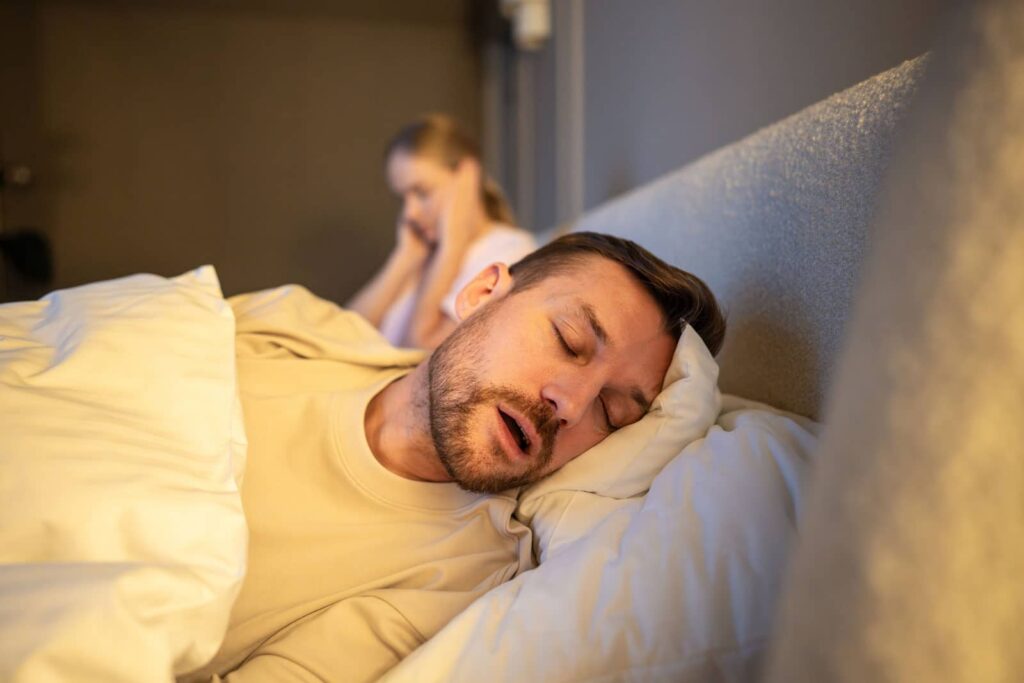
A person with primary snoring generally wakes feeling reasonably rested and moves through the day with normal energy. A person with obstructive sleep apnea often feels exhausted no matter how many hours they spend in bed, because the sleep is fragmented hundreds of times by micro-awakenings they never remember.
Key Differences at a Glance
To make the comparison concrete, here is how ordinary snoring typically differs from snoring linked to sleep apnea:
- Breathing: Primary snoring keeps airflow steady. Sleep apnea involves repeated stops and starts.
- Oxygen levels: Primary snoring does not meaningfully lower oxygen. Sleep apnea causes measurable drops.
- The sound pattern: Primary snoring is continuous. Apnea snoring is often interrupted by silent pauses followed by gasps.
- Daytime energy: Primary snorers usually feel rested. People with apnea feel persistently fatigued.
- Health impact: Primary snoring is mostly a social issue. Untreated sleep apnea raises the risk of serious health problems.
- Who else notices: Primary snoring annoys a partner. Apnea alarms a partner who witnesses the person stop breathing.
If your snoring looks more like the second half of each pair, the answer to is snoring sleep apnea may well be yes, and a professional evaluation is the responsible next move.
Why the Difference Matters for Your Health
It would be easy to shrug off snoring as a cosmetic problem for the ears. Getting the distinction right matters because untreated obstructive sleep apnea is not a minor inconvenience. Every apnea event stresses the cardiovascular system, floods the body with stress hormones, and starves tissues of oxygen. Repeat that a few hundred times a night, year after year, and the consequences accumulate.
Health Risks of Untreated Sleep Apnea
Research links untreated obstructive sleep apnea to a range of serious conditions, including:
- High blood pressure, since repeated oxygen drops trigger blood pressure spikes.
- Heart disease, heart attack, irregular heartbeat, and stroke.
- Type 2 diabetes, through effects on how the body handles blood sugar.
- Chronic daytime fatigue that erodes quality of life and work performance.
- Motor vehicle and workplace accidents caused by drowsiness.
- Depression, anxiety, and cognitive decline over time.
- Complications during surgery and anesthesia.
- Worsened acid reflux and weight-management struggles.
The Centers for Disease Control and Prevention notes that insufficient and poor-quality sleep is tied to many of the nation’s most common chronic diseases. You can review the public health picture through the CDC’s sleep and sleep disorders resources. This is why treating sleep apnea is about far more than quieting a bedroom. It is a genuine investment in longevity and daily well-being, which aligns closely with the whole-body philosophy that guides holistic and biological dentistry.
How Sleep Apnea Is Diagnosed
An important point deserves emphasis. Neither a dentist nor a partner nor an online article can diagnose sleep apnea. A diagnosis requires objective testing interpreted by a qualified physician, typically a board-certified sleep specialist. A dental practice plays a valuable role in screening, awareness, and treatment for appropriate cases, but the diagnosis itself comes from medical testing.
The Role of a Sleep Study
The gold standard for diagnosing sleep apnea is polysomnography, commonly called a sleep study. Traditionally performed overnight in a sleep lab, it records brain waves, breathing patterns, oxygen levels, heart rate, muscle activity, and eye movements. From this data, a sleep physician calculates the apnea-hypopnea index and determines whether sleep apnea is present, and if so, how severe it is.
Home Sleep Apnea Tests
For many patients with suspected uncomplicated obstructive sleep apnea, physicians may order a home sleep apnea test. These portable devices track breathing, airflow, and oxygen from the comfort of your own bed. They are more convenient and less costly than a lab study, though a physician still interprets the results and may recommend an in-lab study if the picture is unclear. Either way, the pathway to a real answer runs through medical testing rather than guesswork.
The Dental Connection: How a Holistic Dentist Fits In
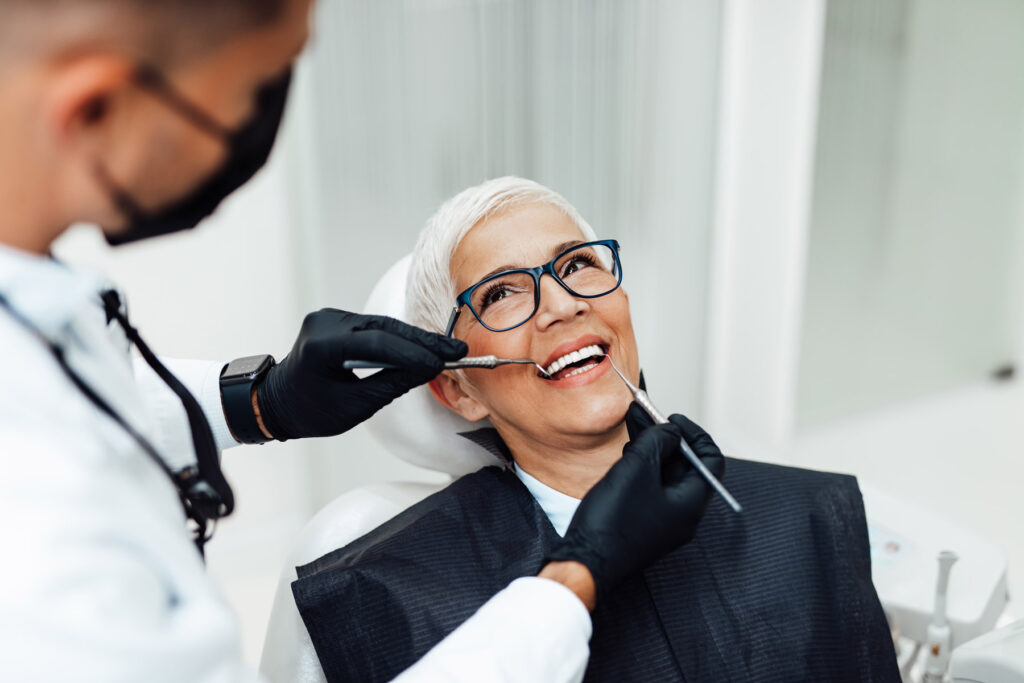
Patients are sometimes surprised to learn how much a dentist can contribute to airway and sleep health. The mouth is the gateway to the airway, and the structures a dentist examines every day, including the tongue, the jaw position, the palate, the tonsils, and the dental arches, all influence how easily air flows during sleep. An airway-focused dental practice looks at these structures not only for cavities and cosmetics but for their role in breathing. The link between sleep apnea and oral health runs deeper than most people realize.
Signs Your Dentist May Spot First
Because dental teams see inside the mouth so regularly, they often notice early airway warning signs before anyone else, sometimes even before symptoms feel serious to the patient. Clues a knowledgeable dentist may observe include:
- Worn or flattened teeth from nighttime grinding, which frequently travels alongside airway disturbances and TMJ discomfort.
- A scalloped tongue with indentations along the edges, suggesting a tongue crowded against the teeth.
- A large tongue or a narrow, high-arched palate that reduces oral space.
- Redness or irritation of the throat tissues consistent with snoring and mouth breathing.
- Dry mouth and related decay patterns that point to chronic open-mouth sleep.
- Crowded dental arches or a recessed lower jaw that can crowd the airway, which orthodontic care may help address.
Spotting these signs allows the dental team to raise the conversation, encourage a proper medical evaluation, and, when a physician confirms a diagnosis, collaborate on treatment.
Oral Appliance Therapy for Snoring and Mild to Moderate Sleep Apnea
One of the most valuable tools a dentist can provide is oral appliance therapy. A custom-fitted oral appliance looks somewhat like a sports mouthguard or an orthodontic retainer, and it works by gently repositioning the lower jaw and tongue forward to help keep the airway open during sleep. For many people this reduces or eliminates snoring, and for appropriate cases of mild to moderate obstructive sleep apnea it can be an effective treatment.
The American Academy of Dental Sleep Medicine recognizes oral appliance therapy as a front-line option for snoring and for mild to moderate obstructive sleep apnea, as well as an alternative for people with more severe apnea who cannot tolerate other therapies. Guidance on this approach is available through the American Academy of Dental Sleep Medicine. Oral appliances are comfortable, quiet, portable, and easy to maintain, which makes them a welcome option for patients who struggle with bulkier equipment. Importantly, dentists provide oral appliance therapy for diagnosed sleep apnea in coordination with the patient’s physician, keeping medical and dental care working together.
Treatment Options for Snoring and Sleep Apnea
Effective treatment depends on the cause and severity, which is why an accurate answer to whether snoring is sleep apnea matters so much. Options generally fall into several categories, often used in combination.
Lifestyle and Positional Changes
For both primary snoring and mild sleep apnea, foundational changes can make a real difference:
- Reaching and maintaining a healthy weight to reduce airway pressure.
- Sleeping on the side rather than the back.
- Avoiding alcohol and sedatives close to bedtime.
- Treating nasal congestion and allergies to improve airflow.
- Establishing consistent, sufficient sleep habits.
- Quitting smoking, which reduces airway inflammation.
Continuous Positive Airway Pressure (CPAP)
CPAP therapy is the standard treatment for moderate to severe obstructive sleep apnea. A machine delivers a steady stream of pressurized air through a mask, splinting the airway open all night. CPAP is highly effective when used consistently, though some patients find the mask and hose difficult to tolerate, which is where oral appliances become an appealing alternative or complement.
Oral Appliance Therapy
As described above, custom dental appliances offer a comfortable, non-invasive path for snoring and mild to moderate obstructive sleep apnea, and for CPAP-intolerant patients with more severe disease. This is the treatment area where an airway-focused dental practice contributes most directly.
Surgical and Advanced Options
When structural issues drive the problem, physicians may consider procedures to address the nose, throat, tonsils, or jaw. These are typically reserved for specific cases and evaluated carefully against less invasive options first.
A Whole-Body, Airway-Focused Approach at Aria Dental Care
Airway health is not a side note in holistic and biological dentistry. It is central to it. The belief that human health is deeply interconnected shapes how every part of the mouth is understood, including its role in how well you breathe and sleep. Poor sleep touches nearly every system in the body, so caring for the airway is a natural extension of caring for the whole person.
Led by Dr. Maryam Horiyat, DDS, AIAOMT, CIABDM, an accredited member of leading holistic, biological, and integrative dental associations, Aria Dental Care brings meticulous attention to detail, advanced technology, and biocompatible, patient-centered care to airway and sleep concerns. The practice screens for airway warning signs during routine visits, educates patients on the difference between simple snoring and sleep apnea, and, in coordination with sleep physicians, provides custom oral appliance therapy for appropriate cases.
If loud snoring, restless nights, or daytime exhaustion sound familiar, the worst thing to do is nothing. Whether the answer to is snoring sleep apnea turns out to be a simple habit or a treatable disorder, finding out is one of the kindest things you can do for your health and for everyone who shares your home. Aria Dental Care in Mission Viejo serves patients across Orange County who want a thoughtful, whole-body approach to their smile and their sleep.