




If your child’s orthodontist, or your own dentist, has mentioned a palatal expander, your first reaction was probably a mix of curiosity and concern. What exactly is this device? Why does my child need it before braces? Will it hurt? How long does it stay in? These are exactly the right questions to ask, and this comprehensive guide answers every one of them.
An expander for braces is one of the most powerful tools in orthodontic treatment, but it is also one of the least understood. Most patients have heard of braces and even Invisalign, but the expander occupies a less visible space in public dental awareness, despite the fact that it frequently makes the difference between a treatment plan that works beautifully and one that struggles against an underdeveloped arch. More importantly, from the perspective of a holistic biological dental practice like Aria Dental Care, the expander is far more than an orthodontic convenience, it is a tool that can profoundly influence a patient’s airway, facial development, breathing, and long-term health.
This guide covers everything: what a palatal expander does, the different types of palate expanders, the signs you need a palate expander, how the palate expander before and after transformation works, what the palatal expander age range is for optimal results, and how Aria Dental Care approaches orthodontic expansion with a whole-body philosophy.
The short answer: A dental expander for braces, also called a palatal expander or orthodontic expander, is a device used to widen the upper jaw (palate) or lower arch to create room for properly aligned teeth. It works by gradually separating the two halves of the palate, allowing new bone to form in the gap. Signs you may need one include crowding, crossbite, impacted teeth, mouth breathing, and a narrow upper arch. At Aria Dental Care, Dr. Maryam Horiyat takes a holistic, biocompatible approach to orthodontic expansion, treating the jaw, the airway, and the whole-body health of every patient.
What Is an Expander for Braces? The Fundamentals
An expander for braces is an orthodontic appliance designed to widen the dental arch, most commonly the upper arch, before or during orthodontic treatment with braces or clear aligners. The upper jaw (maxilla) is not a single fused bone in growing patients; it is composed of two halves joined at the midline by a suture called the mid-palatal suture. A palatal expander applies gentle, controlled outward pressure to the two halves of the palate, gradually widening the arch by stimulating new bone growth in the suture.
This process is called palatal expansion or maxillary expansion, and it is one of the most well-documented interventions in orthodontics. Unlike braces, which move individual teeth within the existing arch, a palatal expander actually changes the size and shape of the arch itself, creating room for teeth that would otherwise be crowded, impacted, or misaligned, and correcting jaw width discrepancies that affect the bite.
The Biology Behind Palatal Expansion
Understanding why the expander works requires a brief look at the biology of the mid-palatal suture. In children and adolescents, this suture is open, meaning the two halves of the palate are not yet fused and can be separated by sustained gentle force. As the expander pushes the two halves apart, the body responds by depositing new bone in the widening gap, a process analogous to the bone remodeling that underlies all orthodontic tooth movement.
This new bone formation is the reason the expansion is stable: you are not just stretching soft tissue, you are creating genuinely new skeletal structure. Once the suture closes (typically in the late teens to early twenties, though timing varies significantly), the expansion process becomes progressively more difficult and, in adults, may require surgical assistance, which is one of the most important reasons why addressing a narrow arch during childhood or adolescence is so clinically valuable.
Types of Palate Expanders: Which One Is Right for You?
Not all expanders are the same device. There are several distinct types of palate expanders, each suited to different clinical situations, patient ages, and treatment philosophies. Understanding the options helps you have a more informed conversation with Dr. Horiyat during your consultation.
1. Rapid Palatal Expander (RPE)
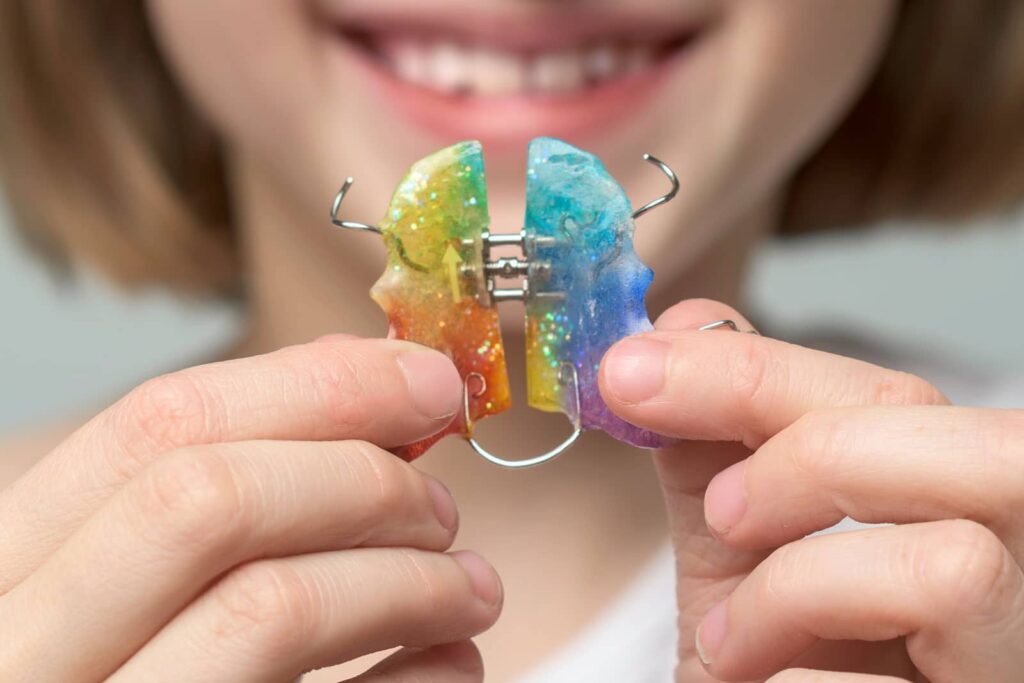
The rapid palatal expander is the most widely used type of fixed palatal expander and is the device most people picture when they think of a palate expander. It consists of two bands fitted around the upper molar teeth, connected by a metal framework that spans the roof of the mouth. At the center is a small metal key mechanism, the activation screw. Parents or patients use the key to turn the screw a small amount (typically one quarter turn) once or twice daily, gradually applying outward pressure to the palate.
The word “rapid” in rapid palatal expander refers to the relatively fast pace of expansion, typically 0.5–1 mm per week, compared to slower orthodontic tooth movement. Despite this clinical usage of “rapid,” patients and parents should understand that the full expansion period still takes 3–6 months to complete, followed by a retention period of several additional months while new bone consolidates.
Best suited for:
- Children and early adolescents (typically ages 7–14)
- Moderate to significant arch narrowing requiring correction
- Crossbite correction
- Creating space for crowded or impacted teeth
2. Removable Palatal Expander
A removable palatal expander is similar in function to the fixed RPE but can be taken out of the mouth for eating and oral hygiene. It typically consists of an acrylic plate that fits against the roof of the mouth with wire clips that anchor to specific teeth. The central expansion screw is activated less frequently than in a fixed RPE, making the expansion process slower and more gradual.
Best suited for:
- Mild arch expansion needs
- Patients who need intermittent expansion as part of a broader treatment plan
- Cases where appliance hygiene is a particular concern
- Patients who require expansion but also need appliance flexibility
The primary drawback of the removable expander is compliance: because it can be removed, it is only as effective as the patient’s willingness to wear it consistently. For significant expansion goals, the fixed rapid palatal expander is generally more reliable.
3. Haas Expander
The Haas expander is a tissue-borne fixed expander that, unlike the purely tooth-borne RPE, also rests on and applies force to the palatal tissue as well as the anchor teeth. Some orthodontists prefer it for cases requiring greater skeletal change. It is slightly bulkier than a standard RPE and requires meticulous hygiene under the acrylic portion that contacts the palate.
4. Hyrax Expander
The Hyrax expander is a purely tooth-borne fixed expander without the tissue-contacting acrylic component. It is open in design, making hygiene easier to maintain and reducing soft tissue irritation. It is widely used and is considered a highly effective fixed expander option, particularly in adolescent patients.
5. Surgically Assisted Rapid Palatal Expansion (SARPE)
In adults whose mid-palatal suture has fused, conventional palatal expansion is no longer effective because there is no suture to separate, the bone is continuous and rigid. Surgically assisted rapid palatal expansion (SARPE) combines an orthodontic expander with minor oral surgery to release the palatal suture and allow expansion to proceed. This approach allows adults who would otherwise be unable to benefit from palatal expansion to achieve meaningful arch widening without full orthognathic (jaw) surgery.
At Aria Dental Care, adult patients who present with narrow arches and the associated functional and aesthetic concerns are evaluated thoroughly for their specific options, including SARPE when appropriate, as part of a comprehensive treatment plan.
Signs You Need a Palate Expander: How to Know If Expansion Is Right for You
The question of signs you need a palate expander is one of the most important for parents of growing children and for adults seeking orthodontic evaluation. Some indicators are visually obvious; others require clinical assessment by an experienced orthodontic provider. Here are the most common and significant signs:
1. Dental Crowding
Crowding, teeth that overlap, rotate, or are displaced because there is insufficient arch space, is the most common reason patients are referred for palatal expansion. A narrow upper arch simply does not provide enough room for all the permanent teeth to erupt in correct alignment. Attempting to correct crowding with braces alone, without first expanding the arch, frequently produces a result where teeth are straightened but the arch remains narrow, compromising the aesthetic result, the stability of the outcome, and in some cases the airway.
An expander for braces creates the foundational space that allows teeth to align naturally. This is a biologically superior approach: rather than extracting teeth to relieve crowding (a common historical practice that has been shown to have consequences for facial appearance and airway volume), arch expansion preserves all teeth and improves the overall dental and skeletal foundation.
2. Posterior Crossbite
A posterior crossbite occurs when upper back teeth sit inside, rather than outside, the lower back teeth when the mouth is closed. This is an abnormal bite relationship that indicates the upper arch is narrower than the lower arch. Posterior crossbite is one of the clearest, most direct indicators for palatal expansion, and it is also one of the clinical situations in which an expander produces the most dramatic and stable correction.
Left untreated, a posterior crossbite can cause:
- Abnormal jaw growth and facial asymmetry
- Temporomandibular joint (TMJ) dysfunction
- Uneven tooth wear
- Compensatory jaw shifting that worsens over time
3. Impacted Teeth, Particularly Upper Canines
Impacted teeth, teeth that cannot erupt into the mouth because there is insufficient space, are a common consequence of a narrow arch. The upper canines (the “eye teeth” or “fang” teeth) are the teeth most commonly impacted after wisdom teeth, and a narrow upper arch is a primary contributing factor. A palatal expander that creates adequate arch width can allow impacted canines to erupt naturally, or at minimum, creates the space necessary for orthodontic guidance of these teeth into position without surgical exposure.
Early identification of this risk, through orthodontic evaluation and dental X-rays beginning around age 7, as recommended by the American Association of Orthodontists (AAO), is one of the most powerful reasons for proactive orthodontic assessment in children.
4. Mouth Breathing and Airway Narrowing
This is where the holistic significance of an expander for braces becomes particularly profound, and where Aria Dental Care’s biological dental philosophy brings unique value to orthodontic treatment. A narrow upper arch and a high, vaulted palate are strongly associated with mouth breathing, and the relationship is bidirectional. Mouth breathing in childhood can contribute to the development of a narrow arch; simultaneously, a narrow arch constricts the nasal passages and makes nasal breathing more difficult, perpetuating the mouth-breathing cycle.
Mouth breathing has wide-ranging systemic consequences that extend far beyond orthodontics:
- Altered facial growth and development (adenoid facies)
- Poor sleep quality and increased risk of pediatric obstructive sleep apnea
- Reduced oxygen efficiency
- Increased risk of dental decay and gum disease (dry mouth from constant oral airflow)
- Behavioral and cognitive effects in children secondary to sleep disruption
Palatal expansion widens the floor of the nasal cavity, increasing nasal airway volume and making nasal breathing significantly easier. Multiple studies have documented meaningful improvements in nasal airflow, sleep quality, and oxygen saturation following palatal expansion in appropriate patients. This is not just orthodontics, it is airway medicine, and it is central to the holistic dental philosophy at Aria Dental Care.
5. Speech Difficulties
A narrow palate and the resulting dental crowding and crossbite can interfere with tongue positioning during speech, contributing to lisping and other articulation difficulties. Palatal expansion creates more space for correct tongue placement and can be a meaningful adjunct to speech therapy in children with both anatomical and functional speech concerns.
6. Difficulty Chewing or an Uncomfortable Bite
If a patient consistently chews on one side, avoids certain foods, or reports that their bite feels uncomfortable or uneven, a narrow arch and associated crossbite may be contributing factors. This clinical sign warrants orthodontic evaluation.
Palatal Expander Age Range: When Is the Best Time for Treatment?
The palatal expander age range for optimal results is a question with both a simple answer and important nuance. The simple answer: earlier is better, because the mid-palatal suture is most amenable to non-surgical separation during childhood and early adolescence. The nuanced answer is that “optimal timing” depends on the specific clinical problem being addressed.
Ideal Age Range for Palatal Expansion
- Ages 6–10 (early mixed dentition): Expansion at this age can intercept developing problems before they become established, allowing impacted teeth room to erupt naturally, correcting crossbites before they cause jaw asymmetry, and supporting normal facial and airway development. This is the window of maximum skeletal plasticity
- Ages 11–14 (late mixed to early permanent dentition): Still an excellent time for palatal expansion. The suture is open and responsive. Many patients receive their expander in this age range, either as a precursor to braces or as part of a coordinated treatment plan
- Ages 15–19 (adolescence): Expansion is still possible but becomes progressively more challenging as the suture matures. Higher expansion forces may be needed, and treatment may be somewhat slower
- Ages 20 and older (adults): The mid-palatal suture is typically fused. Conventional expansion is ineffective. SARPE (surgically assisted rapid palatal expansion) or orthognathic surgery may be required for significant arch correction
The AAO recommends that all children have an orthodontic evaluation no later than age 7, precisely because identifying arch width problems, crossbites, and impaction risk at this age allows the maximum window for non-invasive, skeletally beneficial intervention.
Palate Expander Before and After: What Changes Can You Expect?
Understanding the palate expander before and after transformation helps patients and parents set realistic expectations and appreciate the full scope of what expansion achieves.
During Active Expansion
- A gap between the upper front teeth: This is one of the most surprising and initially alarming changes patients experience. As the two halves of the palate are separated, a gap opens between the upper central incisors. This is completely normal and expected, it is direct evidence that the palate is successfully separating. This gap closes on its own within a few weeks after active expansion is complete, as the teeth are drawn together by the elastic recoil of the periodontal fibers
- Mild soreness and pressure: After each activation of the expander, patients typically feel a sensation of pressure or mild soreness in the palate, teeth, and sometimes at the bridge of the nose. This is normal and typically resolves within 20–30 minutes of activation
- Temporary changes in speech: A lisp or difficulty with certain sounds is common during the adjustment period and resolves as the tongue adapts to the new palatal dimensions, usually within 2–4 weeks
- Initial difficulty eating: Hard or sticky foods can be challenging during the first week or two. Soft food is recommended during the early adjustment period
After Expansion Is Complete
The palate expander before and after changes, both functional and aesthetic, can be remarkable:
- Wider smile and improved facial balance: A broader upper arch produces a fuller, more symmetrical smile by reducing dark triangular shadows at the corners of the mouth
- Improved nasal breathing: Widening the palate expands the floor of the nasal cavity, often producing a noticeable improvement in nasal airflow
- Resolved or reduced crossbite: Posterior crossbite correction is typically stable and long-lasting following palatal expansion
- Space created for tooth alignment: The arch now has the width to accommodate all teeth without the crowding, rotation, or impaction that the narrow arch was causing
- Better foundation for braces: Braces placed after expansion work more efficiently and produce more stable results because they are working with adequate arch space rather than fighting against an insufficient one
How Aria Dental Care Approaches Orthodontic Expansion Holistically
At Aria Dental Care, the decision to use an expander for braces is never made in isolation, it is made as part of a comprehensive evaluation of the patient’s orthodontic needs, facial development, airway health, and systemic wellbeing. Dr. Maryam Horiyat’s holistic and biologically oriented approach to orthodontic expansion includes:
Airway-Focused Treatment Planning
Every orthodontic evaluation at Aria Dental Care includes an assessment of the patient’s airway. Mouth breathing, snoring, restless sleep, and behavioral changes in children are all questions Dr. Horiyat asks as part of orthodontic intake, because these symptoms may indicate that narrow arch anatomy is affecting breathing and sleep quality. When arch expansion is indicated, the airway benefit is treated as an equally important outcome alongside the orthodontic one.
Biocompatible Materials
In keeping with Aria Dental Care’s commitment to biocompatible dental materials, the materials used in any orthodontic appliance, including expanders, are chosen with biological safety in mind. Metal alloys used in expanders are evaluated for nickel content and potential sensitivity, and alternatives are discussed with patients who have documented metal sensitivities or who request the most biocompatible available options.
Coordination with Comprehensive Care
For patients whose orthodontic treatment at Aria Dental Care is part of a larger restorative or cosmetic treatment plan, including patients who will subsequently receive veneers, implants, or full-mouth rehabilitation, the expansion phase is carefully coordinated with all downstream treatment planning to ensure that the final result is not just orthodontically sound but aesthetically exceptional.
The National Institute of Dental and Craniofacial Research (NIDCR) supports the value of early orthodontic intervention, recognizing that addressing skeletal and dental discrepancies during the growth period produces superior outcomes compared to waiting until growth is complete.
Caring for Your Expander: Practical Tips for Patients and Parents
An expander for braces requires consistent care and hygiene to function properly and to keep the surrounding teeth and gum tissue healthy throughout treatment.
Daily Oral Hygiene with an Expander
- Brush after every meal, food debris accumulates easily around the metal framework and under the expander body, and must be removed thoroughly to prevent decay and gum inflammation
- Use a water flosser or irrigation syringe to flush food and bacteria from under the appliance body and around the anchor bands
- Rinse with an alcohol-free fluoride mouthwash daily to protect enamel around the anchor teeth
- Avoid sticky, chewy, or hard foods that can dislodge or damage the appliance, including chewing gum, hard candies, popcorn, and raw carrots
Activation Instructions
If your expander requires daily activation with a key, follow Dr. Horiyat’s instructions precisely. Activating more frequently than directed does not produce faster results, it produces uncontrolled forces that can damage the periodontal ligament and bone. Activating less frequently than directed slows treatment unnecessarily. The activation schedule is a clinically calibrated prescription, not a general guideline.
Retention After Expansion
Once active expansion is complete, the expander typically remains in place for a retention period of 4–6 months, sometimes longer, to allow the new bone that has formed in the mid-palatal suture to fully mineralize and consolidate. Removing the expander too early before this consolidation is complete risks relapse, the arch narrowing back toward its original dimensions. After the fixed expander is removed, a retainer is typically prescribed to maintain the expanded arch dimensions until treatment is fully complete.
Conclusion: An Expander for Braces Is More Than an Orthodontic Tool
An expander for braces is one of the most powerful interventions in dentistry, not just because it straightens teeth, but because it fundamentally changes the skeletal foundation upon which a lifetime of oral and systemic health is built. Correcting a narrow arch during the growth years creates room for teeth to align naturally, corrects crossbites before they cause lasting skeletal and joint damage, and, perhaps most significantly, widens the nasal airway in a way that can profoundly improve breathing, sleep, and overall health for decades to come.
At Aria Dental Care, Dr. Maryam Horiyat approaches every orthodontic case with the same philosophy: treat the person, not just the teeth. Whether the concern is a crowded smile, an uncomfortable bite, impacted canines, or a child who constantly breathes through their mouth and sleeps poorly, the evaluation begins with the whole patient, and the treatment plan addresses the whole patient in return.
If you or your child has been told they may need an expander, or if you have noticed any of the signs you need a palate expander described in this guide, the most important next step is a comprehensive orthodontic consultation with a provider who understands both the orthodontic mechanics and the whole-body health implications of arch development.
That consultation is available at Aria Dental Care. Contact us today.
Ready to find out if an expander for braces is right for you or your child? Schedule your orthodontic consultation at Aria Dental Care, Orange County’s #1 holistic, biological, and cosmetic dental practice.