



Let us start with the answer you came here for, because you should not have to scroll through 2,000 words to get it.
Yes, most patients notice some change in their speech after receiving all on 4 dental implants. And for the overwhelming majority, that change is temporary, mild, and resolves within a few weeks as the tongue learns the new landscape of your mouth.
Here is the part almost nobody tells you: if you are currently wearing a removable denture, your speech is likely to get better, not worse. Fixed full-arch implants remove the two biggest speech saboteurs in prosthetic dentistry, which are a plate that moves and a palate that is covered in acrylic.
But “most patients” is not the same as “you.” At Aria Dental Care in Mission Viejo, we have seen the full spectrum, from patients who spoke normally the same afternoon to patients who needed three weeks and a set of tongue exercises. This guide explains exactly why speech changes happen with all on 4 dental implants, which sounds are affected, how long adaptation takes, and what your dentist should be doing to protect your voice from the very first appointment.
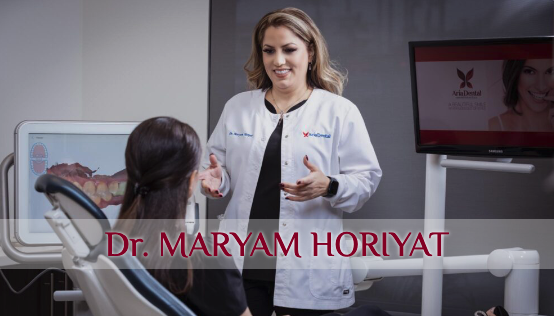
Have questions about your specific case? Schedule a consultation with Dr. Maryam Horiyat
How Your Mouth Actually Produces Speech
To understand why full-arch implants influence speech, you first need to understand that speech is a physical event happening inside a very small, very precise space.
The American Speech-Language-Hearing Association describes speech sound production as depending on the coordinated perception and motor production of individual sounds, a process that can be disrupted by structural changes to the oral cavity. You can read more at the ASHA Practice Portal on Articulation and Phonology.
Your mouth uses two categories of structures to shape sound:
- Active articulators move. Your tongue, lips, and lower jaw.
- Passive articulators stay still and act as targets. Your teeth, the alveolar ridge just behind your upper front teeth, and your hard palate.
Speech happens when the moving parts hit the stationary parts with millimeter accuracy, thousands of times per hour, without you thinking about it once.
Now consider what a full-arch restoration does. It replaces your passive articulators. The targets your tongue has been aiming at for decades are removed and rebuilt in a slightly different position, with a slightly different thickness, contour, and texture.
Your tongue is not confused. It is simply aiming at coordinates that have moved. Give it a little time and it recalibrates.
What Are All on 4 Dental Implants?
For readers new to the concept, a quick definition.
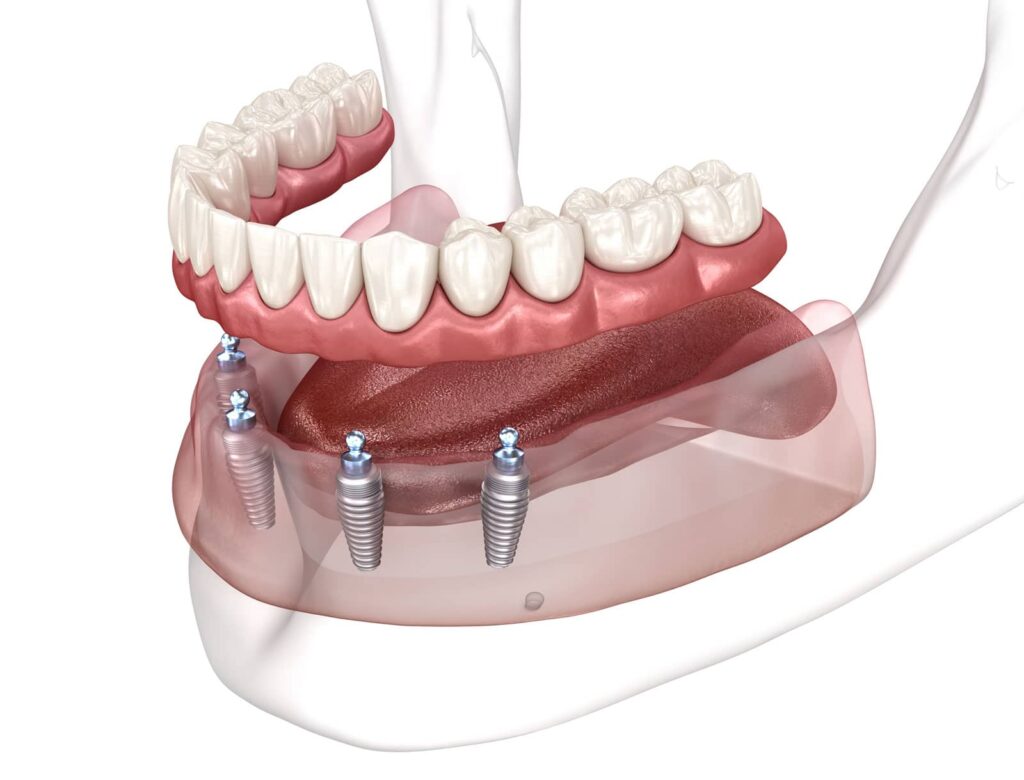
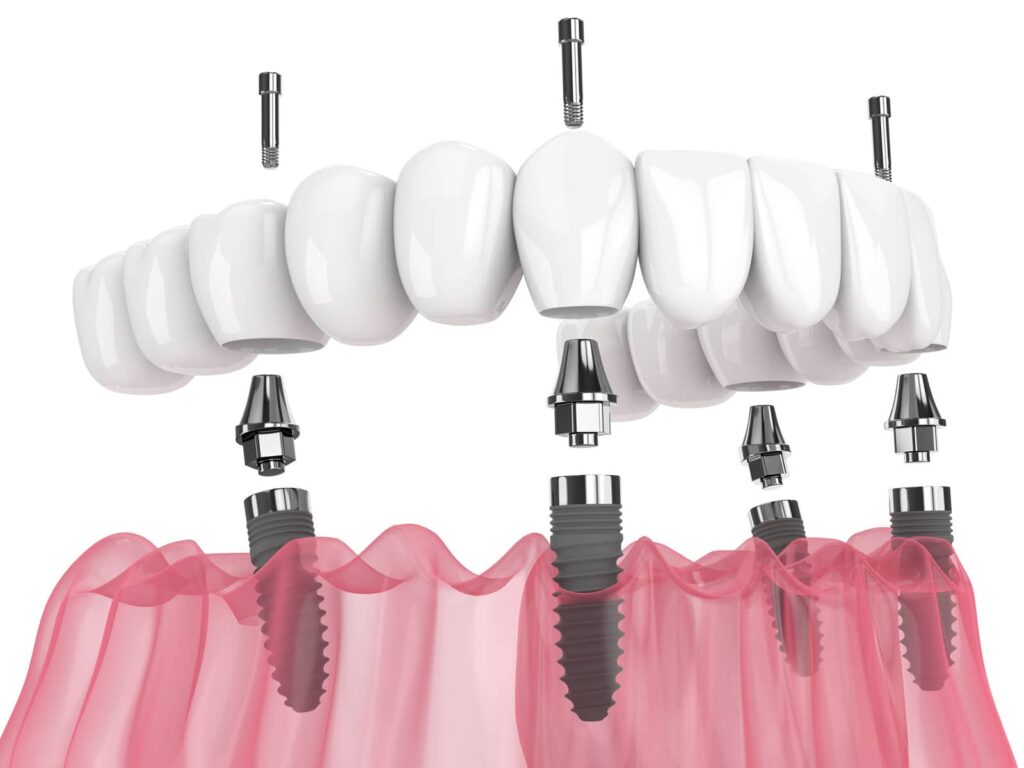
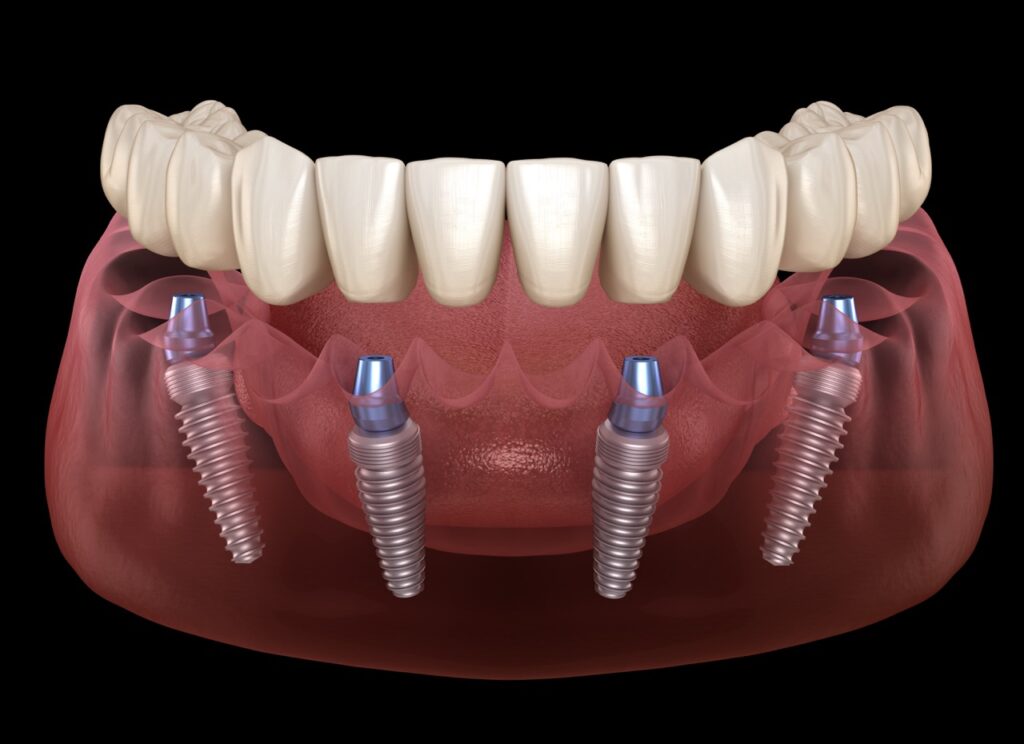
All-on-4 is a full-arch tooth replacement protocol in which four dental implant posts support one complete fixed bridge of teeth, on the upper jaw, the lower jaw, or both. Rather than replacing each missing tooth individually, the whole arch is rebuilt on four strategically positioned anchors.
Key characteristics:
- The two rear implants are typically angled to engage denser bone, which often avoids the need for sinus lifts or extensive grafting.
- The implants fuse to the jawbone through osseointegration, transmitting bite force into bone the way natural roots do.
- The prosthesis is fixed. It does not come out at night. Only your dental team removes it, and only for maintenance.
- Many patients receive a fixed provisional bridge the same day as surgery.
This matters for your speech in a very specific way, which we will get to shortly.
The Denture Comparison Nobody Makes Honestly
If you are considering full-arch implants, you are almost certainly comparing them against dentures. So let us talk about what dentures do to speech.
The American Dental Association notes that dentures replace missing teeth and help restore both eating and speaking, and that they make it easier to speak than you could without teeth. That is true and worth acknowledging.
But conventional upper dentures have two structural features that fight against clear speech:
1. Full palatal coverage. An upper denture is a plate of acrylic covering the roof of your mouth. Your tongue needs that palate to produce a huge portion of English consonants. Adding one to three millimeters of acrylic over the entire palate changes every one of those targets at once, and it also blunts the tactile feedback your tongue relies on to know where it is.
2. Movement. A denture retained by suction and adhesive shifts. It drops slightly on wide vowels. It clicks. It slides during rapid speech. Your speech muscles end up doing two jobs at once, forming sounds and stabilizing an appliance that will not stay still.
Here is the honest comparison:
| Speech Factor | Conventional Upper Denture | All-on-4 Fixed Bridge |
| Palate covered? | Yes, fully | Often no, open palate design possible |
| Appliance movement during speech | Common | None once integrated |
| Clicking sounds | Frequent complaint | Rare |
| Tactile feedback from palate | Reduced | Largely preserved |
| Adhesive interference | Yes | None |
| Bulk in the mouth | Greater | Reduced |
| Adaptation period | Ongoing, recurs with every reline | One-time, typically weeks |
This is why so many of our Mission Viejo patients describe the switch from dentures to all on 4 dental implants as getting their voice back rather than losing it.
Which Speech Sounds Are Actually Affected?
Not all sounds are equally vulnerable. Speech changes after all on 4 dental implants concentrate in predictable places, and knowing which ones helps you recognize normal adaptation versus a genuine design problem.
S and Z Sounds (Sibilants)
These are the most sensitive sounds in the entire language when it comes to prosthetics.
To make an /s/, your tongue tip approaches the alveolar ridge just behind your upper front teeth, leaving a channel roughly the width of a human hair for air to jet through. That gap is called the closest speaking space, and prosthodontists design around it deliberately.
- Too much space and you get a lisp or a slushy, lateral /s/.
- Too little space and you get a whistle on every S.
If you are going to notice anything after your implants, it will most likely be here.
F and V Sounds (Labiodental)
These are made by touching your lower lip to the edge of your upper front teeth. If the upper front teeth are set slightly longer, shorter, or more forward than your natural teeth were, /f/ and /v/ can feel awkward for a while. The fix is usually tooth position, and it is highly correctable at the provisional stage.
TH Sounds (Interdental)
Your tongue tip protrudes slightly between your teeth for “think” and “this.” A thicker prosthetic edge or a change in incisal position can make TH feel unfamiliar. This one typically adapts fast.
T, D, N, and L Sounds (Alveolar and Lingual)
Your tongue presses against the alveolar ridge or the palate. On upper restorations, palatal contour matters enormously here. A poorly contoured palatal surface can flatten or muffle these sounds.
Air Escape and the “Windy” Voice
This one is specific to fixed bridges supported by all on 4 dental implants, and it deserves its own explanation.
Underneath your bridge, there is a small space between the prosthesis and your gum tissue. That space exists on purpose so you can clean underneath with a water flosser. But it also means air can escape through it during speech, producing a breathy or windy quality, or occasionally a whistle.
This is a design variable, not a defect. Your dentist balances cleanability against air seal. Getting that balance right is a matter of skill and iteration, which is exactly what the provisional phase is for.
The Adjustment Timeline: What to Actually Expect
Every mouth adapts to all on 4 dental implants on its own schedule, and the timeline below reflects general clinical patterns rather than a guarantee. Your experience may be faster or slower depending on your previous prosthetic history, your tongue’s baseline dexterity, your age, your arch, and whether you are restoring one jaw or both.
Days 1 to 3: The Strange Phase
Your mouth is swollen. There is a new object in it. You will likely feel like your tongue is too big and your words are landing in the wrong place.
Almost nobody speaks normally in this window, and almost nobody should expect to. This is not your speech outcome. It is a swollen mouth with a temporary bridge in it.
Week 1: Early Recalibration
Swelling begins to subside. Sibilants are usually still imperfect. Many patients report a mild lisp or a slight whistle. Your tongue is actively mapping the new surfaces.
This is the week to start speaking out loud on purpose. Do not go quiet. Silence delays adaptation, because your tongue only recalibrates through use.
Weeks 2 to 4: Rapid Improvement
This is where most of the gains happen. The majority of patients report that speech feels close to normal in ordinary conversation by the end of this window. Rapid speech, reading aloud, and phone calls may still surface occasional errors.
Weeks 4 to 12: Refinement
Residual sibilant issues either resolve or reveal themselves as design problems that need adjustment. By around the three-month mark, we expect speech to be settled.
If a specific sound is still consistently wrong at three months, that is your signal to speak up. Persistent, sound-specific errors after full adaptation are usually a prosthetic design issue, not a you issue, and they are correctable.
Why Some Patients Have More Trouble With All on 4 Dental Implants Than Others
Speech outcomes with full-arch implants are not random. These factors move the needle:
- What you wore before. Patients converting from a long-worn upper denture usually adapt fast and often improve, because we are removing bulk and freeing the palate. Patients going straight from natural teeth to a fixed bridge tend to notice more change, because their baseline was better.
- Upper versus lower arch. Upper restorations affect speech far more than lower ones. The palate is where most consonants live.
- Both arches at once. Restoring the full mouth simultaneously changes every target at the same time. Adaptation is still very achievable, but expect a longer curve.
- Prosthesis thickness and material. Bulky acrylic hybrids intrude into tongue space more than well-designed monolithic zirconia bridges.
- Vertical dimension. If your bite height changes significantly from what you were used to, your tongue and lips have to relearn their travel distance.
- Tooth position and the closest speaking space. The single biggest controllable factor.
- Age and neuroplasticity. Adaptation is possible at every age, but it is generally faster in younger patients.
- Whether you actually talk. The patients who read aloud daily adapt noticeably faster than the ones who withdraw from conversation.
How Aria Dental Care Protects Your Speech From Day One
This is where the difference between a package deal and real treatment planning shows up.
With all on 4 dental implants, speech is not something to hope for after delivery. It is something to design for before a single implant is placed. Here is how Dr. Maryam Horiyat approaches it.
Digital Planning Before Surgery
Every case begins with 3D CBCT imaging, digital records, and a prosthetically driven plan. That phrase matters. We decide where the teeth need to be for your speech, bite, and face first, and then we place implants to support those teeth. The opposite approach, placing implants where the bone is easy and then designing teeth around them, is faster for the office and worse for the patient.
The Provisional Bridge Is a Speech Prototype
Your temporary fixed bridge is not just something to get you through healing. It is a working prototype.
We ask you to live in it, talk in it, take phone calls in it, and report back. Every observation you make about a sound that feels wrong becomes data we use to refine the final prosthesis. This is the single most valuable speech tool in full-arch dentistry, and it is wasted by offices that treat the provisional as a placeholder.
Phonetic Testing at Try-In
Before your definitive bridge is finalized, we test it phonetically:
- Sibilant testing. Counting from sixty to seventy loads your mouth with S sounds. It is the classic test for closest speaking space.
- F and V testing. Saying “fifty-five” and “very” checks the incisal edge position against your lower lip.
- TH testing. Reading a sentence loaded with “th” checks incisal length and thickness.
- Reading aloud. A paragraph of connected speech reveals things isolated words never will.
If something is off, we adjust before the final restoration is made, not after.
Material and Contour Choices
- Monolithic zirconia allows a thinner, smoother, more polished palatal and lingual surface than bulky acrylic, meaning less intrusion into tongue space.
- Highly polished surfaces give your tongue better tactile feedback and reduce plaque retention.
- Open palate design where clinically feasible, so the roof of your mouth stays available for speech.
The Biological and Holistic Layer
Aria Dental Care is a holistic and biological practice, and that shapes the whole process:
- Biocompatible material focus, with materials selected against your individual health history and sensitivities.
- Metal-free options discussed honestly. We will explain where ceramic and zirconia implant systems are clinically appropriate for your anatomy and where full-arch metal-free protocols have documented limitations. You get a real assessment, not a marketing script.
- Ozone therapy to support a clean surgical field and healthy tissue during maintenance.
- Laser dentistry for precise, tissue-conserving soft tissue work.
- Mercury-safe SMART protocol if existing amalgam restorations must be removed first.
- Airway assessment. Your tongue, your bite, and your airway are one connected system. A full-arch restoration changes tongue space, and tongue space affects breathing and sleep. We evaluate this deliberately rather than ignoring it.
Speech Exercises You Can Do at Home After All on 4 Dental Implants
Your tongue adapts through repetition. These are simple, free, and effective. Start once your dentist clears you.
- Count 60 to 70 out loud. Slowly, then faster. This is sibilant training in its purest form.
- Read aloud for 10 to 15 minutes daily. A newspaper, a book, anything. This is the single most effective exercise on the list.
- Practice sibilant sentences. “She sells seashells by the seashore.” “Sixty-six silver spoons.”
- Practice labiodentals. “Five very fine friends.”
- Practice interdentals. “Thirty-three thoughtful thinkers.”
- Record yourself. Once a week. Your ear normalizes to your own voice faster than you realize, so recordings show progress you cannot hear in real time.
- Talk to real humans. Conversation is harder than reading and trains faster. The urge to withdraw socially during adaptation is understandable and counterproductive.
When to Call Your Dentist
Adaptation is normal. These are not:
- A persistent whistle on S sounds that has not improved by six to eight weeks
- A specific sound that is consistently wrong past three months
- Speech that is getting worse rather than better
- Pain, pressure, or a sore spot on your tongue, lip, or cheek from the prosthesis
- A new clicking or mobile sensation in what should be a fixed bridge
- Bleeding, swelling, or discharge around any implant
The U.S. Food and Drug Administration notes that complications with dental implant systems can occur soon after placement or much later, and that some complications result in implant failure requiring additional treatment. Do not sit on symptoms. Early calls solve problems that late calls do not.
All on 4 Dental Implants vs. All-on-6: Which Is Better for Speech?
Reasonable question, and the honest answer is that implant count is not primarily a speech variable.
Four implants versus six changes force distribution, cantilever length, and bone requirements. It does not directly determine whether you lisp. What determines your speech is prosthesis design: tooth position, palatal contour, thickness, material, and the closest speaking space.
That said, there is an indirect connection. More anchor points can allow certain design flexibility in the prosthesis, and bone volume influences where teeth can be positioned. Dr. Horiyat determines whether all on 4 dental implants or a six-implant design suits you based on your CBCT scan, your bite forces, and your arch anatomy, not on a price list.
Serving Patients Across Orange County
Aria Dental Care welcomes full-arch implant patients from Mission Viejo, Laguna Niguel, Lake Forest, Rancho Santa Margarita, Aliso Viejo, Ladera Ranch, San Juan Capistrano, San Clemente, Irvine, Coto de Caza, Dana Point, and communities throughout Orange County.
For patients seeking a holistic dentist in Orange County who performs full-arch implant work with biocompatible material protocols and genuine attention to function, we are one of the few practices combining both disciplines under one roof.
Your Voice Deserves a Plan, Not a Guess
The question “will implants affect my speech” is really a question about whether you can trust the person doing the work. Speech is not a side effect to manage after the fact. It is a design input from the first scan.
At Aria Dental Care, Dr. Maryam Horiyat plans every case involving all on 4 dental implants around how you will eat, breathe, smile, and speak for the next several decades. We build in a provisional phase specifically so your voice gets a vote before anything becomes permanent.
Bring your questions. Bring your skepticism. Leave with a plan.
👉 Schedule Your Consultation at Aria Dental Care
📍 Mission Viejo, Orange County, California 🔗 ariadentalcare.com