








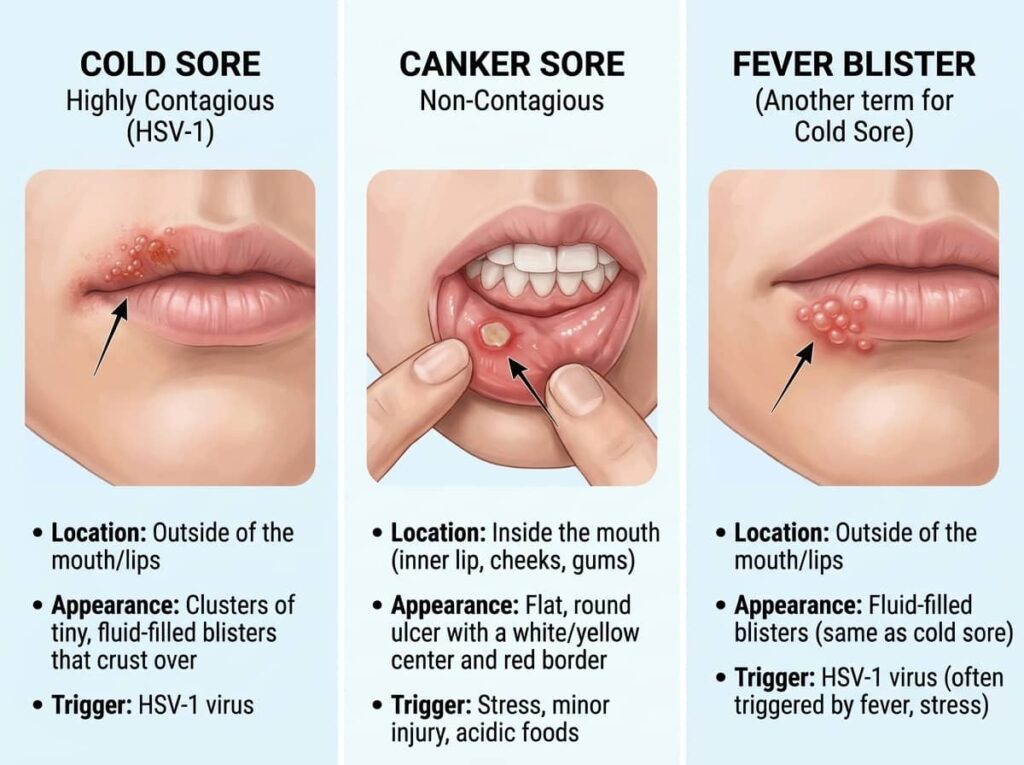
Here is the short answer to the cold sore vs canker sore vs fever blister question: there are three names but only two conditions. A cold sore and a fever blister are the same thing, a contagious cluster of fluid-filled blisters on or around the lips caused by the herpes simplex virus. A canker sore is something else entirely: a non-contagious ulcer that forms inside the mouth, on the soft lining of the cheeks, lips or tongue, and is not caused by a virus at all.
That distinction matters. One type of sore can spread to a partner, a child or even your own eyes; the other cannot spread to anyone. One responds best to antiviral treatment started at the very first tingle; the other calls for soothing care and a closer look at triggers such as toothpaste ingredients, nutrition and stress. Mixing them up can mean the wrong treatment, unnecessary worry, or passing a virus to someone you love.
This guide explains the cold sore vs canker sore vs fever blister difference the way a dentist would in the exam chair: what causes each one, how to recognize them, how to treat them, and when a mouth sore deserves a professional evaluation.
Key takeaways
- Cold sores and fever blisters are two names for the same viral condition, caused most often by herpes simplex virus type 1 (HSV-1).
- Canker sores (aphthous ulcers) are not caused by a virus and are not contagious.
- Location is the fastest clue: cold sores usually form outside the mouth, canker sores inside it.
- Cold sores start as blisters; canker sores start as shallow ulcers without a blister stage.
- Any mouth sore that has not healed within two weeks should be examined by a dentist.
Cold Sore vs. Canker Sore vs. Fever Blister: Why the Names Cause Confusion
All three terms describe a painful spot around the mouth, all three tend to come back, and people use them interchangeably. The names add to the mix-up. “Cold sore” and “fever blister” both come from the same observation: outbreaks often appear when someone is run down by a cold, flu or fever. Clinicians call this condition herpes labialis, meaning herpes of the lip.
“Canker sore” refers to a completely different condition that clinicians call recurrent aphthous stomatitis. These ulcers have nothing to do with the herpes virus, even though they can also flare up when you are stressed or unwell.
So when you weigh cold sore vs canker sore vs fever blister, think of a two-column chart, not three. Cold sores and fever blisters share one column. Canker sores have the other.
What Is a Cold Sore (Fever Blister)?
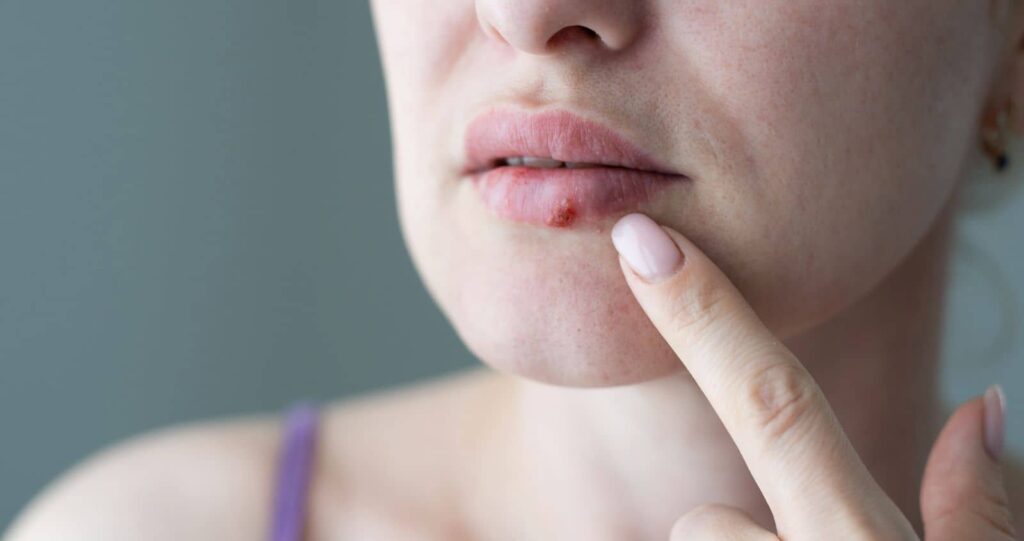
A cold sore, also called a fever blister, is a small cluster of fluid-filled blisters that usually appears on the border of the lips, and sometimes under the nose, on the chin or on the cheek. The American Dental Association’s MouthHealthy guide to cold sores describes these blisters as highly contagious.
What Causes Cold Sores? The Herpes Simplex Virus (HSV-1)
Cold sores are caused by the herpes simplex virus, most often type 1 (HSV-1), and this virus is extremely common. The World Health Organization’s first global estimates found that roughly two-thirds of people under age 50 carry HSV-1, spread mainly through oral contact. Many carriers never develop a visible sore.
Most people catch HSV-1 in childhood, often from a kiss or a shared cup. The virus never fully leaves the body. It retreats into a nerve cluster near the jaw and face and stays dormant, sometimes for years. When something triggers it, the virus travels back along the nerve to the skin and produces a new outbreak, usually in the same spot.
The very first infection can look quite different. In young children it sometimes causes primary herpetic gingivostomatitis: fever, swollen and bleeding gums, and many painful sores throughout the mouth. Parents often mistake this for severe canker sores, which is why a child with widespread mouth sores and a fever should be examined.
Common Cold Sore Triggers
- Sun exposure. Ultraviolet light on the lips is one of the most reliable triggers.
- Illness and fever. Colds, flu and other infections, hence the name fever blister.
- Stress and fatigue. A demanding week or poor sleep can tip the balance.
- Hormonal changes. Some people notice outbreaks around menstruation.
- Lip trauma. Chapped lips, cosmetic procedures, or a long dental appointment that stretches the lips.
- A weakened immune system. Immune-suppressing conditions or medications can mean more frequent, severe outbreaks.
The 5 Stages of a Fever Blister Outbreak
A recurrent cold sore usually runs its course in about 7 to 10 days:
- Tingle. Tingling, itching or burning, often 12 to 24 hours before anything is visible. This is the best moment to start treatment.
- Blister. Small, fluid-filled blisters appear in a cluster on a red, swollen base.
- Weeping. The blisters break open and release fluid. This is the most contagious stage.
- Crusting. A yellowish or brown scab forms and may crack when you smile or eat.
- Healing. The scab falls off and the skin returns to normal, usually without a scar.
What Is a Canker Sore (Aphthous Ulcer)?
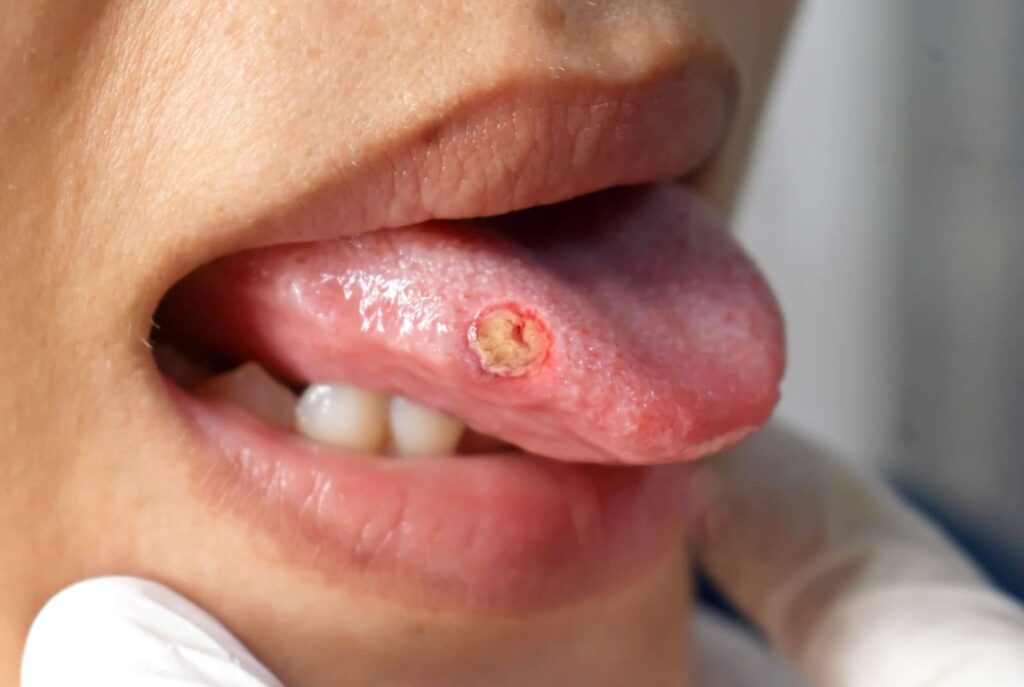
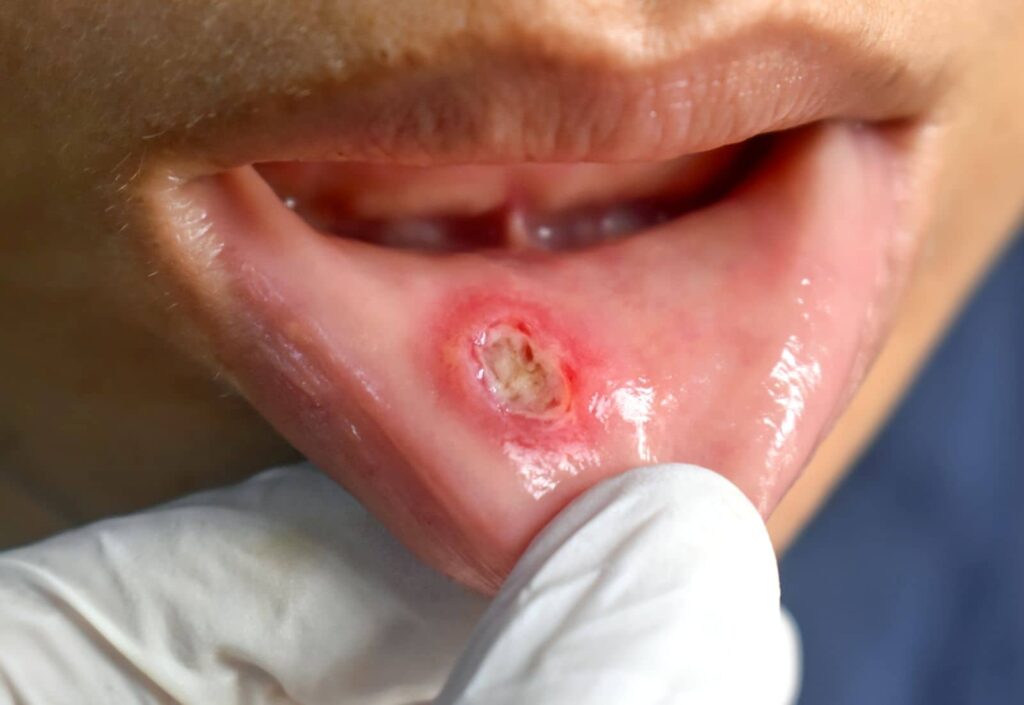
A canker sore is a small, shallow, painful ulcer inside the mouth. The U.S. National Library of Medicine’s MedlinePlus entry on canker sores describes them as white or yellow open sores surrounded by a bright red area, notes that they are not cancerous, and states plainly that a canker sore is not the same as a fever blister.
Canker sores appear on the soft, movable tissue of the mouth: the inside of the lips and cheeks, the underside and sides of the tongue, the floor of the mouth, and the soft palate. They are very common; researchers estimate that about one in five people experience recurrent canker sores at some point, often starting in childhood or the teen years.
Types of Canker Sores: Minor, Major and Herpetiform
- Minor canker sores. The most common type. Usually under 1 centimeter, oval, and healed in one to two weeks without scarring.
- Major canker sores. Larger and deeper, often over 1 centimeter. They can be very painful, take up to six weeks to heal, and leave a scar. These deserve a dental evaluation.
- Herpetiform canker sores. Clusters of pinpoint ulcers that can merge. Despite the name, they are not caused by the herpes virus; the name refers only to their clustered look.
What Causes Canker Sores? Common Triggers
The exact cause is not fully understood. Most experts believe canker sores result from a local immune reaction in the lining of the mouth, set off by one or more triggers:
- Minor injury. A cheek bite, hard brushing, a sharp tooth edge, braces wires, or a rough filling. Our article on canker sores after dental work explains why a sore sometimes follows a dental visit.
- Acidic or spicy foods. Citrus, tomatoes, pineapple and hot spices can trigger or worsen sores.
- Sodium lauryl sulfate (SLS). This foaming agent is common in toothpaste. A 2019 systematic review in the Journal of Oral Pathology & Medicine found that people with recurrent canker sores had fewer ulcers, shorter episodes and less pain with SLS-free toothpaste. The studies were small, but the switch is simple and low-risk.
- Stress and poor sleep. Outbreaks often cluster around deadlines and difficult life events.
- Nutritional gaps. Low vitamin B12, folate, iron or zinc is associated with recurrent ulcers in some people.
- Underlying conditions. Frequent or severe canker sores can be linked to celiac disease, inflammatory bowel disease, Behçet’s disease and certain immune conditions.
- Hormones and genetics. Some women notice a menstrual pattern, and canker sores tend to run in families.
This is where a whole-body view becomes valuable. A mouth that keeps producing ulcers may be signaling something about nutrition, digestion, stress, or a product that disagrees with the tissue.
Cold Sore vs. Canker Sore: Side-by-Side Comparison
This table summarizes the cold sore vs canker sore vs fever blister differences at a glance. The first column covers both cold sores and fever blisters, since they are the same condition.
| Feature | Cold Sore / Fever Blister | Canker Sore |
| Medical name | Herpes labialis | Recurrent aphthous stomatitis |
| Cause | Herpes simplex virus, usually HSV-1 | Not a virus; local immune reaction to triggers |
| Contagious? | Yes, highly | No |
| Typical location | Outside the mouth: lip border, under the nose, chin | Inside the mouth: inner lips, cheeks, tongue, floor of mouth |
| First sign | Tingling or burning, then blisters | A tender red spot that becomes an ulcer |
| Appearance | Cluster of blisters that crust over | Round or oval sore with a white, yellow or gray center and red border |
| Healing time | About 7 to 10 days | 1 to 2 weeks for minor sores; up to 6 weeks for major sores |
| Recurrence | Often in the same spot | Often in different spots |
| Best early treatment | Antiviral at the first tingle | Protecting the sore and avoiding irritants |
How to Tell the Difference: A Dentist’s 4-Point Check
Dentists run through a quick mental checklist when examining a sore. You can use the same approach at home for a reasonable first guess.
1. Location: Outside or Inside the Mouth?
This is the most helpful clue. A sore on the outer edge of the lip, under the nose or on the chin is almost always a cold sore. A sore on the inside of the lip, cheek or tongue is most likely a canker sore.
2. Blister First or Ulcer First?
Cold sores begin as clear, fluid-filled blisters before they break open and crust. Canker sores skip the blister stage; they start as a sore red spot and quickly become a shallow ulcer with a pale center.
3. Movable Tissue or Tissue Attached to Bone?
This is the clue dentists rely on for sores inside the mouth. Canker sores almost always form on the soft, movable lining, the tissue you can easily stretch with a finger. Recurrent herpes inside the mouth, which is less common, typically appears on firm tissue bound to bone: the hard palate (roof of the mouth) and the gums that hug the teeth. A cluster of tiny sores there after a tingling sensation points toward herpes, not canker sores.
4. Warning Signs and Pattern
Cold sores usually announce themselves with a tingle a day ahead and return to the same spot. Canker sores often arrive without warning, appear in a different place each time, and may follow a cheek bite or a new toothpaste.
If the signs are mixed, treat the sore as potentially contagious until a dentist or physician confirms otherwise.
Are Cold Sores and Canker Sores Contagious?
Cold sores and fever blisters are contagious. The virus spreads through contact with the sore or with saliva: kissing, or sharing cups, utensils, lip balm, razors or towels. Risk is highest when blisters are weeping, but it lasts from the first tingle until the skin has fully healed. HSV-1 can also be shed in saliva when no sore is visible.
During an outbreak:
- Avoid kissing and close face-to-face contact, especially with newborns and infants, for whom herpes infection can be serious
- Do not share drinks, utensils, lip products, towels or toothbrushes
- Wash your hands after touching the sore or applying medication
- Avoid touching your eyes, since HSV-1 can infect the eye
- Take extra care around anyone with eczema or a weakened immune system
Canker sores are not contagious. You cannot catch one from a kiss or a shared fork. When several family members get them, that reflects shared genetics, diet or habits, not infection.
Treatment Options for Cold Sores and Fever Blisters
There is no cure that removes HSV-1 from the body, but treatment can shorten outbreaks, ease pain and lower the chance of spreading the virus.
- Start early. Treatment works best at the first tingle, before blisters form.
- Over-the-counter cream. Docosanol 10% cream, available without a prescription, can modestly shorten healing when applied early and often.
- Prescription antivirals. Oral valacyclovir, acyclovir or famciclovir can shorten an outbreak significantly when started at the first sign. People with frequent outbreaks may benefit from keeping a prescription on hand.
- Comfort care. A cool compress eases burning; over-the-counter pain relievers, used as directed, can help.
- Protect the lips. An SPF lip balm reduces sun-triggered outbreaks. Replace the tube after an outbreak.
- Hands off. Picking blisters can spread the virus, delay healing and cause scarring.
A note about dental appointments. If a cold sore appears before a cleaning or procedure, call the office. Elective treatment is usually rescheduled while a cold sore is active, because stretching the lips can irritate the sore and spread the virus. If dental visits tend to trigger your outbreaks, ask your dentist or physician whether a preventive antiviral before longer appointments makes sense.
Treatment Options for Canker Sores
Most minor canker sores heal on their own in one to two weeks. Treatment aims to ease pain, protect the sore and reduce how often new ones appear.
At-home care:
- Avoid irritants. Skip acidic, spicy, salty and crunchy foods until the sore heals.
- Rinse gently. Half a teaspoon of salt or baking soda in a cup of warm water soothes the area and keeps it clean.
- Use a protective or numbing product. Over-the-counter gels and pastes coat or numb the sore. Products with the ADA Seal of Acceptance have submitted evidence of safety and effectiveness. Do not use benzocaine products on children under two.
- Switch to an SLS-free toothpaste if canker sores are frequent. Our guide to toxic-free dental care covers how to choose gentler daily products.
- Consider gentle natural options. Some people find relief with aloe vera gel or honey; small studies are encouraging. See our article on herbal remedies for oral health for options and their limits.
Professional care:
- Prescription rinses or pastes. For large or very painful sores, a dentist may prescribe a corticosteroid paste or rinse.
- Laser therapy. A soft-tissue dental laser can reduce canker sore pain, often right away, and may help healing. Learn more about laser dentistry at Aria Dental Care.
- Trigger investigation. For frequent sores, a dentist may suggest blood tests through your physician for iron, vitamin B12 and folate, and check for sharp edges, rough fillings or appliances that keep injuring the tissue.
When to See a Dentist About a Mouth Sore
Most cold sores and canker sores are a nuisance rather than a danger. Schedule a dental visit if:
- A sore has not healed within two weeks
- A sore is unusually large (over 1 centimeter) or very deep
- New sores appear before old ones heal, or outbreaks are very frequent
- Pain makes it hard to eat, drink or speak
- Sores come with a high fever, rash, diarrhea or swollen glands
- A cold sore spreads toward the eye, or you notice eye pain or redness
- You have a weakened immune system
- A sore is painless, firm or bleeds easily, or a red or white patch does not go away
That last point matters. A persistent sore or patch can occasionally be an early sign of something more serious, including oral cancer. A dentist can examine the area and arrange a biopsy if needed. Our guide to white patches in the mouth (leukoplakia) explains which changes deserve a closer look.
How Aria Dental Care Approaches Recurring Mouth Sores in Mission Viejo
At Aria Dental Care, a mouth sore is treated as information, not just an inconvenience. Dr. Maryam Horiyat, DDS, earned her dental degree from UCSF, is accredited by the International Academy of Oral Medicine and Toxicology (AIAOMT), and is certified by the International Academy of Biological Dentistry and Medicine (CIABDM). Her biological approach considers how the mouth connects to the rest of the body, while relying on established clinical evidence for diagnosis and treatment.
For patients troubled by mouth sores, that approach typically includes:
- A careful soft-tissue exam to identify whether a sore is a canker sore, a cold sore, a traumatic ulcer, or something needing further evaluation, along with an oral cancer screening.
- A trigger review covering toothpaste ingredients, diet, stress, sleep, medications and recent illness.
- A check for mechanical causes such as sharp edges, worn fillings or irritating appliances. Replacing rough restorations with smooth, biocompatible materials can remove a source of repeated injury.
- Coordination with your physician when nutritional testing or evaluation for an underlying condition makes sense.
- In-office comfort care, including soft-tissue laser treatment for painful sores when appropriate.
- Thoughtful scheduling for patients prone to cold sores, so dental visits do not become outbreak triggers.
Get Clear Answers About Your Mouth Sores
The cold sore vs canker sore vs fever blister question comes down to a simple rule: cold sores and fever blisters are the same contagious viral blisters that usually form outside the mouth, and canker sores are non-contagious ulcers that form inside it. Knowing which one you have lets you treat it correctly, protect the people around you, and recognize when a sore needs professional attention.
If you get frequent mouth sores, have a sore that will not heal, or simply want a clear answer, Aria Dental Care welcomes patients from Mission Viejo, Laguna Niguel, Rancho Santa Margarita, Lake Forest, Irvine and across Orange County. Visit us at 27652 Crown Valley Pkwy, Mission Viejo, CA 92691, call (949) 364-9600, or request an appointment online.