
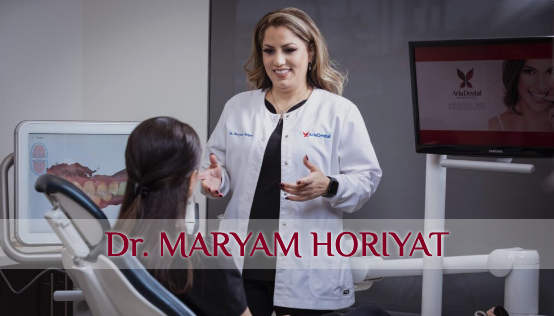


Written and clinically reviewed by Dr. Maryam Horiyat, DDS, AIAOMT, CIABDM · Last reviewed October 19, 2026
The short answer: LANAP (Laser-Assisted New Attachment Procedure) is an FDA-cleared laser protocol for moderate to severe gum disease that cleans infected periodontal pockets without cutting the gum away from the tooth. Traditional osseous surgery reduces pockets by opening the gum, reshaping bone and stitching the gum lower on the tooth, which commonly leaves gum recession, longer-looking teeth and root sensitivity.
At Aria Dental Care in Mission Viejo, CA, Dr. Maryam Horiyat performs LANAP and, when it fits the case, prefers it over traditional surgery. This guide explains both procedures side by side, what the research does and does not show, and the questions every patient should ask before agreeing to any gum surgery.
Key takeaways
- Both treatments aim to stop gum disease by eliminating deep, infected periodontal pockets. They get there in opposite ways.
- Traditional osseous (pocket reduction) surgery shrinks the pocket by moving the gum down to the bone level. It works, but recession, black triangles between teeth and sensitivity are common trade-offs.
- LANAP works through the pocket with a thin laser fiber, removes diseased tissue, and seals the pocket with a blood clot so the gum can reattach. There are no incisions and no stitches.
- The FDA cleared the LANAP protocol in 2016 for true periodontal regeneration, and human histology studies have shown new bone, cementum and ligament in a portion of treated teeth.
- The American Academy of Periodontology (2018) found the evidence too limited to call lasers better than conventional surgery across the board. Case selection and clinician training matter.
Watch: Dr. Horiyat Compares LANAP and Traditional Gum Surgery
In this video, Dr. Horiyat walks through both procedures, the trade-offs patients are rarely told about, and when traditional surgery is still the right choice.
If You Have Been Told You Need Gum Surgery, the Real Question Is “How?”
Gum disease (periodontitis) is one of the most common reasons adults lose teeth. According to CDC research using full-mouth periodontal exams, about 47% of U.S. adults aged 30 and older have periodontitis, and the rate climbs to roughly 70% in adults 65 and older [1][2]. Many people have no idea, because periodontitis is usually a chronic, silent and painless disease until it has already destroyed a significant amount of bone.
Once a dentist or periodontist recommends surgery, the question is no longer whether to treat. Advanced gum disease needs treatment. As Dr. Horiyat puts it, the real question is how to treat it, because that choice decides:
- What your smile looks like afterward
- How many days you spend recovering and managing post-op discomfort
- Whether the bone you have lost has any chance of growing back
That is why it is worth understanding both options before the appointment, not after.
What a Periodontal Pocket Is, and Why Depth Drives the Treatment Plan
“Your gum is supposed to hug the tooth snug like a turtleneck,” Dr. Horiyat explains. In a healthy mouth, the gum attaches to the neck of the tooth and leaves a tiny gap called the sulcus, usually 1 to 3 mm deep.
With gum disease, bacteria colonize that gap, the gum pulls away from the tooth, and the space deepens into a periodontal pocket of 4, 5, 6, 7 mm or more. A toothbrush and floss only reach about 2 to 3 mm below the gum line, so a deep pocket becomes a protected breeding ground for bacteria. Over time, the infection and the body’s inflammatory response break down the bone that holds the tooth in place.
| Pocket depth | What it usually means | Typical next step |
| 1 to 3 mm | Healthy gum attachment | Routine cleanings and home care |
| 4 to 5 mm | Early to moderate periodontitis | Scaling and root planing (deep cleaning), then re-evaluation |
| 5 to 6 mm | Moderate periodontitis | Deep cleaning may be enough for some patients; re-measure after healing |
| 6 to 7 mm and deeper | Moderate to severe periodontitis with bone loss | Surgical treatment is usually discussed: LANAP or osseous surgery |
This table is a general guide. Treatment depends on bone levels, tooth mobility, health history and how the gums respond to deep cleaning.
Non-surgical deep cleaning is always the first step, and it can resolve shallower pockets; more advanced disease may need surgery [9]. When pockets remain at 6 to 7 mm or deeper, the conversation turns to surgery. For more background, see our guides to the stages of periodontal disease and gingivitis vs. periodontitis.
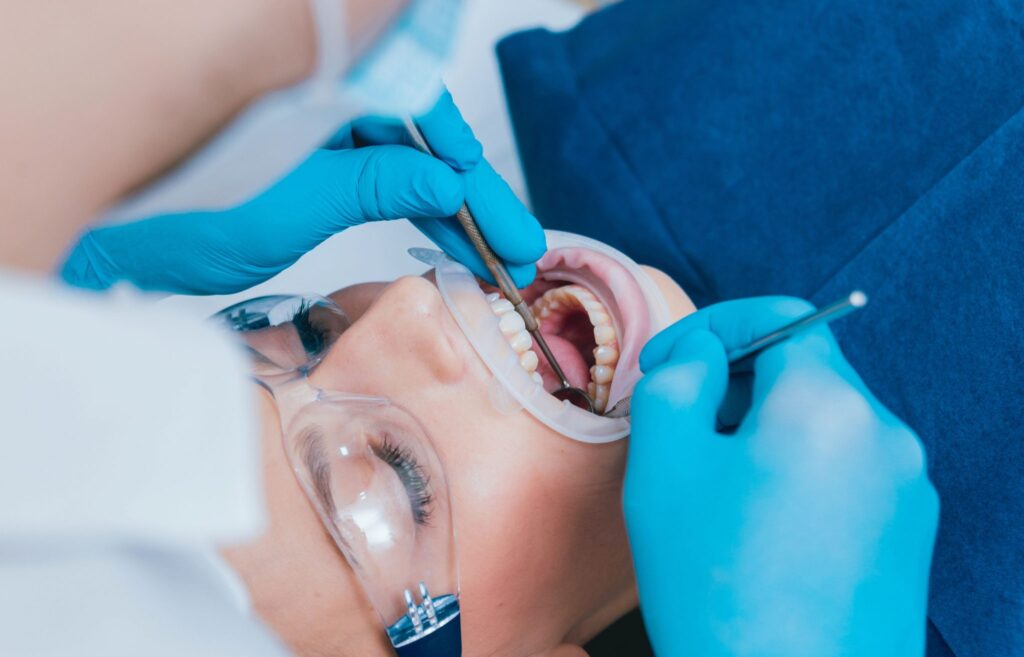
Option One: Traditional Osseous (Pocket Reduction) Surgery
“Osseous” simply means bone, so osseous surgery is bone surgery. It is the long-established standard for treating deep pockets, and it typically follows these steps:
- The area is numbed with local anesthesia.
- The gum is cut along the gum line and folded back as a flap to expose the roots and bone.
- The root surfaces are cleaned (debrided) of tartar and bacteria.
- The bone is reshaped and smoothed.
- The gum is stitched back into place, but lower on the tooth, at the new bone level.
The logic is straightforward: the pocket gets shallower because the gum is moved away from where it used to sit. That is also where the trade-offs come from.
What patients are often not told in advance:
- Gum recession is built into the procedure. Because the gum is repositioned down to the bone, teeth commonly look longer afterward.
- Black triangles can appear. The small dark gaps between teeth near the gum line become more visible as gum tissue is lost.
- Exposed roots can be sensitive. Root surfaces that used to sit under the gum are now exposed, which can cause sensitivity to cold and sweets.
- Recovery takes longer. Healing typically involves 1 to 2 weeks of stitches, a sore mouth and post-op discomfort.
- More appointments. Osseous surgery is usually done one section of the mouth at a time, often over two to four visits.
To be fair, osseous surgery has decades of research behind it and predictably reduces pocket depth. It works. It is simply a trade-off between pocket reduction and the gum line you keep.
Option Two: LANAP, the Laser-Assisted New Attachment Procedure
LANAP follows the opposite philosophy. Instead of cutting the gum away to reach the problem, the clinician works through the pocket and preserves the gum. The protocol uses the PerioLase MVP-7, a pulsed Nd:YAG dental laser designed specifically for LANAP.
How LANAP works, step by step:
- Measure. Pocket depths are recorded around every tooth and compared with X-rays.
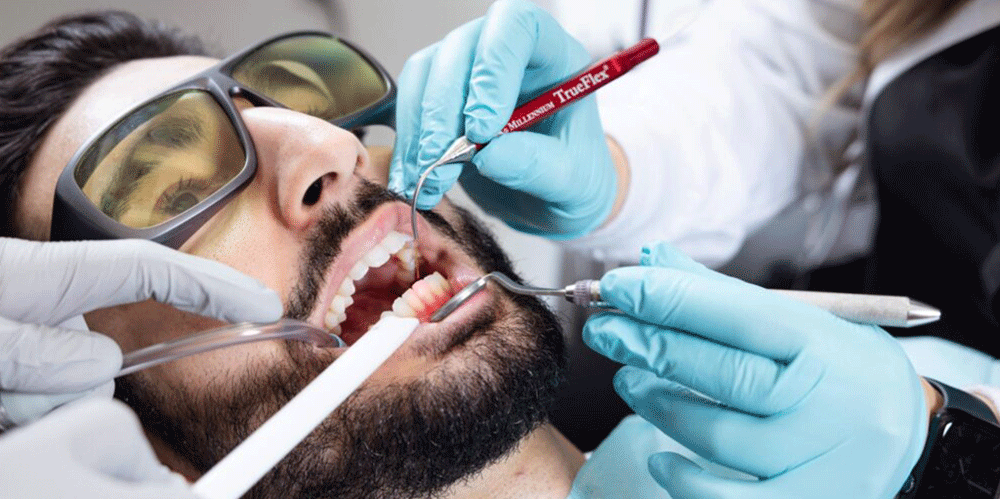
- First laser pass. A thin laser fiber slides down between the gum and the root. It targets the infected pocket lining and bacteria while leaving healthy gum tissue in place.
- Root cleaning. Tartar and bacterial deposits are removed from the root surface with ultrasonic and hand instruments.
- Second laser pass. The laser is used again at different settings to help form a stable blood clot that seals the top of the pocket. The clot keeps bacteria out while the gum reattaches to the root surface underneath.
- Bite adjustment. Teeth weakened by bone loss are protected with a careful occlusal (bite) adjustment so healing is not disrupted by heavy biting forces.
Because the gum is never cut open, there are no stitches, and the gum stays essentially where it was. For a deeper walkthrough of the protocol itself, see What Is the LANAP Procedure?

LANAP vs. Traditional Gum Surgery (Osseous Surgery): Side-by-Side Comparison
| LANAP | Traditional osseous surgery | |
| How the pocket is reduced | Diseased lining removed through the pocket; gum reattaches to the root | Gum repositioned lower on the tooth to match the bone level |
| Gum incisions and stitches | None | Yes |
| What happens to bone | No bone removed or reshaped; goal is regeneration | Bone is reshaped and recontoured |
| Expected gum recession | Usually minimal; gum line largely preserved | Common and often visible |
| Black triangles and root sensitivity | Less likely | Common side effects |
| Bone graft or foreign material | Not required by the protocol | Sometimes added |
| Post-op discomfort | Typically mild; many patients use little or no pain medication | Moderate; sore mouth during healing |
| Return to routine | Usually the next day | Often 1 to 2 weeks |
| Typical appointments for a full mouth | Often one visit (some cases are split into two) | Often two to four visits |
| Strength of evidence | FDA-cleared for true regeneration; human histology studies; fewer long-term comparative trials | Decades of clinical research |
| Best suited for | Moderate to severe periodontitis where preserving the gum line matters | Cases needing major bone reshaping or grafting |
Recovery and comfort descriptions reflect typical experience at Aria Dental Care and vary from patient to patient.
Why Dr. Horiyat Prefers LANAP as a Holistic Dentist
As a biological, holistic and integrative dentist, Dr. Horiyat’s guiding principle is to remove only what is diseased and protect everything that is healthy. LANAP fits that philosophy closely.
It is minimally invasive. Only infected tissue is targeted. Healthy gum is left alone rather than trimmed away to shorten the pocket.
It works with the body’s own healing. “With LANAP, the goal is to regenerate bone, not to remove bone,” Dr. Horiyat says. The protocol relies on the patient’s own blood clot to seal the pocket and support reattachment, rather than requiring graft material or other foreign substances.
It protects the smile. Because the gum line stays largely where it was, patients are far less likely to end up with longer-looking teeth, new black triangles or exposed, sensitive roots. For anyone who has already experienced recession, that difference matters. (If recession is already present, see our guide to gum recession surgery options.)
Recovery is gentler. In the practice’s experience, most patients return to work and normal routines the next day, and many do not need prescription pain medication. Healing still requires care, and some tenderness is normal, but the post-op experience is typically much easier than recovering from flap surgery.
It is efficient. A full-mouth LANAP treatment is often completed in a single appointment at Aria Dental Care, compared with the multiple visits osseous surgery usually requires.
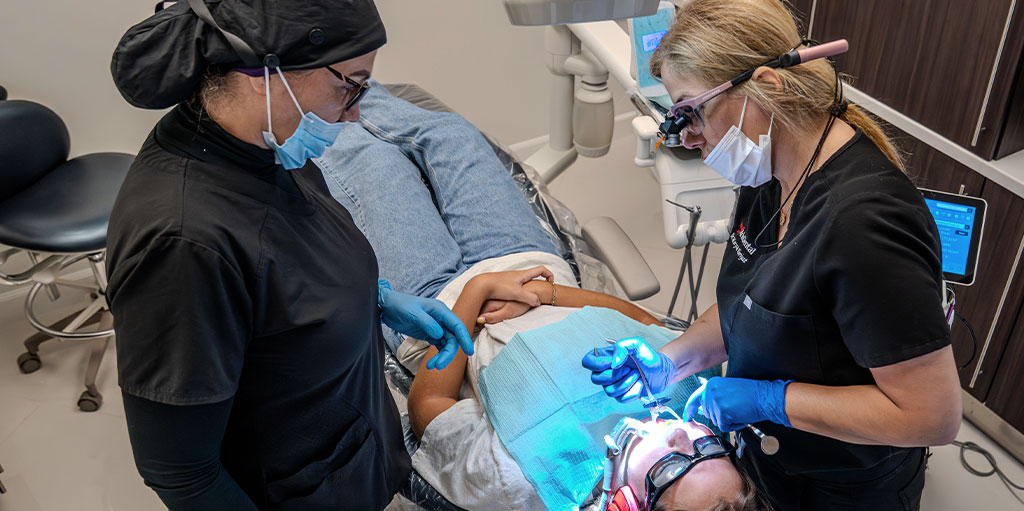
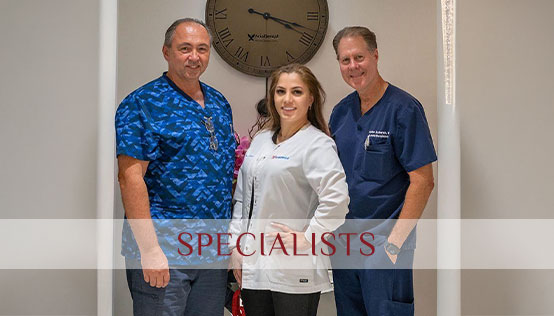
LANAP is performed at the practice by Dr. Horiyat and the periodontists on the Aria Dental Care specialist team, and it is one of the most frequently performed procedures in the office.
What the Research Actually Says
Patients deserve the full picture, including the parts that are still debated.
FDA clearance (2016). On March 15, 2016, the FDA cleared the PerioLase MVP-7 (510(k) K151763) for “periodontal regeneration” when used specifically in the LANAP protocol, defined as new cementum, new periodontal ligament and new alveolar bone on a previously diseased root surface [3][4]. Note the wording: LANAP is FDA-cleared, which is a different regulatory pathway from FDA approval.
Human histology. Regeneration claims in dentistry require microscopic proof, and LANAP has human histology behind it. In a 2007 study, every LANAP-treated tooth showed new cementum and new connective tissue attachment, while most control teeth treated with root planing alone did not [5]. In a 2012 study of severely involved teeth, half of the teeth analyzed showed periodontal regeneration, including new bone [6]. These are small studies, but they are the kind of evidence most laser therapies do not have.
The professional consensus (2018). The American Academy of Periodontology (AAP) reviewed laser research in a 2018 best evidence consensus statement. It found that lasers used alongside conventional therapy may offer a modest additional benefit, but that the evidence was not sufficient to conclude that laser therapy is better than, or equivalent to, traditional periodontal treatment across the board [7]. The AAP also stated that its findings were not meant to suggest lasers are more or less beneficial, and that clinicians should rely on their judgment and training [8].
That is a fair summary, and Dr. Horiyat agrees with it: osseous surgery simply has decades more data. LANAP has strong biological evidence and FDA clearance for regeneration, and fewer long-term head-to-head trials.
When Traditional Surgery Is Still the Right Call
LANAP is not the answer for every case. Traditional surgery can still be the better choice when:
- The bone needs major reshaping to create a stable, cleansable contour.
- The defect needs a bone graft or other regenerative materials to rebuild lost structure.
- Anatomy or access makes a closed, through-the-pocket approach impractical.
Results also depend heavily on the clinician. “LANAP results depend on who’s holding that laser,” Dr. Horiyat notes. The protocol requires specific training, certification and clinical skill, and owning a dental laser is not the same thing as being trained in LANAP.
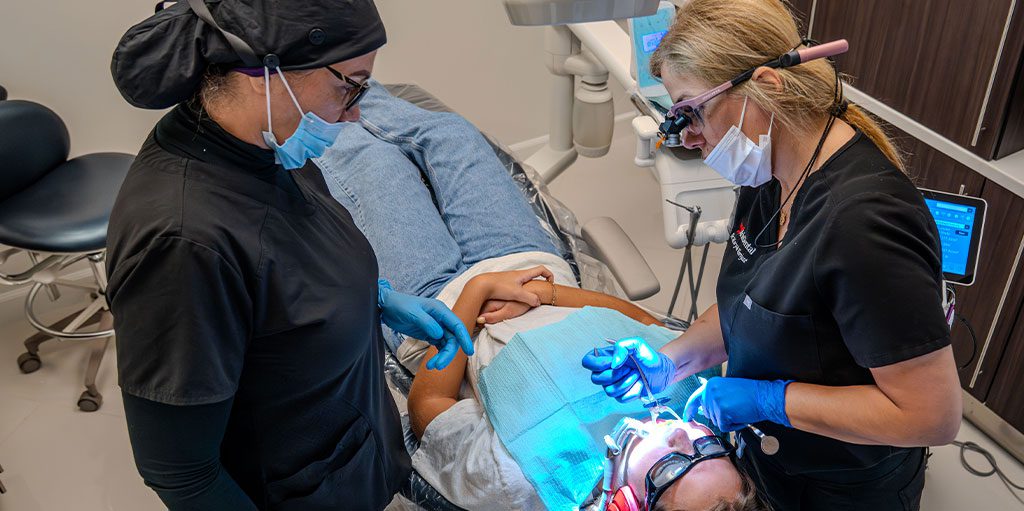
The Holistic Difference: How LANAP Is Supported at Aria Dental Care
In a conventional office, LANAP is usually a stand-alone procedure. At Aria Dental Care, it is part of a broader biological approach to gum health. Depending on the case, the treatment plan may include:
- Ozone therapy as an antimicrobial adjunct during and after treatment. Ozone is part of the practice’s holistic philosophy; research on dental ozone is still developing.
- Platelet concentrates from the patient’s own blood, such as PRF (platelet-rich fibrin) and PRP (platelet-rich plasma), which are used in many regenerative dental procedures to support healing.
- Whole-body risk review, including factors such as smoking, blood sugar control and nutrition, which influence how gums heal and whether disease returns.
- Comfort options, including sedation dentistry for patients with dental anxiety.
These adjuncts reflect the practice’s approach to care. They are offered when they fit the case, not as a replacement for the core LANAP protocol.
Recovery: What to Expect After LANAP vs. Osseous Surgery
After LANAP:
- First day: Mild soreness and some tenderness are normal. Most patients return to work and daily routines the next day.
- First few days: A liquid or very soft diet, avoiding hot, spicy, crunchy and chewy foods. Our list of soft foods after oral surgery is a useful planning tool.
- Following weeks: Soft foods and gentle home care as directed, while the pocket heals and the gum reattaches.
- Long term: Bone and attachment changes develop over months. Regular periodontal maintenance visits protect the result.
After traditional osseous surgery:
- Stitches typically stay in place for about 1 to 2 weeks.
- Soreness, swelling and dietary restrictions usually last longer.
- Each treated section of the mouth has its own recovery period, since the surgery is often staged.
Three Questions to Ask Before Any Gum Surgery
Whichever office you visit, Dr. Horiyat recommends asking three questions before you agree to treatment:
- What are the pocket depth numbers? Ask for the actual measurements around each affected tooth, not just “you have gum disease.”
- Will the gum line recede after treatment? A clear answer tells you whether the procedure trims the gum down or preserves it.
- Is the dentist certified in the LANAP protocol, or do they just own a laser? Training and certification are part of the protocol, and they directly affect results.
Who Is a Good Candidate for LANAP?
LANAP may be a good fit if you:
- Have moderate to severe periodontitis with pockets that persist after deep cleaning
- Want to keep your current gum line and avoid the look of longer teeth
- Have been told you need flap surgery and want a second opinion on less invasive options
- Have had gum treatment before and the disease has returned
Candidacy is confirmed only after a full periodontal exam with pocket charting and X-rays. Health conditions, medications and the shape of the bone loss all factor into the recommendation. You can learn more on our LANAP laser gum therapy page and our overview of periodontal (gum) treatments.
Frequently Asked Questions
Is LANAP better than traditional gum surgery?
It depends on the case. For moderate to severe gum disease where preserving the gum line matters, LANAP offers less recession, no stitches and a faster recovery. Traditional osseous surgery has a longer research record and can be the better choice when bone needs major reshaping or grafting. A periodontal exam with pocket measurements determines which fits.
Does LANAP cause gum recession?
Usually much less than traditional surgery. LANAP does not cut the gum or move it down the tooth, so the gum line stays largely where it was. Some minor shrinkage can occur as inflamed tissue heals, but the visible recession and black triangles common after osseous surgery are far less likely.
Is LANAP painful?
Most patients report much less discomfort than with traditional gum surgery. LANAP is performed under local anesthesia, and because there are no incisions or stitches, post-op soreness is typically mild. Many patients at Aria Dental Care need little or no pain medication, and sedation is available for anxious patients.
How long is recovery after LANAP?
Most patients return to normal activities the next day. A liquid or very soft diet is recommended for the first few days, followed by soft foods for the next few weeks as directed. Bone and attachment changes continue to develop over several months, so follow-up and maintenance visits matter.
Is LANAP FDA-approved?
LANAP is FDA-cleared, not FDA-approved. In March 2016, the FDA cleared the PerioLase MVP-7 laser through the 510(k) pathway for true periodontal regeneration (new cementum, periodontal ligament and bone) when used in the LANAP protocol. Clearance and approval are different regulatory pathways.
Can LANAP regrow bone?
It can in some cases. Human histology studies have shown new bone, cementum and periodontal ligament after LANAP, though not in every treated tooth. Results depend on the defect, the patient’s healing and the clinician’s training. Learn more in our article Can LANAP Regrow Gums and Bone?
How many visits does LANAP take?
Often one. A full-mouth LANAP treatment is frequently completed in a single appointment at Aria Dental Care, though some cases are split into two visits. Traditional osseous surgery is usually done one section at a time over two to four appointments.
Does insurance cover LANAP?
Coverage depends on your plan. Many dental plans include benefits for periodontal surgery, and LANAP may be covered in part. Our team can verify your insurance benefits before treatment so you know your costs in advance.
Get a Second Opinion on Gum Surgery in Mission Viejo
If you have been told you need gum surgery and want to understand your options, Dr. Horiyat and the Aria Dental Care team will measure your pockets, review your X-rays and show you which approach fits your case and your goals. Patients visit from across Orange County, including Mission Viejo, Laguna Niguel, Rancho Santa Margarita and Irvine.
Aria Dental Care 27652 Crown Valley Pkwy, Mission Viejo, CA 92691 Call or text: (949) 364-9600
And if someone you know keeps putting off gum surgery, share this article or the video with them. Most people know at least one.